
RR (....).hwp
|
|
|
- 준서 낭
- 9 years ago
- Views:
Transcription
1

2
3
4 머 리 말 끊임없는 기술의 혁신, 정보화, 세계화 등으로 특징 지워지는 급격한 환경 변화에 따라 학교의 존립 목적과 수행해야 할 역할도 변모하고 있다. 개인과 국가의 생존과 발전을 위한 초석으로서 학교 교육의 중요성이 더욱 강조되는 만큼이나 학교 교육의 질적 수준에 대한 걱정과 불안도 더욱 가중되는 추세이다. 한편에서는 학교가 전통적 인 역할로부터 탈피하여 새로운 변신을 시도하고 활로를 찾아야 한다는 주장이 제기되 는가 하면, 다른 한편에서는 학습의 장으로서 학교의 본질적 역할을 충실히 하고 강화 해야 한다는 주장이 제기된다. 이와 같이 혼란스러운 변화의 와중에서, 학습 공동체로서 학교가 소기의 성과를 거두 기 위해서는 학교장의 자질과 역할이 중요하다는 점에 전 세계가 새롭게 주목하고 있다. 특히, 학교 경영의 책임자로서 학교장에 대한 기대와 요구가 변화하고 있고 또한 강해지 고 있는데 반하여, 이러한 새로운 요구에 부응하여 성공적으로 학교를 경영할 수 있는 자질과 능력을 갖춘 학교장들이 확보되어 있지 못하며, 이들이 학교의 변화를 주도하고 성공으로 이끌 수 있도록 지원하는 체제 또한 미흡하다는 우려가 만연해 있다. OECD 주관으로 2002~2005년까지 25개국과 더불어 수행한 우수 교사의 충원, 개 발 및 유지(Attracting, Developing and Retaining Effective Teacher) 프로젝트의 결론에 서도 학교에서의 교수-학습의 질 향상을 위해서는 교사들이 교수 전문가로서 역할을 잘 수행하고 직무에 만족감을 느끼며 자기 개발에 충실할 수 있는 여건의 조성자로서, 또한 지원자로서 학교장의 리더십이 중요하다는 점을 재천명함으로써 학교장 리더십 개선을 위한 국제 공동 연구의 필요성이 환기되었다. 이러한 필요에 부응하여 OECD 사무국은 2005년 말에 학교 리더십 개선(OECD Activity: Improving School Leadership) 이라는 대규모 프로젝트를 출범시켰다. 총 20개 국가 1) 의 참여로 진행되고 있는 이 프로젝트는 2006~2007년까지 2년에 걸쳐 연구가
5 수행될 예정이다. 주로 학교장과 관련된 제반 정책에 초점을 맞추지만, 비단 학교장뿐 만 아니라, 교감, 부장 교사 등 각국의 중간 수준의 리더들까지도 연구 대상으로 한다. 연구의 목적은 학교 리더십을 개선하기 위하여 각국에서 수립, 집행하고 있는 각종 정책을 종합하고, 성공적이고 혁신적인 정책과 전략을 탐색하여 리더의 임용, 전문성 개발, 지원 등을 둘러싼 교훈과 경험, 정책 대안 등을 공유하기 위한 것이다. 우리나라는 이 프로젝트가 학교장의 양성, 자격, 임용, 연수, 평가 등의 사안을 국제 적이고 객관적인 시각에서 총체적으로 진단해 볼 수 있는 기회라 판단하였으며, 다른 나라와의 비교 분석을 통하여 정책 개발을 위한 유익한 시사점을 얻을 수 있다는 기대 에서 참여를 결정하였다. 따라서 연구의 대상을 학교장으로 국한시켰으며, 필요할 경 우 교감이나 부장 교사에 대하여 추가적으로 언급하는 방식을 취하였다. 이 배경 보고서는 연구 주관 기관인 한국교육개발원의 연구진이 1차 연도 연구의 성과물로서 작성한 것이다. 연구 방법에 있어서 분석적 연구(analytical strand) 와 혁신 사례 연구(innovative case study strand) 라는 두 가지 상호보완적인 접근법이 사용되었 는데, 배경 보고서는 분석적 연구의 일환으로 20개 참여 국가 모두가 공통의 분석틀에 의거하여 각국의 관련 정보를 제공하는 것이다. 배경 보고서 작성을 안내한 연구 질문은 다음과 같다. 한국의 경제, 정치, 사회, 문화, 교육적 배경 하에서 학교장의 역할과 책임은 무엇인가? 학교장의 교수-학습 관련 리더 십을 강화하기 위한 각종 정책 현황은 어떠한가? 학교장의 임용, 보수, 평가, 정년 등의 정책에 비추어 볼 때, 학교장직은 사람들이 선호하는 매력 있는 직업인가? 우수한 학교장의 리더십은 양성과 연수 과정에서 어떻게 개발될 수 있는가? 이러한 제반 과정 에서 학교장의 리더십을 개선하는 데 기여한 혁신적인 정책은 무엇이며, 효과성을 입증하기 위한 연구가 수행되었는가? 동 배경 보고서는 총 7장으로 구성되어 있으며, OECD가 20개 국가의 정책적 도전, 현황, 혁신을 비교 분석하기 위한 기초 자료가 된다. 따라서 OECD가 제시한 지침에 의거하여 충실한 자료를 제공하는 한편, 각 단계에서 부각된 문제점과 정책 대안을 보다 객관적으로 제시하려고 하였다. 기술의 객관성을 확보하고자 교육인적자원부 관계자, 학자 및 연구가, 교장 협의회 관계자, 교직 단체 관계자 등으로 구성된 국가자 문위원회를 구성하여 연구의 시작 단계부터 의견을 구하는 한편, 작성된 보고서 초안
6 에 대한 검토 과정을 거쳤다. 이 보고서를 작성하는 데 많은 분들의 도움이 있었다. 이 지면을 빌어, 보고서 작성과 정에서 협조를 아끼지 않은 국가자문위원회 위원들과 풍부한 기초 자료와 자문을 제공 해 주신 자문진들께 감사를 드린다. 아울러 부단한 연구와 헌신으로 보고서를 작성한 연구진의 노고를 특별히 치하한다. 아무쪼록 이 보고서가 한국의 교장들이 직면한 도전과 현황, 이와 관련된 제반 정책적 맥락을 이해하고자 하는 국내외 인사들에게 귀중한 자료로 활용될 수 있기를 기대한다. 2006년 12월 한국교육개발원 원장 고 형 일
7 연 구 요 약 학교 교육 관련 국가 배경 한국 경제는 1970년대 근대화와 1980년 이후 가파른 산업화의 영향으로 1990년대 중반까지 세계에서 그 유래를 찾아볼 수 없는 급성장을 이룩하였다. 그러나 1997년 국가적 경제 위기를 겪은 이후부터 경제 성장률은 급격히 낮아지고 있다. 특히 2003년 이후 에는 4%대의 경제 성장률을 보이고 있고 이러한 저성장 추세가 고착화될 가능성 이 우려되고 있다. 1993년 문민 정부의 출범을 기점으로 한국은 매우 빠른 속도로 민주화를 이룩하였 다. 국민의 권리 의식과 정치적 참여의식이 높아지면서, 각종 조직과 단체를 중심으로 국가의 중요한 의사결정에 참여해야 한다는 요구가 증대하고 있으며, 정부는 국민의 권리를 보장하기 위한 제도적 장치를 새로 만들거나 정비하고 있다. 학교 교육은 국민 의 정치 의식 발전과 시민 사회의 성장에 중요한 역할을 수행하고 있다. 최근 들어 사회적, 경제적, 문화적, 인구학적 측면에서 급격한 변화가 감지되고 있다. 출산율 저하로 인한 인구 감소 및 고령화 사회로의 진입, 동남아시아 사람들의 취업 이민 증대와 농어촌 남성의 국제 결혼 증대로 인한 인종적 다양성의 증대, 경제적 양극화와 이혼율의 증대로 인한 결손 가정의 증대, 청년 실업률 등이 심각한 문제로 지적되고 있다. 이러한 변화는 학교 교육이 수행해야 하는 역할과 범위에 대한 새로운 도전을 제기하고 있으며, 교육 내용 변화와 더불어 교원 수급의 양적, 질적 지표를 재검토할 필요성을 제기한다. 학교 제도 및 교원 현황 한국은 제를 근간으로 하는 학제를 채택하고 있으며, 학교의 종류는 국립, 공립, 사립으로 구분된다. 중등 학교에서 사립 학교가 차지하는 비중은 다른 나라에 비하여 매우 크다. 한국의 교육 행정 조직은 일반 행정 단위와 병행하여 중앙, 광역 단위, 그리고 기초 단위라고 하는 3단계의 구조를 지니며, 광역 단위인 16개 시 도교 육청을 중심으로 지방교육 자치제를 시행하고 있다. 1990년대 후반부터 교육행정 권한
8 의 지방분권화 노력이 지속되고 있으나, 여전히 중앙 집권적 성향이 매우 강하다. 교육 예산은 해마다 증가해 2005년 현재 27조에 달하고 있어 정부 총 예산 대비 20.4%를 차지하고 있다. 한국의 초 중등학교 교원 총수는 국 공립 및 사립을 합하여 2005년 4월 현재 484, 612명이다. 초 중학교의 경우 여교사의 비율이 높은 반면 고등학교의 경우 남교사의 비율이 높다. 일반계 초 중등학교 교원의 수는 지속적인 증가세를 보이고 있지만 실업계 교원의 경우 실업계 고등학교 수의 감소로 2001년부터 점차 감소하는 추세이 다. 향후 교원의 수급 문제는 저출산 및 이촌향도 현상과 같은 인구학적 변화와 정부의 학급당 학생수 및 교원 수업 시수 감축 정책, 주5일제 수업의 도입 등과 같은 교육 정책 변화 등이 영향을 미친다. 2020년까지 교원의 수요과 공급을 예측해 볼 때, 초등과 중등 모두 공급이 수요를 초과하여 양성 규모 축소를 위한 정책적 고려가 필요한 것으 로 판단되었다. 한국의 교원 단체는 전문직 단체와 노동조합으로 이원화되어 있다. 전문직 단체로는 한국교원단체총연합회가 있고, 노동 조합은 1999년에 합법화된 이래, 전국교직원노동 조합, 한국교원노동조합, 그리고 최근에 결성된 보수 성향의 자유교원조합이 있다. 한편, 학교장은 학교급별, 학교 설립별, 지역별로 다양한 단체를 형성하고 있으며, 학교 교육과 관련된 당면 과제나 현안에 대한 단체의 의견을 제시하는 등, 교장들의 의견이 교육정책 결정에 반영되도록 목소리를 높이고 있다. 학교 교육의 질에 대한 국민의 불만은 상당히 높은 편이다. 좋은 대학 진학을 위한 경쟁 과열로 정상적인 학교 교육이 왜곡되고 사교육이 조장되고 있으며, 그 책임의 상당 부분이 교사들에게 전가된다. 전통적으로 교사들에 대하여 학문적, 도덕적으로 높은 기준이 요구되어 왔으며, 따라서 교육자의 부도덕한 행동이나 범죄 행위는 일반 국민들로부터 심한 지탄을 받는다. 학교장은 전통적으로 존경의 대상이었으며 선망하 는 직위이다. 그러나 교원 노조의 탄생 이후 교장직에 대한 인식도 변화하고 있으며, 능력 검증 및 임용 방식을 변화시켜야 한다는 주장이 강력하게 제기되고 있다. 학교의 지배 구조와 리더십 한국의 교육 행정 체제는 중앙 집권적 성격이 강하다. 따라서 단위학교에서 학교장 이 결정할 수 있는 사항은 매우 제한되어 있다. 단위학교의 목표를 결정하는 주체는
9 학교장이지만 재정과 인사에 있어서 교육인적자원부와 시 도교육청이 상당 부분을 관장한다. 교육과정의 경우에도 국가 교육과정이 있어서 주어진 범위 내에서 학교 교육과정을 편성, 운영하도록 되어 있다. 단위학교 내에 교직원, 학부모, 지역사회 인사 등으로 구성되는 학교운영위원회가 있어서 학교 경영을 위한 제반 사항을 심의하도록 되어 있다. 단위학교에서 리더십을 발휘하는 그룹으로는 교장과 교감, 그리고 중간관리자인 부장 교사가 있다. 교장과 교감이 되기 위해서는 자격을 취득하여야 하나 부장 교사는 학교 조직 운영을 위한 보직의 개념이다. 한국 교육 재정의 주된 재원은 중앙 정부로부터의 지원금과 학생, 학부모가 부담하 는 납임금이다. 지방 정부와 학교법인으로부터의 재정 지원은 상대적으로 미미한 실정 이다. 2001년부터 학교 회계제도가 도입되어 운영 중인데, 이는 단위학교 재정 운영의 자율성을 높이기 위하여 학교에 목적 별로 배분하던 재원을 통합하여 총액으로 배분하 고, 학교에서 우선순위에 따라 세출 예산을 편성, 집행하도록 한 제도이다. 국 공립 학교 교사의 임면권자는 대통령이나 시 도교육청 교육감으로 학교장의 인사권은 극히 제한적으로 행사될 수 있다. 가령, 보직 교사 임면, 교직원의 승급, 계약제 교사의 임면 등에 관한 사항만 학교장에게 위임되어 있다. 한편, 학생의 입학, 유지 및 진급에 대한 결정 권한은 국 공립과 사립 학교를 막론하고 국가에 귀속되어 있다. 단위학교 책임경영제의 일환으로 학교장에게 재정이나 교육과정 운영, 학교 경영에 필요한 교사의 초빙 등 과거에 비해 자율권이 부여된 것도 사실이다. 그러나 이러한 권한의 강화와 더불어 새로운 역할과 책임도 추가되었으며 경영에 대한 책무성도 요구 된다. 또한, 교직원과 학부모의 학교 경영 참여를 통한 경영의 민주성 증대, 예산 집행 의 투명성과 효율성 증대, 교사의 전문성 개발을 위한 장학, 지역사회와의 연계 등을 보다 내실 있게 추진할 것이 요구되고 있다. 학습과 학교장 리더십 강화 교수-학습의 질 개선이 최근 들어 강조되고 있으며, 학교장들이 학력 신장을 위한 노력을 경주할 필요성이 강조되고 있다. 그러나 다른 한편으로 학력 신장이나 학업 성취도에 대한 강조가 지나친 점수 경쟁으로 이어져 부작용이 초래될 수 있다는 시각
10 도 있다. 학교장의 교수-학습에 대한 책무성을 점검하는 기제로 학교 평가와 종합장학 을 들 수 있다. 학교장은 학생의 학업 성적 평가 및 관리의 공정성과 투명성을 높이기 위해 노력하 며, 다양한 평가 도구와 방법을 사용하여 학교에서 가르친 내용과 결과에 대해 학생을 평가하도록 소속 직원을 감독 지도할 책무를 지닌다. 학교장에게는 수업 의무가 부과 되지 않으며, 따라서 대부분의 교장들은 수업을 담당하지 않는다. 다만, 수업에 대한 관리 책임을 지며, 공개 수업에 대한 피드백 제공, 교사들의 협의회 지원 등을 통해 교사의 능력 향상을 지원한다. 교사들의 수업 전문성 향상을 목표로 한 교사 평가제의 도입이 활발하게 추진됨에 따라 교장과 교감이 교사의 능력 개발의 필요성을 진단하고 지원할 수 있는 여지가 확대되고 있다. 교사의 전문성 개발을 위한 각종 연수 프로그램이 운영되고 있으며, 학교장은 소속 교직원이 연수를 통해 전문성을 개발할 수 있도록 지원을 제공하도록 되어 있다. 그러 나 학교장이 재량권을 가지고 지원할 수 있는 범위는 매우 제한되어 있으며, 주로 연수 기관에서 실시하는 연수 프로그램에 연수 대상자를 추천하거나 연수 경비의 일부 를 지원하는 일을 한다. 학교장직의 매력 학교장은 전통적으로 교사 가운데 최고의 교사, 학교의 큰 어른, 학교의 최고 관리자 로서 존경을 받아 왔다. 학교장은 교직의 꽃이라 불릴 만큼 모든 교직 종사자가 희망하 는 최고의 직위이다. 학교의 최고 경영자로서, 높은 도덕적 덕망과 신뢰를 받는 인물로 서, 교수( 敎 授 )와 행정의 전문가로서 존경의 대상이 되어 왔고, 따라서 교원들 간에 학교장 직으로의 승진을 위한 경쟁은 치열하다. 학교장의 임용은 주로 승진 임용과 초빙 임용이라는 두 가지 방식으로 이루어진다. 대부분 승진 임용 방식을 통해 교장이 되며, 이 때, 경력, 연수 성적, 근무 성적, 기타 성적 등이 중요한 평정 기준이 된다. 국 공립 학교 교장의 임기는 4년이며, 1차에 한하여 중임할 수 있어서, 봉직 기간이 최대 8년밖에 되지 않는다. 1차 임기 이후 재임 용을 위한 심의가 있으나 특별한 결격 사유가 없는 한 대부분 재임용된다. 임기제로 인하여 교장들은 교육 환경이 열악한 지역에서 근무하기를 꺼리는 경향이 있다. 한국 교원의 봉급 체계는 단일 체계로 초 중등 학교의 교사, 교감, 교장 구분 없이
11 하나의 체계로 통합되어 운영된다. 최고호봉에 이르는 기간이 37년으로 상대적으로 길기 때문에 대부분이 고경력자인 교장들의 보수는 많은 편이다. 학교장의 이직은 사망이나 질병 등과 같은 특별한 경우가 아니면 거의 없으며, 62세 정년까지 그 직을 유지하는 경향이 있다. 국 공립학교 교장은 교육 당국에 의해 임용되어 학교에 배치 되고, 정기적으로 순환 근무를 하는 관계로 교장 교체에 따른 업무의 혼란을 피하기 위하여 업무 인수인계서를 작성하여 후임자에게 전달하도록 되어있다. 학교장 양성 및 전문성 개발 한국에서는 최근 2~3년 사이에 교장 인사 정책 전반에 대한 국가적 관심이 증대하였 다. 과거에 문제 인식이 없었던 것은 아니지만 다른 교육 현안에 밀려서 상대적으로 주목 받지 못하였으나, 2002년 대통령 선거에서 학교장 임용 제도의 다양화, 교원 직급 과 승진 제도의 합리적 개선 등이 대선 공약에 포함되면서 개혁의 주요 쟁점으로 부각 되었다. 기존의 학교장 인사 제도는 고경력자에게 유리하고 승진을 위해 오랫동안 점수를 관리해 온 사람만이 교감이 될 수 있고, 교감을 거쳐야만 교장이 될 수 있었다. 그러나 최근에 교장 자격증 특례 제도 의 마련으로 비록 제도 운영의 한계가 있긴 하지만 교장 자격증을 취득하지 않고 교장이 될 수 있는 대안적 경로가 모색되었고, 2006년 9월부터 교장 초빙 공모제를 시범 운영하여 다양한 경력을 지닌 사람이 교장 이 될 수 있는 기회도 열렸다. 한국에서는 교감이나 교장을 양성하기 위한 별도의 기관은 없고, 교사에서 교감, 교장으로 승진하는 것이 일반적이기에, 교감이나 교장이 되기 위해서 필수 과정으로 이수해야 하는 자격 연수 과정을 양성 프로그램으로 간주할 수 있다. 그러나 이러한 양성 프로그램의 질적 문제와 현실 적용의 문제가 제기되면서, 연수 기간을 늘리고 연수 내용을 현장에서 요구되는 능력과 지식을 연마할 수 있는 내용으로 개선해야 한다는 주장이 제기되고 있다. 학교장은 교장 자격 연수를 받은 후 학교에 일단 임용되면, 전문성 개발을 위한 재직 연수를 전혀 받지 않아도 신분상의 불이익이나 기타 다른 지장이 초래되지 않는 다. 따라서 교장들의 현직 연수 참여는 매우 저조하고 프로그램도 활성화되지 못하고 있는 것이 현실이다. 학교장의 능력이 학교의 질을 좌우하는 현 시점에서 학교장의
12 전문성 개발을 위한 보다 많은 연구와 정책이 필요하다. 학교장 리더십 개선을 위한 정책 개발의 우선순위 교장직이 모든 교사들이 선망하는 매력적인 지위로 학교 행정가의 부족과 이직에 대해 걱정할 필요가 없다는 점은 커다란 장점이다. 또한, 중앙 집권적 교육 행정 체제에 서 탈피하여 단위학교 중심의 학교 경영으로 나아가야 한다는 필요성이 인식되고 있 다. 이를 실현하기 위하여 학교운영위원회의 제도화, 단위학교 회계제도의 도입, 학교 교육과정의 편성 및 운영에 있어서 학교장의 재량 강화 등과 더불어 학교장의 책무성 을 물을 수 있는 제도적 장치도 강화되고 있다. 다양한 변화에 대응하여 교장의 수행해야 할 역할과 자질이 새로운 각도에서 조명되 기 시작하였으며, 특히, 학교 교육과정의 편성과 운영, 교수-학습 지원, 교사 장학, 지역 사회와의 관계 형성, 그리고 학교 비전과 혁신의 안내자라는 적극적인 역할 등이 요구되고 있다는 점에서 학교 리더십은 새로운 국면을 맞이하고 있다. 그러나 학교장들은 새롭게 요구되는 역할 수행과 더불어 학교 구성원 간 갈등 및 대립 구도를 극복하고 경영의 민주성, 예산의 투명성을 증대시키고, 궁극적으로 학생 의 학업성취도를 향상시켜야 한다는 도전에 직면해 있다. 그러나 교장들이 변화를 이끌어내고 현장에 성공적으로 착근시키기 위한 권한과 지원은 아직 미흡한 실정이다. 학교장의 리더십이 실질적인 개선으로 이어지기 위해서는 다음과 같은 정책 개발에 우선순위가 주어질 필요가 있다. 첫째, 학교의 성공적 운영에 필요한 권한과 지원을 대폭 강화하고, 그에 병행하여 결과를 책임지도록 하는 장치도 강화되어야 한다. 둘째, 과도한 승진 경쟁을 완화하고 교수-학습에 보다 초점을 맞춘 리더십이 행사될 수 있도록 수석교사제의 도입을 검토 할 필요가 있다. 셋째, 중간 관리자인 부장 교사들의 역할이 강화되고 보상이 주어지는 유익한 경력 개발 단계가 될 수 있도록 해야 한다. 넷째, 학교 리더들이 역할을 성공적 으로 수행할 수 있도록 직무 수행 기준을 개발하고 이를 양성, 자격, 임용, 연수와 긴밀하게 연계시켜야 한다. 그리고 마지막으로, 학교경영 전문가로서의 열정과 능력을 갖춘 사람이 교장이 될 수 있도록 임용 제도를 개선하고 재직 연수를 강화하는 방안이 모색되어야 한다.
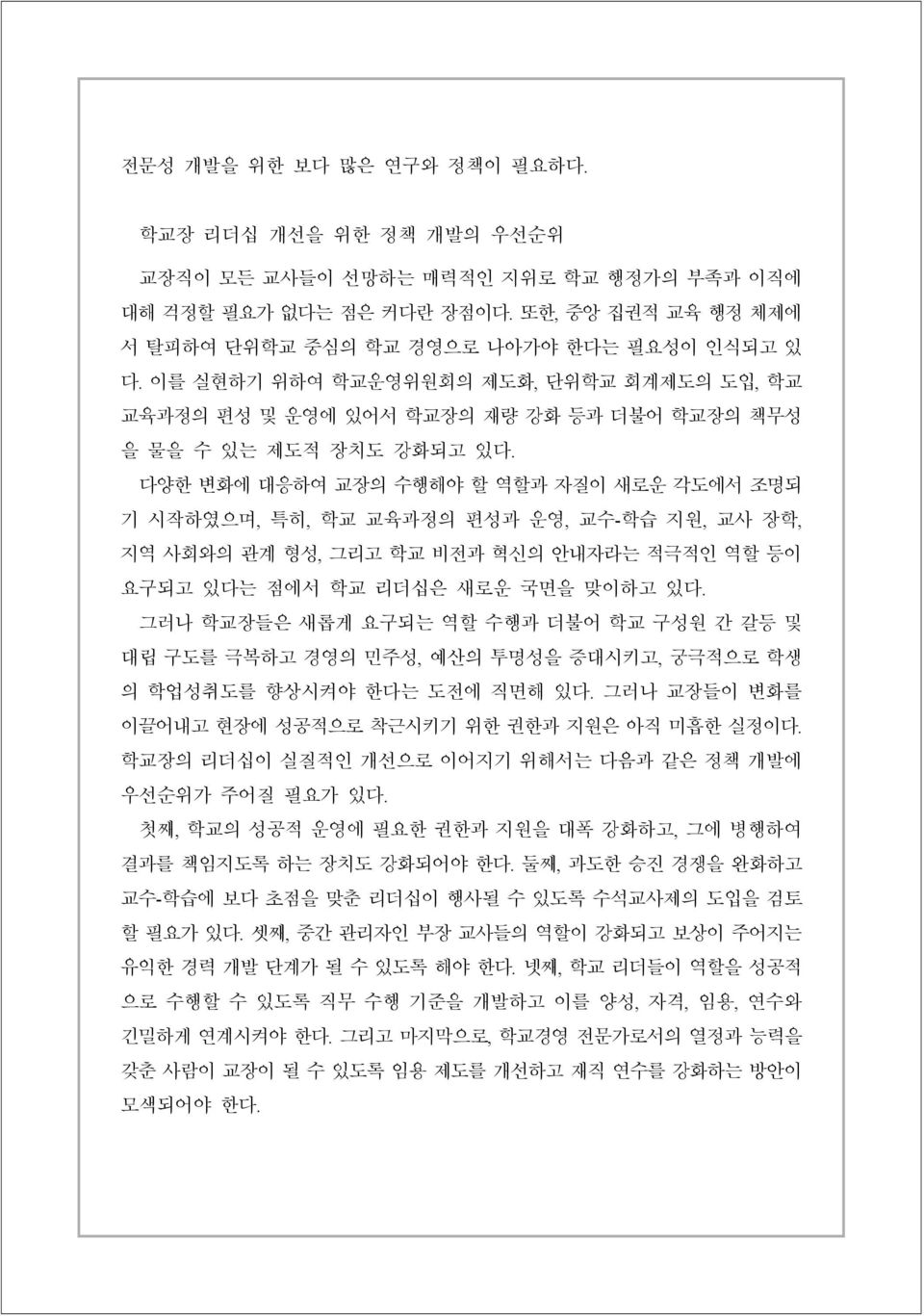
13 목차 Ⅰ. 학교 교육 관련 국가 배경 1 1. 경제, 정치, 사회, 문화적 배경 3 2. 학교 교육 관련 인구 지표 4 Ⅱ. 학교제도 및 교원 현황 7 1. 교육 행정 제도 9 2. 교육 예산 학교 제도 교원 단체 및 학교장 단체 학교 교육의 질과 교원에 대한 일반 국민의 인식 15 Ⅲ. 학교의 지배 구조와 리더십 단위학교의 의사 결정 구조 학교장 리더십과 관련된 최근 논의 교육당국과 학교 간 권한 배분 및 갈등 단위학교의 지배 구조와 교장의 역할과 책임 단위학교의 리더십 관련 조직 및 구조 리더십 차이에 의한 단위학교 내 외부 인사들의 갈등 학교 협력 네트워크 구성 사례와 학교장의 역할 지역 사회 개발 및 봉사를 위한 학교 및 학교장 역할 효과적인 학교 리더십에 요구되는 능력 관련 연구 32 Ⅳ. 학습과 학교장 리더십 강화 교수, 학습, 평가의 질과 관련된 정책 현안 교수, 학습, 평가의 질과 관련된 정책 개발에서 학교장의 역할 41 - i -
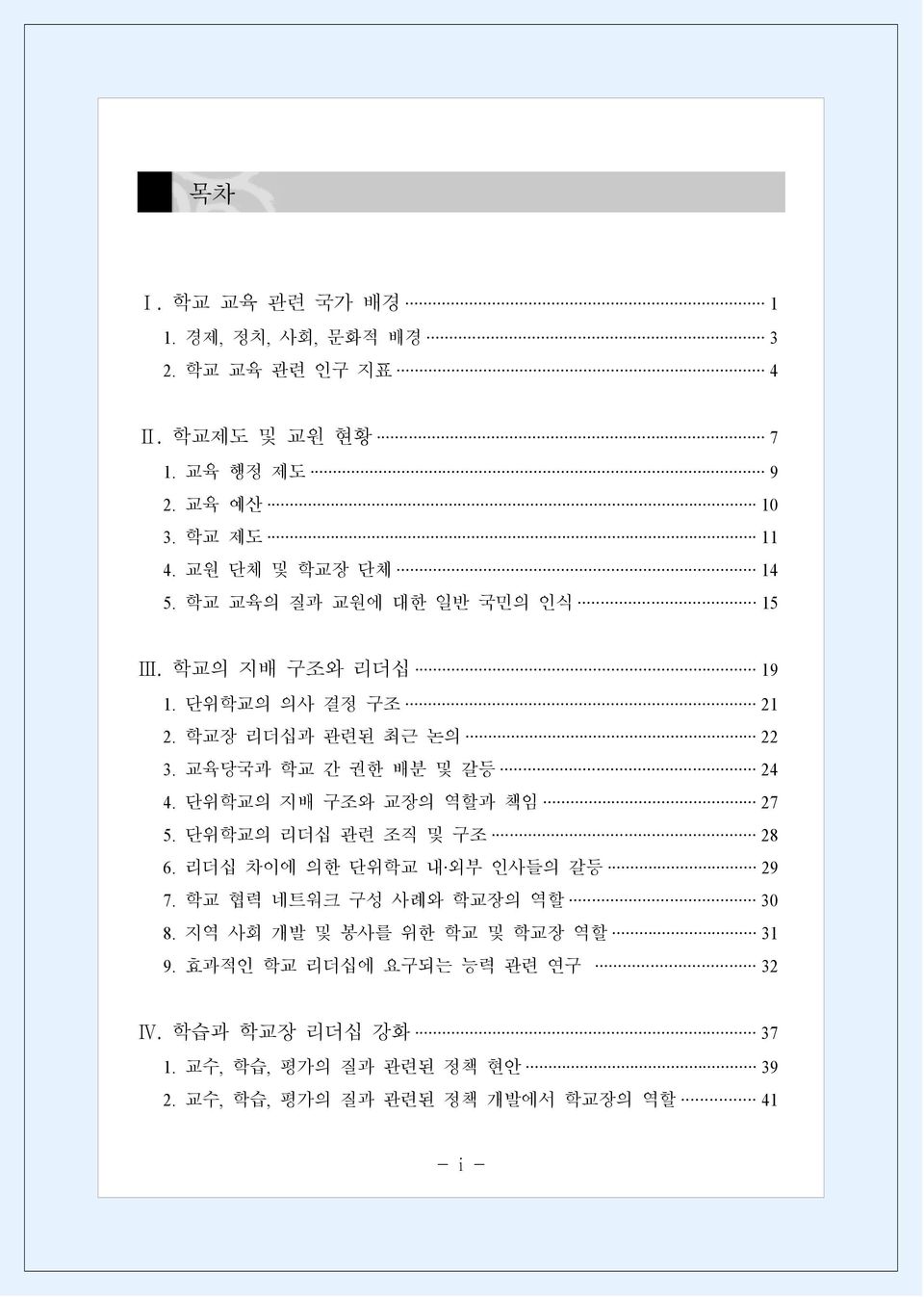
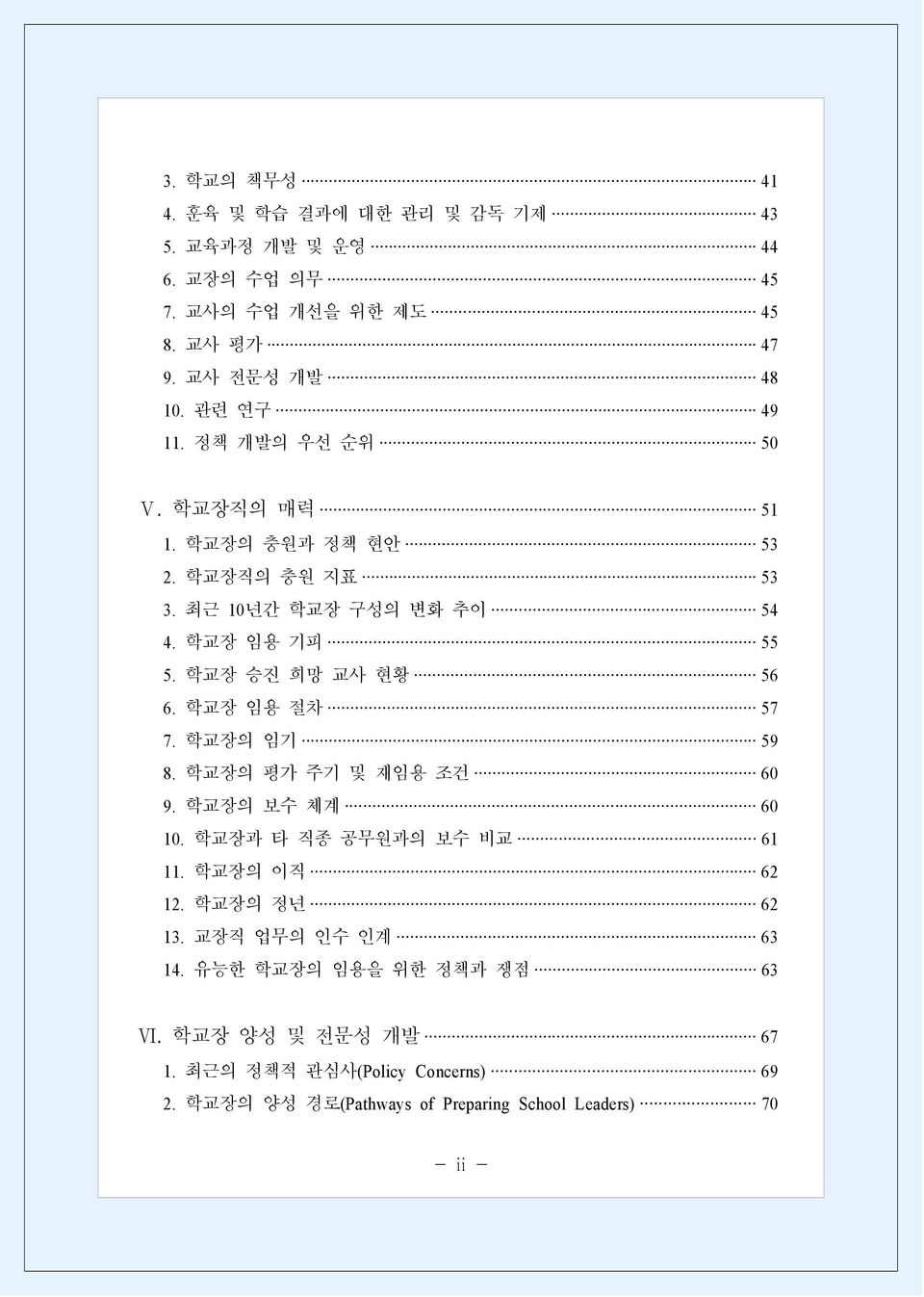
14 3. 학교의 책무성 훈육 및 학습 결과에 대한 관리 및 감독 기제 교육과정 개발 및 운영 교장의 수업 의무 교사의 수업 개선을 위한 제도 교사 평가 교사 전문성 개발 관련 연구 정책 개발의 우선 순위 50 Ⅴ. 학교장직의 매력 학교장의 충원과 정책 현안 학교장직의 충원 지표 최근 10년간 학교장 구성의 변화 추이 학교장 임용 기피 학교장 승진 희망 교사 현황 학교장 임용 절차 학교장의 임기 학교장의 평가 주기 및 재임용 조건 학교장의 보수 체계 학교장과 타 직종 공무원과의 보수 비교 학교장의 이직 학교장의 정년 교장직 업무의 인수 인계 유능한 학교장의 임용을 위한 정책과 쟁점 63 Ⅵ. 학교장 양성 및 전문성 개발 최근의 정책적 관심사(Policy Concerns) 학교장의 양성 경로(Pathways of Preparing School Leaders) 70 - ii -
15 3. 학교장 양성 프로그램(Pre-service Programmes) 학교장 자격 부여 현직 학교장의 전문성 개발 미래 정책 개발의 우선순위 78 Ⅶ. 결 론 학교장 리더십 개발 정책의 강점과 약점 교장 리더십 개선을 위한 정책 개발의 우선순위 84 참 고 문 헌 87 부 록 93 - iii -
16 Ⅰ. 학교 교육 관련 국가 배경
17 Ⅰ. 학교 교육 관련 국가 배경 1. 경제, 정치, 사회, 문화적 배경 한국 경제는 1970년대 근대화와 1980년 이후 가파른 산업화의 영향으로 1990년대 중반까지 세계에서 그 유래를 찾아볼 수 없는 성장을 이룩하였다. 그 원동력은 우수하 고 근면한 노동력과 상대적으로 낮은 노동 비용, 기업가 정신의 앙양 등을 들 수 있다. 그러나 1997년 외환 위기를 겪은 이후부터 경제 성장률은 급격히 낮아지고 있다. 특히 2003년 이후에는 4%대의 경제 성장률을 보이고 있고 이러한 저성장 추세가 고착화될 가능성에 대한 진단이 이루어지고 있는 실정이다. 물적 자원이 부족한 한국에서는 인적 자원이 경제 발전의 원동력이라는 인식 하에 교육을 통한 인적 자원의 개발에 총력을 기울여 왔고, 학교 교육의 중요성은 크게 강조되었다. 한국은 1962년부터 30여 년간 군사 통제 정치 속에서 경제 성장을 이룩하 였고 이는 민주화의 실현을 요구할 수 있는 잠재력이 되었다. 1987년 광주 민주 항쟁과 1993년 문민 정부의 출범을 기점으로 한국은 매우 빠른 속도로 민주화를 이룩하고 있다. 국민 의 권리 의식이 높아지고, 국가는 국민의 권리 를 보장하기 위한 여러 제도적 장치를 충실히 갖추고 운영하고 있다. 이러한 민주화의 발전으로 국민의 권리 의식은 높아졌 고, 국민들은 스스로 각종 단체를 조직하여 국가 행정에 참여하는 정도 또한 높아지고 있는 실정이다. 이는 학교 교육에서 정치적 민주화에 대한 긍정적 가치를 다음 세대에 전달하려는 노력으로 이어지고 있으며, 교육이 정치 선진화의 중심 역할을 하고 있다. 민주화의 결실로 시민 사회의 성장을 들 수 있다. 시민 사회는 정부가 제기 하지 못한 여러 문제들을 새로운 시각에서 바라보기도 하고, 정부와 시민간의 갈등에 개입 하여 새로운 해결을 모색하기도 하였다. 다양한 시민 운동 단체, 이익 집단, 비영리 조식 등의 등장은 한국에서의 시민 사회 발전을 보여주는 증거라고 할 수 있다. 정부 또한 시민 사회의 역할을 인정하고 협력의 묘를 살리려 하고 있다. 이에 정부나 국민 모두 학교 교육을 통한 시민 의식의 함양과 실천에 기대를 하고 있다. 한국은 전통적으로 단일 민족 이라는 특징을 지녔고, 이는 한국의 빠른 교육 발전에 일정 부분 기여하였다. 그러나 1990년대 후반부터 동남 아시아 등지에서 취업을 목적 으로 한국으로 건너 온 사람들이 증가하고, 주로 농어촌 지역의 한국 남성과 동남. 학교 교육 관련 국가 배경
18 아시아나 중국 출신 여성 사이의 국제 결혼이 지속적으로 증가하면서 인종적 다양성이 증대되고 있다. 이러한 추세는 이들 가정에서 태어난 자녀의 교육 문제와 더불어 문화 적, 인종적 차이 를 인정해야 하는 다양성 교육의 필요성을 제기하고 있다. 2. 학교 교육 관련 인구 지표 가. 인구 동향 2005년 현재, 한국의 인구는 4천8백3십만 명으로 지난 1995년도 조사 당시 4천5백만 명보다 약 3천명 이상 증가하였다. 그러나 같은 기간 인구 성장률은 1.01%에서 0.44% 로 크게 낮아졌고, 2020년을 기점으로 마이너스 성장률을 기록할 것으로 예측되면서 인구수도 2020년을 정점으로 감소 추세로 돌아설 것으로 전망된다. 학생수를 가름할 수 있는 유소년 인구 수(0~19세)는 이미 1990년을 정점으로 점차 감소세가 두드러지고 있는데, 1995년과 2005년을 비교하면 1995년에는 전체 인구의 31.6%였으나 2005년에 는 25.6%로 낮아 졌다. 이러한 유소년 인구수의 감소는 학교수, 교원수 등에 많은 영향을 미칠 것으로 예상된다. 한국의 인구 동향과 관련하여 교육적 측면에서 주목할 만한 특징으로 출산율의 감 소, 출생 성비의 불균형, 노령 인구의 증가, 결손 가정의 증가 등을 들 수 있다. - 출산율은 여성 1명이 가임 기간 동안 갖는 평균 출생아 수를 의미하는데, 1970년 4.5명이었던 것이 2003년 1.19명, 2004년 1.16명으로 크게 낮아지고 있는 실정으로, 이는 세계적으로 가장 낮은 수준에 속하며, 저하 속도 또한 가장 빠른 편이다. 이러한 출산율 저하는 학령 인구수와 교원수에 많은 영향을 미칠 것으로 예상된다. - 한국인의 남아 선호로 인한 출생 성비의 불균형은 1980년 중반부터 1990년대 중반까지 매우 높아지다가 정부의 강력한 정책에 따라 1993년을 정점으로(여자 백 명당 남자 수 115.3명)으로 계속 낮아지고 있으며, 2005년의 경우 101.6명으로 아직도 높은 수준이다. 이 경향은 향후에도 유지될 가능성이 큰 것으로 예측되며 2020년에는 101.4명으로 약간 낮아질 것으로 전망된다. 학교장 리더십 개선 방안 연구(2)
19 - 65세 이상의 노령 인구는 2000년을 기점으로 총 인구의 7%를 상회하여 본격적인 고령화 사회(aging society)에 돌입하였고, 2018년에는 14%를 넘어 고령 사회(aged society)에 진입할 것으로 전망되고 있다. 또한 노령 인구가 총 인구의 20%를 상회하는 초 고령 사회(post-aged society)의 진입이 2026년으로 예상되고 있는데, 이러한 진입 속도는 여타 선진국에 비해 매우 빠르게 진행되고 있다. 노령 인구의 증가는 노동 인구의 급속한 감소로 이어지기 때문에 양질의 노동 인구 배출을 위한 학교 교육과정의 개선이 요구된다. - 최근의 이혼의 증가, 경제적 어려움 등이 결손 가정 및 조손가정( 祖 孫 家 庭 )의 증가를 부추기고 있다. 1994년에 1,000명당 1.4쌍이 이혼하였고, 2003년에는 1,000명당 3.5쌍이 이혼하여 최고치를 보였으나, 2005년에는 1,000명당 2.6쌍이 이혼하여 이혼율은 약간씩 줄어들고 있는 추세이다. 또한, 전체 가정의 6.8%가 이혼을 포함, 별거, 가출 등 부부 불화로 해체되었다. 가정 해체로 인하여 상대적 으로 편부, 편모 가정과 조부모와 손자녀로 구성된 조손 가정 이 증가하고 있다. 편부, 편모 가정의 경우 2005년 기준으로 1,369,943가구로 전체 가구의 약 8.6%이 고, 조손 가정의 경우 2005년 기준으로 58,101가구로 전체 가정의 약 0.36%에 이르고 있다. 이러한 결손 가정의 경우 생계 불안, 교육열 약화, 심리적 환경 열악 등으로 자녀 및 손자녀의 학습 부진 및 문제행동에 직접적인 영향을 미치고 있다. 이러한 가정 해체의 증가는 학교 교육에 새로운 도전을 제기하고 있다. 나. 노동 시장 동향 한국 노동 시장의 동향을 살펴보기 위한 지표로서 실업률(unemployment rate)을 들 수 있다. 실업률 통계는 매월 통계청에서 약5만개 가구를 표본으로 하여 설문 조사 방식으로 발표된다. 2006년 8월 기준으로 실업률은 3.4%로 지난 1년간 3%대를 유지하 고 있는 실정이다. 그러나 15~24세 청년층 실업자수는 2005년 8월 기준, 전체 실업률의 9.1%를 차지하고 있는 것으로 나타나 다른 연령대보다 상대적으로 높은 것으로 나타 났다 1). 취업률은 노동 시장의 구조와 역동성, 각급 학교 졸업자의 규모 및 그들의 진로. 학교 교육 관련 국가 배경
20 의식 등 다양한 요인에 의해 영향을 받는다. 이 취업률을 각 교육 단계별로 살펴보면 다음과 같다. 대학 졸업자의 경우 취업률은 1970~80년대까지 70%가 넘는 높은 수준을 보이다가 1980~85년에 대학 졸업자 수의 증가 및 경기 둔화에 따라 급격히 감소하여 50%대로 낮아졌다. 1995년에 60.9%로 증가하였으나 이후 경제 위기의 여파로 다시 감소하여 2005년에는 65.0%로 다소 증가하였다. 반면 2년제 전문대학의 취업률은 지속 적으로 증가하고 있다. 이는 전문대학의 설립 목적이 현장 실무 교육을 통해 중견 기술 인력을 양성하기 위한 것이라는 점과, 산업사회의 요구에 부응하는 학과 개설과 교육과정 개편 및 산학협동 강화 등 대학 측의 적극적인 노력도 한몫 하였다. 전문대학 졸업자의 취업률은 1990년대부터 지속적인 상승세를 보여 2005년 현재, 83.5%를 나타 내고 있다. 실업계 고등학교 졸업자의 취업률은 2003년도에 90.2%를 정점으로 꾸준히 증가하였으나, 그 이후 약간의 하락세를 보이며 2005년 현재 86.3%를 나타내고 있다. 이는 최근 실업계 고등학교 지원자 감소와 취업보다는 상급 학교의 진학 등으로 나타 나는 현상으로 실업계 고등학교 교육에 대한 근본적인 위기로 인식되고 있다(교육인적 자원 부 & KEDI, 2005). 교사가 되기 위한 임용 시험 응시자수 및 경쟁률을 통해 노동 시장에서의 교직의 선호도를 간접적으로 살펴볼 수 있다. 전국 중등교사 임용 시험에서 모집 인원, 응시 인원 및 경쟁률을 살펴보면, 2005년 3,985명 모집에 55,936명이 응시하여 14.0대 1의 경쟁률을 보여왔고, 2006년에는 5,245명 모집 59,090명이 응시해 11.3대1의 높은 경쟁 률을 보이고 있다(교육부 보 도자료). 이렇듯 응시자 수가 증가하고 경쟁률이 높은 배경 요인으로는 3개월 간의 방학 등 좋은 근무 조건, 62세까지 정년 보장, 각종 연금과 복지 혜택 등을 들 수 있다. 그 외에도 1997년 외환 위기 이후 계속되는 경기 불황으로 취업난이 심화되고 있는 탓도 있지만 기업들의 고용 안정성이 교직에 비해 상대적으로 크게 악화된 데 있다고 할 수 있다. 학교장 리더십 개선 방안 연구(2)
21 Ⅱ. 학교제도 및 교원 현황
22 Ⅱ. 학교제도 및 교원 현황 1. 교육 행정 제도 한국의 교육 행정 조직은 일반 행정 단위와 병행하여 중앙, 광역 단위, 그리고 기초 단위라고 하는 3단계의 구조를 근간으로 한다. 중앙 단위에는 교육인적자원부가, 광역 단위에는 16개 시 도교육청이, 그리고 기초 단위 에는 180개에 달하는 지역 교육청이 있다. 교육인적자원부는 2001년 초에 그 명칭이 교육부로부터 교육인적자원부로 바뀌었으 며 부총리의 리더십 하에 초등, 중등, 고등교육 정책 및 평생교육 정책의 형성 및 집행, 교원 정책의 수립 및 집행, 국가 교육과정의 수립, 교과서의 출판 및 인정, 각급 학교에 행정적 재정적 지원의 제공, 지방 교육 기관 및 국립 대학의 지원 등의 기능을 수행한다. 광역 단위 지방 교육 행정 조직인 16개 시 도교육청은 교육 자치를 기본으로 하고 있다. 시 도교육청은 교육 기관의 설립과 폐지, 교육과정 운영, 학교 교칙 제정 등을 주요 기능으로 수행하고 있다. 그러나 지방 교육 정책 개발이나 지역 교육 발전 계획 수립 등과 같은 자치기관으로서 당연히 해야 할 기능의 수행은 미흡한 실정이다. 180개 지역교육청은 시 도교육청의 하급 행정 기관으로서 기초 자치 단체인 시, 군, 구에 설치되어 있다. 시 도의 사무 가운데 공 사립 유치원, 초등 및 중학교 등의 운영에 관한 지도 및 감독을 주된 기능으로 하고 있다. 중앙과 지방의 교육 행정 기관간 권한과 책임의 분배에 있어서는 아직도 중앙 집권 적 성향이 매우 강하다. 1990년대 후반부터 한국 정부는 작고 효율적인 정부 를 구현 한다는 구호를 걸고 중앙 행정 기구의 축소를 추진해 오고 있다. 이러한 감축 노력에 힘입어 교육인적자원부 역시 조직과 정원을 축소하고, 그 기능을 대폭 지방 교육 행정 기관으로 이양하고 있다. 이러한 노력의 일환으로 교육인적자원부는 예산 계획을 비롯 한 주요 행정적 결정권을 지방 교육 행정 기관에 위임하고 있다. 그러나 전통적으로 중앙 집권적 경향이 워낙 강한 탓에 아직도 재정, 인사, 조직 관리 등 핵심적인 부문에 서는 중앙 통제의 경향이 짙게 남아있다. 특히, 지방 교육비의 재원 구조에 있어서 약 80% 이상의 지방 교육 재원이 중앙정부로부터 조달되고 있는 바 중앙정부 의존도가 지나치게 높게 나타나고 있다.. 학교제도 및 교원 현황
23 2. 교육 예산 교육인적자원부 예산의 절대액은 해를 거듭할수록 증가해왔다. 평균적으로 교육인 적자원부 예산의 증가율이 정부 예산 증가율을 상회하고 있다는 점은 적어도 정부의 교육에 대한 관심이 여타 부문과 비교할 때 상대적으로 높다는 것을 시사한다. 정부 예산 대 교육인적자원부의 예산 비율은 1985년 19.9%에서 1990년 22.8%로 증가하였고, 2000년 이후로 2005년까지 각각 20.4%, 19.5%, 19.6%, 20,3%, 20.8%, 20.8%로 2005년 교육 예산은 27조에 달하고 있다. 초 중등교육을 주고 담당하고 있는 시 도의 교육비 현황, 즉 지방 교육 재정은 중앙정부의 교부금, 지원금 등과 지방 자치 단체의 전입금, 자체 재산 수입, 지방채 발행 수입, 학부모의 수업료, 입학금 등으로 이루어져있다. 지방 교육 재정 총 규모는 계속 증가하고 있는데, 이 중 중앙정부 재원 비율은 1998년 85.2%를 정점으로 점차 감소하고 있다. 이는 지방 교육 재정 자립도가 점차 높아지고 있음을 의미하고 있다. 한편 지방 교육 재정 가운데 지방 정부 재원 비율은 2000년부터 크게 늘어나 2005년 현재 총 예산의 24%에 달하고 있다. 한국의 교육 재정이 안고 있는 문제점의 하나는 사교육비의 규모가 지속적으로 증대 되고 있다는 점이다. 과외비는 특기 및 재능개발을 위한 비용도 있지만, 주로 입시 준비를 위한 교육 활동에 드는 경비가 많다. 이러한 사교육비 문제는 가계에 주는 경제적 부담 이외에도 교육적 측면에서는 학생들의 전인적 발달을 저해하고, 학교 교육과정의 정상적 운영을 저해하여 학교 기능의 마비와 학교 교육에 대한 불신을 증폭시켜 공교육의 위기를 초래한 원인의 하나로 인식되고 있다. 교육 당국은 2008학 년도 대학 입시부터 고등학교 내신을 50% 반영하겠다고 하면서 공교육을 정상화 시키 고 사교육비를 줄이겠다고 했지만, 한국의 주요 대학들은 내신 50%를 제외한 나머지 50%에서 논술의 반영 비율을 일제히 높임으로 인해 내신 뿐만 아니라 논술을 위한 학부모의 사교육비 지출이 더욱 늘어날 것으로 우려되고 있다. 학교장 리더십 개선 방안 연구(2)
24 3. 학교 제도 가. 학교 제도의 특징 한국의 학제는 미군정 시대에 채택한 제를 근간으로 하는 기본 학제가 큰 변화 없이 현재까지 유지되고 있으며, 이는 [그림 2.1]에 나타난 바와 같다. 학교 유형에 는 유치원, 초등학교, 중학교, 고등학교, 대학, 교육대학, 사범대학, 전문대학, 방송통신 대학과 개방대학, 기술학교, 고등기술학교, 공민학교, 고등공민학교, 특수학교 등이 있다. 한편 설립 주체에 따라 국립, 공립, 사립으로 구분되기도 한다. 이 가운데 초등학 교 6년과 중학교 3년이 무상 의무 교육으로 이루어지고 있는데, 중학교 의무 교육은 1985년부터 농어촌 지역을 중심으로 도입된 이래 2002년부터 전국적으로 확대, 실시되 고 있다. 현행 학제는 각급 학교 사이의 협력 및 연계성이 부족하고 정규 학교와 사회 교육 기관 사이의 연계성도 미약하다는 지적을 받고 있다. 더구나 산업 구조의 변화에 따라 요구되는 고등교육 수준의 다양한 전문 기술 훈련을 담당할 교육 기관 및 과정이 분화 되어 있지 않으며, 특히 공교육 제도 안에서의 직업기술 훈련도 취약한 실정이다. 또한 학교와 산업체 사이의 협력 체제가 충분히 구축되어 있지 않은 실정이라고 볼 수 있다. 이와 함께 연령에 관계없이 수시로 필요로 하는 교육 및 훈련을 받을 수 있도록 하는 평생 교육 체제의 확립이 미흡하다는 것도 문제점으로 지적될 수 있다. 이러한 지적에 따라 최근 제로의 학제 개편 논의가 활발히 진행되고 있다. 나. 학교의 종류 및 수 학교 설립의 구분은 국립, 공립, 사립으로 구분된다. 초등학교를 제외하고 중학교, 고등학교, 대학교 수준에서 사립 학교가 차지하는 비중은 다른 나라에 비하여 매우 높은 편이다. 2005년 현재, 모든 초등학교의 1.3%, 중학교의 22.9%, 고등학교의 44.8%, 그리고 대학교의 84.7%가 사립 학교라는 통계가 이를 입증한다. 중등학교에서 사립 학교가 많은 이유는 과거에 한국이 중등 교육의 보편화를 위하여 사학법인의 설립 요건을 완화함으로써 사학이 팽창하게 되었기 때문이다.. 학교제도 및 교원 현황
25 한국의 초등학교는 만6세 어린이부터 입학이 가능하나, 학부모의 희망과 학교의 학생 수용 능력이 있으면 만5세에도 입학을 허용한다. 2005년 현재, 초등학교 현황은 <표 2.1>에 제시되어 있다. 초등학교의 수는 1990년에 6,335개였던 것으로부터, 농촌 인구의 감소에 따른 농촌 지역의 학교 수 감소와 소규모 학교의 통폐합 정책에 따라 학교수가 점차 감소하여 2000년에는 5,267개에 이르렀다. 그러나 2000년 이후, 취학 아동수의 소폭 증가와 학급당 학생수 감축 정책에 기인하여 2005년 현재 학교수가 5,646개로 늘고 있는 추세이다. 중학교의 수는 1965년 이후 꾸준히 증가해 왔는데, 이는 지나친 중학교 입시 경쟁을 완화하기 위하여 1969년에 중학교 무시험 진학 정책으로 중학생 수가 급격히 증가하였 기 때문이다. 1885년 중학교 취학률이 100%에 도달한 이후에도 학급 당 학생수 감소 정책으로 인하여 학교수는 계속 증가하고 있는 실정이다. 공립 학교가 증설되는데 비하여 사립 학교는 감소해 왔기 때문에 1965년의 경우 사립 학교가 전체 중학교에서 차지하는 비율이 42.5%였으나, 2005년에는 22.9%로 감소하였다. 2005년도 한국 중학 교의 학교수, 교원수, 학생수 현황은 <표 2.2>에 제시되어 있는 바와 같다. 한국의 고등학교는 일반계 고등학교, 실업계 고등학교, 방송통신 고등학교 등으로 구분된다. 근래에 고등학교 교육의 다양화 차원에서 특수목적 고등학교 및 특성화 고등학교 등도 운영 중이다. 2002년도 한국 일반계, 실업계, 그리고 특수목적 고등학교 의 학교수, 교원수, 학생수 현황은 <표 2.3>, <표 2.4>, <표 2.5>에 제시되어 있는 바와 같다. 앞의 의 인구 동향에 제시한 저출산 문제에 따른 학생수 감소에 따라 향후 10년 간 초등학교, 중학교, 고등학교 순으로 학교수가 감소될 것으로 전망된다. 단, 학급 당 학생수를 몇 명으로 유지하려고 하는가에 따라 그 감소 속도에는 다소간 변화 가 있을 것으로 예상된다. 다. 교원 및 사무직 현황 초등학교 교원은 초등학교 학생수가 지속적으로 증가하던 1970년대 이전에 급격한 증가를 나타냈다. 1990년대 이후 학생수와 학교 수 모두 뚜렷한 감소 추세를 보이면서 교원 수 증가율이 크게 낮아졌으며, 1999년에는 교원정년 단축의 영향으로 전년도보다 교원수가 줄어들기도 했다. 그 이후 초등학교는 계속해서 교원 부족 사태를 겪고 있다. 학교장 리더십 개선 방안 연구(2)
26 2005년도 초등 교원의 총 숫자는 160,143명에 달하고, 이 중 여성 교원은 113,751명으로 여성 교원의 비율은 약 71%이다. 중학교 교원의 수는 2005년 현재, 총 103,835명으로서, 지속적인 증가세를 보이고 있고, 특히 중학교 무시험 진학 제도가 도입된 1960년대 후반 이후 1970년대 초반과 중학교 의무 교육이 실시되기 시작한 1980년대 후반 및 1990년대 초반에 급증하였다. 남녀 교원의 분포는 1990년대 후반에 역전되어, 이제 여성 교원이 다수를 차지하고 있으며, 그 비율도 점차 증가하고 있다. 2005년 현재, 여성 교원의 수는 64,659명으로 여성 교원의 비율은 약 62%이다. 일반계 고등학교 교원 수는 계속 증가 일로에 있다. 2005년 현재 총 79,158명이고, 국 공립 학교 교원이 41,156명으로 사립 학교 교원에 비해 약간 많다. 여성 교원은 39.1%이나 그 배율은 점차 증가하고 있다. 사립 학교의 경우, 여성 교원의 비율이 26.9%로 국공립 학교에 비해 사립 학교는 남교사를 선호하고 있다. 실업계 고등학교의 경우, 학교수가 2001년부터 지속적으로 감소하고 있는 추세에 따라 실업계 교사수는 감소하고 있다. 초 중 고등학교 사무직원의 수를 보면 2005년 현재 각각 초등학교 28,691명, 중학 교 11,840명, 일반계 고등학교 7,755명, 실업계 고등학교 5,441명으로 집계되고 있다. 교원 단체는 교원의 행정 업무 처리 부담이 과중하다는 요구를 지속적으로 개진하고 있으며, 정부 역시 이 요구를 수용하고자 하는 입장을 보임에 따라, 매년 사무직원 수를 점증적으로 늘리고 있다. 단, 실업계 고등학교의 경우는 학교수의 감소에 따라 사무직원의 수가 감소하고 있다. 향후 교원의 수급 문제는 저출산과 이촌향도 현상과 같은 인구학적 변화와 정부의 학급당 학생수 및 교원 수업 시수 감축 정책, 주5일제 수업의 도입 등과 같은 교육 정책 변화에 의해 영향을 받을 것으로 예상할 수 있다. 2020년까지 교원의 수급을 추정한 최근의 연구(김이경 외, 2006)에 따르면, 초등학교의 경우 저출산의 영향으로 학령 인구가 급격히 감소되어 공급이 수요를 초과할 것으로 예측되었다. 2020년까지 연평균 신규 교사 수요는 2,400명에 불과한데, 매년 6,000명 이상이 양성되므로 초등 교원 양성기관 정원 조정이나 신규 채용 억제가 필요한 것으로 판단되었다. 한편, 중등 학교의 경우 양성 경로가 다원화되어 현재의 수급 체제 하에서도 공급이 수요를 크게 초과하는 바, 양성 규모 축소를 위한 정책적 고려가 필요한 것으로 판단되었다.. 학교제도 및 교원 현황
27 4. 교원 단체 및 학교장 단체 가. 교원 단체 한국의 교원 단체는 전문직 단체와 노동조합으로 이원화되어 있다. 전문직 단체로는 한국교원 단체총연합회(The Korean Federation of Teachers Association, 한국교총)가 있고, 노동조합으로는 전국교직원노동조합(Korean Teachers and Educational Workers Union)과 한국교원노동조합(Korean Union of Teaching & Educational Workers)이, 그리 고 최근에는 보수 성향의 자유교원조합(Korea Liberal Teachers Union)이 새로 결성되 어 총 4개가 있다. 이원화 정책이란 교직 단체를 전문직 단체와 노동조합의 형태로 나누고 전문직 단체 는 전문성 향상의 측면에서 교원연수 등을 포함한 교원정책 일반에 관하여 교섭하고, 노동조합은 경제적 사회적 지위 향상 측면에서 임금 및 근무 조건에 관하여 교섭하도 록 하는 것을 말한다. 교직 단체와 교원 노조는 교원들의 권익증진을 도모하는 교원들 의 조직인 점에서는 유사하지만 설치 근거를 비롯하여, 관련된 기본권 조항, 가입 및 조직, 교섭의 목적, 당사자, 전개 및 효력 그리고 조정 절차에서 많은 차이가 있다. 이러한 이원화 정책은 교섭 사항의 중복, 교섭 결과의 효력 등과 관련하여 지속적인 갈등을 야기하고 있다. 교원 단체들은 교원의 신분이나 임용, 안정성 등에 영향을 미치는 정부의 정책안에 대해 각 단체의 성격과 단체에 가입한 회원들의 이해관계에 따라 때로는 같은 목소리 를 내기도 하고 때로는 상호 의견이 대립되기도 한다. 교원 노조에는 주로 평교사가, 한국교총에는 평교사 및 학교 관리자가 회원으로 가입하는 경향이 있다. 나. 학교장 단체 학교장은 학교급별, 학교 설립별, 지역별, 직급별로 다양한 단체를 형성하고 있다. 한국초등교장협의회, 한국초등여교장협의회, 한국국공립중학교장협의회, 한국국 공 립일반고등학교장회, 한국중등학교여교장회, 전국공업 고등학교장회, 전국사립학교 교장협의회 등이 그것이다. 또한 한국교총 산하 직능단체로 교장단, 교감단 협의회도 학교장 리더십 개선 방안 연구(2)
28 구성되어 있다. 각 단체들은 초 중 고등학교의 당면 과제 및 교육 문제에 대한 단체 입장의 의견을 제시하거나 교육 관련 주제에 대한 토론회 및 발표회를 주최 또는 주관 하는 등 교육계에서 그들의 의견이 반영될 수 있도록 목소리를 높이고 있다. 최근 학교장 관련 단체의 주요 관심사로는 교장 공모제, 사립 학교법 개정, 평준화제도 폐지, 개방형 자율학교 폐지 등을 들 수 있다. 5. 학교 교육의 질과 교원에 대한 일반 국민의 인식 가. 학교 교육의 질에 대한 인식 학교 교육에 관한 한국 국민의 인식은 매우 복합적이다. 전통적으로 한국에서 교육 은 개인에게는 교양을 담보하는 것이자 신분 상승의 결정적 수단이었을 뿐만 아니라 국가적 차원에서의 교육은 국가 발전의 원동력 역할을 담당하였다. 그리고 학교는 교육 기능을 오랫동안 독점적으로 수행해 왔으며 학교 교육의 중요성에 대한 일반 국민의 인식은 절대적인 것이었다. 그러나, 1990년대 후반 들어 학교의 위상이 흔들리는 현상이 나타나기 시작하였다. 첫째, 1973년부터 시행해 오고 있는 고교 평준화 정책이 현재 국제 사회에서 경쟁할 수 있는 양질의 인재를 양성하는데 문제가 있다는 지적이 대두되고 있다. 둘째, 한국의 학교는 지적인 성취만을 지나치게 강조하는 나머지 학생들의 전인적 성장을 도모하지 못한다는 불만이 제기되고 있다. 셋째, 국제적으로 한국의 학교 교육은 학업 성취 면에 서 PISA나 TIMMS 같은 국제 비교 연구에서 좋은 결과와 높은 평판을 유지하고 있으 나, 국내적으로는 사설 학원에 비해 학부모들로부터 그리 좋지 못한 평판을 받고 있다. 즉, 입시 위주의 현 교육 환경에서 학교 교육은 여타 사설 학원에 비해 입시에 필요한 질 높은 교육을 제공하지 못하고 있다는 것이 학부모들의 학교 교육에 대한 공통된 불만이다. 넷째, 일부 학교에서 교사에 의한 과도한 학생 체벌, 교사의 촌지 수수, 부실 급식 등 학교 교육에 부정적 영향을 미치는 내용이 종종 언론에 보도되면서 학교 교육 에 대한 일반 국민의 인식에 영향을 미치고 있다.. 학교제도 및 교원 현황
29 그러나 앞서 살펴본 학교 교육에 대한 부정적 인식은 주로 도시 고소득 계층에서 제기하는 문제일 수 있다. 저소득 계층이나 농산어촌 지역의 경우, 여전히 학교는 유일 하면서도 가장 신뢰할 수 있는 교육 기관이다. 이들 계층과 지역은 학교가 기존에 수행하였던 교육 기능 외에 지역 사회의 교육 센터 역할을 해주기 바라고 있다. 나. 교원에 대한 일반 국민의 인식 군사부일체라는 표현에 잘 나타나있듯이, 한국인은 전통적으로 교원에 대한 존경심 을 가졌다. 높은 학문적 소양과 도덕적 풍모를 가진 학자는 전통 사회에서 신분적으로 높은 지위를 차지하였을 뿐만 아니라 사회적으로도 깊은 추앙의 대상이 되었다. 이러 한 스승, 곧 교사에 대한 존경 외에도 우리 민족에게 허용되었던 몇 되지 않는 높은 보수의 고급 직종 중의 하나가 교직이었기 때문에, 자연히 교직은 수많은 영재들이 앞 다투어 입문하고자 하는 선망의 대상이 되어 왔던 것이다. 이와 같은 교직의 매력은 결국 사회의 어느 부문보다도 우수한 인재들이 몰려드는 결과를 나타냈고, 교사들은 1960년대부터 1970년대까지 고도 산업 성장 시대에 필요한 유능한 산업 인력을 양성할 수 있었던 원동력이었다고 말할 수 있다. 그러나 유능한 교사 인력의 충분한 확보 문제는 1970~80년대 고도경제 성장기를 거치면서 구조적으 로 많은 변화를 겪게 된다. 중화학 공업을 기간 산업으로 하는 공업화가 빠르게 이루어 지면서 도시화의 급진전과 함께 상대적으로 많은 보수를 받을 수 있는 일자리가 크게 늘어났다. 이러한 산업의 고도화는 교직의 경제적, 사회적 위상을 상대적으로 낮추는 결과를 초래하였고, 이로 말미암아 초등 및 중등 교사 양성과정에 진학하는 예비 교사 들의 자질도 다소 떨어지게 되었다. 그러나 1997년 외환 위기를 겪은 후 한국 사회에서 안정적인 일자리가 대폭 줄어든 반면, 교직은1999년 교원 정년 단축으로 교원의 대규모 퇴직 사태에 따른 일시적 교원 부족 현상으로 임용 가능성이 증대되었다. 또한 장기 고용 관행의 쇠퇴와 비정규직 노동자의 증가로 불안한 노동 시장 상황에 비추어 볼 때 교직의 정년 보장과 신분 안정은 교직의 매력을 상대적으로 높이는 결과를 초래하였다. 이는 2000년대 우수한 지원자들이 교원 양성 교육 기관으로 진학하게 하는 동인을 제공하였다. 학교장들은 교사 가운데 최고의 교사, 학교의 큰 어른, 학교의 최고 관리자로서 전통 적으로 대중들의 존경을 받아 왔다. 학교의 얼굴로서, 교원의 최고 지위를 가진 인물로 학교장 리더십 개선 방안 연구(2)
30 서, 높은 도덕적 덕망과 신뢰를 받는 인물로서, 교수( 敎 授 )와 행정의 전문가로서 학교 구성원인 교사와 교직원 뿐만 아니라 일반 국민들로부터 존경의 대상이 되어왔다. 그러나, 최근 교장공모제나 교장선출보직제 등 교장 임용 방법에 관한 정부와 교원 단체의 주장이 제기되면서 교장직에 대한 전통적 인식도 큰 변화를 겪고 있다. 교사 아닌 사람 가운데서 교장으로서 학교를 관리, 운영할 수 있도록 하여야 한다는 방안이 나 교장은 보직으로서 교사 가운데 선출되어야 한다는 방안은 교장직에 대한 일반 국민들의 인식의 변화를 그 배경으로 하고 있다.. 학교제도 및 교원 현황
31 Ⅲ. 학교의 지배 구조와 리더십
32 Ⅲ. 학교의 지배 구조와 리더십 1. 단위학교의 의사 결정 구조 한국의 교육 행정 체제는 중앙 집권적 성격이 강하다. 따라서 단위학교 내에서 교장 이 결정할 수 있는 사항은 매우 제한되어 있다. 단위학교의 목표를 결정하는 주체는 학교장이지만 학교 운영을 위한 재정, 인사, 선발은 기본적으로 교육인적자원부와 시 도교육청이 관장한다. 교육과정의 경우 에도 국가교육과정이 있으며, 그 범위 내에 서 학교 교육과정을 편성, 운영하도록 되어 있다. 1995년 교육개혁안에 따라 학교운영위원회가 결성되면서 교직원과 학부모, 지역 사회 인사가 학교 운영위원으로 학교 경영에 참여하지만 대부분 심의 역할만 수행할 뿐 학교 목표 수립에 영향을 미치지 못하고 있다. 단위학교에서 리더십을 발휘하는 범주에 관리자인 학교장, 교감, 그리고 중간관리자인 부장교사가 포함될 수 있다. 학교장의 역할과 책임, 그리고 권한은 초 중등교육법 제20조에 총체적으로 규정되 어 있다. 교장의 역할은 교무 통할, 교직원 지도 감독, 학생 교육이며, 직무는 1 수업 연한, 학년, 학기, 및 휴업일 결정 2 학급 편제 및 학생 정원 결정 3 교과, 수업 일수, 교수와 과정이수 인정 4 입학, 재입학, 편입학, 전학, 휴학, 퇴학, 수료 및 졸업 결정 5 조기 진급 및 조기 졸업 결정 6 수업료, 입학금, 기타의 비용 징수 7 학생 포상 및 학생 징계 8 학생 자치 활동의 조직 및 운영 9 학칙 개정 절차 등이다. 즉, 학교장은 국가로부터 단위학교의 소속 직원, 학교 교육, 학교 시설, 학사 사무 등에 대한 관리권과 직무상, 신분상 감독권을 위임 받은 학교 최고 경영자이다. 학교장 은 학교 경영의 중심축에 있으며 교장 자신의 요구와 태도, 학생 교사 학부모 상급 자의 기대, 인구 변화, 경제 상태, 정보의 흐름 등의 여러 가지 환경적 요인에 따라 영향을 받는다. 교장의 역할에 영향을 미치는 주체는 상급 기관과 내부조직, 지역 사회, 사회단체, 학술단체, 교육단체, 친목회, 종교단체 등이다. 따라서 상급 기관이 추구하는 정책의 방향에 대해 내부조직이 순응하지 않거나 내부행사와 외부행사가 겹칠 때 역할 갈등이 일어난다. 학교 조직의 직제상 교감의 지위는 교장을 보좌하여 학교를 경영하는 제2인자이다. 명목상 교감을 학교 행정가로 분류하긴 하지만 현실적으로 학교에서 교감이 실제로. 학교의 지배 구조와 리더십
33 관장하는 행정적 업무의 범위는 학교마다 다른 실정이다. 즉, 학교 조직에서 교감의 역할은 학교장의 리더십 유형에 따라 유동적이고 지위 자체에 수반되는 직무 권한의 행사범위 또한 가변적인 경우가 많다. 교감은 교장을 보좌하여 교무를 관리하고 학생 을 교육하며, 교장이 부득이한 사유로 직무를 수행할 수 없는 때에는 그 직무를 대행하 고 있다. 부장교사는 교감과 교사의 중간 위치에 있는 자이다. 이것은 하나의 자격이 아니고 일정한 업무를 수행하기 위하여 마련된 보직의 개념이다. 이러한 보직의 개념은 교육 공무원법 및 교육공무원임용령의 적용을 받는 교육 공무원의 직위와 구별 된다. 따라 서 부장교사는 법률상으로는 자격도 아니고 직위도 아니나 실제에 있어서는 학교 조직 내부에 형성된 계층이라 할 수 있다. 그러므로 부장교사는 분야별로 그 소속원들에 대한 지도적 지위에 설 뿐 아니라 승진 규정상 일반 교사보다 우선권을 가지며, 예산이 허용하는 한도 안에서 일정액의 직무 수당을 받고 있다. 부장교사의 수는 학교급, 학급 수의 다과에 따라 그 수가 달라진다. 학교별 부장교사의 종류 및 그 업무 분장은 학교장 이 정한다. 앞에서 살펴본 학교장, 교감, 부장교사와 관련된 제 법률 제정 주체는 국회와 교육인 적자원부이다. 그리고 교원 자격에 대한 법률적 규정은 초 중등교육법 제21조, 교육 공무원법 제3장, 사립 학교법 제52조와 이들 법률을 근거로 제정된 관련법령, 즉 교원 자격검정령, 동령시행규칙, 교수자격 자질 인정령 등에 의거하고 있다. 2. 학교장 리더십과 관련된 최근 논의 가. 학교장의 인사권 한국의 학교 교직원의 인사권은 원칙적으로 설립자(국가, 시 도, 학교법인)에게 있으나 학교 경영의 원활화와 효율화를 위하여 제한된 범위 내에서, 즉, 교직원의 신규 채용에 관한 것이 아니라 보직교사 임면, 교직원의 승급, 임시 교사의 임면 등 채용된 인력의 운영에 관한 사항만 학교장에게 위임되어 있다. 그러므로 교원의 임용, 전보 학교장 리더십 개선 방안 연구(2)
34 등을 포함한 제반 주요 인사에 관한 권한은 시 도교육청 단위로 이루어지고 있는 것이고 교원의 인사 영역에 있어서 학교장의 의견 개진이나 권한의 배분이 제대로 이루어지지 못하고 있는 실정이다. 단위학교 책임경영제를 표방하고 있음에도 불구하 고 학교 경영의 자율성을 보장하기 위해 전제 조건이 될 수 있는 학교장 추천 교사 전보권이나 문제교사의 징계, 우수교사 포상, 해외 연수 대상자 선발 등의 과정에 아직 도 상급 관청의 암묵적 개입이 이루어지고 있는 실정이다. 나. 학교장과 교원 단체의 관계 학교의 장으로서 학교장은 학교의 교육 목표를 세우고 운영함에 있어 구성원들, 즉 교사의 적극적인 참여와 협조가 반드시 필요하다. 이에 교사들이 가입하여 활동하 고 있는 교원 단체와의 적절한 관계 설정은 원활한 학교 운영에 주요 변수 중 하나이다. 학교장과 교감은 교직 단체인 한국교총에는 가입이 가능하지만 학교장과 교감을 사용자측으로 보고 있는 노동조합에는 가입이 불가능하다. 이러한 구조가 교장과 교원 단체 간에 심심치 않는 갈등을 유발하기도 한다. 즉, 한국교총의 경우 학교장이나 교감 의 입장을 대변해야 하는 위치에 있기에 교육 정책안을 제시하더라도 학교장이나 교감 의 이익에 반하는 내용을 제시하는 경우가 적다. 하지만 대표적 노동조합의 형태인 전교조의 경우 일반 교사의 이익을 주로 대변하고 있기에 학교장이나 교감의 이익에 반하는 내용을 제시하기도 한다. 다. 학령인구 이동으로 인한 학교의 소규모화 인구의 도시 집중 현상으로 인해 농산어촌의 학교는 학생수가 급격하게 줄어들어 소규모 학교가 증대하고 있고, 이로 인해 학교장은 학교 운영에 많은 어려움을 겪고 있다. 학교장은 원활한 교육 프로그램 운영을 위해 인근 학교와 연계하여 프로그램을 개발 운영하고 있는 실정이다. 학교 경영에 있어서도 소규모 학교의 학교장은 어려움 을 겪고 있다. 비록 학교 규모가 작더라도 기본적으로 학교가 수행해야 할 일은 규모가 큰 학교와 다르지 않기 때문이다. 또한 학교장이 하고자 하는 사업이 많을 경우, 적은 교사 인력으로 사업을 소화해내야 하는 업무 부담으로 인해 학교장과 교사 사이에 갈등이 발생할 수도 있다.. 학교의 지배 구조와 리더십
35 라. 학부모 및 지역 사회와의 연계 학부모와 지역 사회는 학교 운영에 능동적으로 참여하면서도 학교에 대해 다양한 역할을 수행할 것을 요구하고 있다. 학부모와 지역 사회는 학교 안팎의 다양한 정보를 학교에 제공하면서 학교운영위원회 등을 통해 학교 운영에 직 간접적으로 참여하고 있다. 그리고 그들은 학교가 지역 사회의 중심이 되고 학생을 우선시 하는 교육수요자 지향의 교육, 단위학교의 자율성을 극대화하기 위한 제도적 변화 등을 적극적으로 요구하고 있다. 학교장 또한 학부모와 지역 사회의 참여와 요구 반영 없이 원활한 학교 운영이 힘들다는 것을 잘 알고 있다. 그러므로 학교장은 효율적인 학교 운영을 위해 학부모와 지역 사회의 참여를 적극적으로 지원하고 요구를 충분히 반영하는 노력 을 경주할 것이 요구되고 있다. 마. 기술 및 수업 관련 혁신 나날이 발전하는 정보화 기술은 학교의 교수법 혁신에 많은 영향을 미쳐 수업에서 컴퓨터, 스캐너, 빔 프로젝트 등의 정보화 기기를 활용한 교사가 늘어나고 있다. 또한 학생들에게 제공되는 교육용 사이버 콘텐트들이 풍부하게 보급되고 있는 실정이다. 교육 인적자원부는 16개 시 도교육청의 연계망을 구축하여 e-러닝 학습조직화에 많은 예산을 투입하고 있는 실정이어서, 학교장은 교사들이 첨단 교수 기기와 교수 자료를 효율적으로 활용할 수 있도록 재정 시설 지원 및 연수 기회를 확대해야 하는 책무가 부여되고 있다. 3. 교육당국과 학교 간 권한 배분 및 갈등 교육 당국과 학교 간 의사 결정과 관련된 책임 분배를 살펴보면, 1991년부터 지방 교육 자치가 실시되면서 시 도교육청 및 지역교육청이 학교 지배 구조의 중심에 위치 하고 있다. 초등학교와 중학교는 지역교육청의 통제를, 고등학교는 시 도교육청의 통제를 받고 있다. 사립 초등학교는 이 기관들 외에 더 직접적으로 학교 이사회의 통제를 받고 있다. 학교장 리더십 개선 방안 연구(2)
36 가. 재정과 자원 분배 국 공립 학교의 재정 자원은 전적으로 정부에 의존한다. 학교 단위 재정 운용에 있어서는 2001년 통합회계제도를 시행하여 인건비와 시설비 이외의 영역에 대한 의사 결정권이 단위학교에 위임되었다. 단위학교의 자구 노력에 의해 사용료, 수수료 수입 등을 확보하고 학교가 직접 관리 운용하게 되어 학교의 의사 결정권이 확대되고 있 다. 그러나 이것은 미미한 수준이고, 앞에서 설명한 것과 같이 지방교육재정의 80% 이상이 아직도 중앙정부에 의해 조달되기에 국 공립 학교의 재정 의사 결정권은 정부 에 있다고 볼 수 있다. 사립 학교는 학교 경영에 충당하기 위한 재원 마련을 위해 수익 사업을 할 수 있다. 이는 학교 회계와 구분해 별도 회계로 관리되었으나 효율적인 학교 경영을 위해 통합, 운영되도록 하고 있다. 그러나 사립 학교의 재정결함보조금을 모두 정부에서 지원해주 면서 등록금을 공립 학교와 동일하게 책정하기 때문에 사립 학교의 재정은 정부에 거의 의존하고 있다고 할 수 있다. 정부는 비리와 연루된 사학에 대해서 감사를 실시하 거나 재정 지원을 줄이는 방법을 통해 사립학교법에 의해 움직이는 사립 학교에 대한 의사 결정권을 행사하고 있다. 나. 교육과정 개발 및 적용 초등학교와 중학교 교육과정은 의무 교육 수준이어서 전국 공통이므로 공 사립 학교의 의사 결정권이 모두 정부에 있다. 고등학교도 학교 평준화 정책이 시행되고 있어서 사립 학교도 공립과 같은 교육과정을 일률적으로 시행하고 있으며, 적용상 세부 프로그램은 단위학교에서 결정하고 책임진다. 다. 교사 임용과 학생 선발 교원의 임용은 국 공립과 사립 학교 법률에 근거하여 동등한 규정에 따라야 하나, 국 공립 학교는 국가 및 시 도교육청에서 공개 경쟁 시험을 통해 교원을 임용하는 형태이고, 사립 학교는 학교별 전형을 통해 임용한다. 교장 임용도 국 공립 학교는 국가에서 하지만 사립 학교는 학교의 법인이나 학교 경영자가 임면한다. 학생에 관한 입학, 유지 및 진급에 대한 결정 권한은 국 공립과 사립 학교 모두 국가가 가지고 있다.. 학교의 지배 구조와 리더십
37 라. 교육당국과 학교 간 갈등 국 공립 학교는 의사 결정 영역 중 재정과 자원 및 교육과정 개발은 공공성 추구라 는 설립 목적에 부합하여 갈등이 적으나, 교사 임용과 학생 유지 및 입학에 있어 학교장 은 교육청과 갈등이 있다. 학교를 경영하는 학교장은 기간제 교사에 대한 초빙권을 가지고 있을 뿐 교육청이 단위학교의 교사와 학생을 모두 배정하고 있다. 그리고 이들 교사와 학생은 학교장의 명을 따르지 않아도 신분상의 불이익이 없으므로 학교장은 학교 경영을 책임지면서도 적극적인 인사를 하기 어려운 처지이다. 국 공립 학교와 교육청의 갈등을 해결하려는 노력은 일반학교 수준과 자율학교, 특성화 특수목적 고등학교 및 시범운영을 앞두고 있는 개방형 자율학교 수준으로 차이 있게 이루어지고 있다. 일반학교에 대한 노력으로는 학생의 추첨 배정에 있어 학교 선택권을 일부 부여하는 점, 학교단위에서 학교장을 선발하게 하는 교장공모제 도입, 재정 자율권을 높이려는 통합회계제도 시행 등을 들 수 있다. 자율학교와 개방형 자율학교 는 재정지원 강화, 공통이수단위 외의 자율교육과정, 교장 공모, 학교단위교 사임용권 등을 부여하고 있다. 사립 학교는 교육청과는 교육과정과 학생 관련 의사 결정에 대한 갈등이 있으며, 이사회와는 재정 운용의 투명성, 교장과 교사 인사에 대한 참여에 대한 갈등이 있다. 즉, 사학의 자율성을 추구하려는 이사회는 교육의 공공성을 추구하려는 교장 및 학교 의 교원들, 교육청과 갈등을 겪고 있다. 이 외에 사립 학교는 국 공립 학교 학교운영위 원회의 역할과는 다른 단지 학교의 학칙과 예 결산에 대한 자문 역할만을 수행해 온 사립 학교 학교운영위원회의 심의 의결 기관화에 대해 정부, 교원 단체 등과의 갈등을 겪고 있다. 사립 학교와 교육청의 갈등 해결 노력은 자율학교와 마찬가지로 자립형 사립 학교로 전환할 경우 공 사립의 차이를 인정하지 않는 평준화 정책상의 과도한 교육규제가 완화되지만 시범학교 평가 결과 제도 확산이 유보되었다. 사립 학교와 이사회의 갈등 해결 노력은 이사 중 일부를 학교 구성원의 추천을 받아 선임하도록 하는 개방형 이사 제 도입, 재정 운용에 대한 투명성을 높이는 방안인 법인 감사제도 강화, 친인척 이사 선임 제한, 교직원 임용 제도 공개화 등이 있다. 학교장 리더십 개선 방안 연구(2)
38 4. 단위학교의 지배 구조와 교장의 역할과 책임 1995년 5월31일 교육개혁안에서 단위학교 책임경영제를 통해 단위학교의 교육 자치 를 실현하고자 하고 있다. 단위학교 책임경영제 (School-based management)란 학교의 운영권을 단위학교에 대폭 위임하여 학교장이 학교를 자율적으로 운영할 수 있도록 하는 것을 의미한다. 즉, 학교장 중심으로 하는 교원 집단의 능동적이고 주체적인 활동 을 통해 단위학교의 특성을 살리는 가운데 교육 목표를 효율적으로 달성하고 수요자 중심의 교육을 이루고자 하는 입장에서 도입된 경영의 개념이다. 주요 내용으로는 학교운영위원회의 설치 및 운영과 도급경비제 2) 실시 등을 들 수 있다. 학교장은 단위학교 책임경영제를 통해 일부 자율권을 부여 받았지만 동시에 새로운 역할과 책임을 경험하고 있다. 학교장은 학교 경영의 책임자로서 학교 교육 운영 및 활동에 대한 기획가 및 의사 결정자, 학교 경영의 실천자, 학교 운영에 대한 통제자 및 평가자, 교사의 전문성을 제고 시켜 주는 교내장학 담당자, 그리고 학부모 및 지역 사회에 대한 조정자 등의 기능을 수행해야 한다. 또한 학교장이 학교 경영의 리더로서 역할과 자질을 갖추어 학생 중심의 학교 경영을 보다 효과적으로 수행하기 위해서는 필연적으로 민주적이고 변혁 지향적인 리더십을 발휘해야 한다. 이를 위해 학교장은 독단적인 학교 운영보다는 학교 조직 구성원들의 광범위한 의견 수렴을 위해 교무 회의와 각종 자문위원회 활성화에 주력해야 한다. 교육과정, 교직원 선발, 평가, 예산에 대한 학교장의 권한과 일반적인 학교장의 경영 책무성의 형평성은 균형을 이룬다고 볼 수 있다. 전국의 대부분 초 중 고 학교들이 국가 교육과정을 적용하고 있으며, 교직원 선발도 국가자격증을 기준으로 하여 국 공 립은 시 도교육청이, 사립은 이사회가 권한을 가지고 있어 학교장에게는 직무에 관한 인사권만 허용된다. 학생 평가도 내용은 교육과정을 기준으로 하고 방법은 교육부와 교육청에서 원칙을 내려 보낸다. 예산은 통합회계 실시로 운용에 있어 자율권이 주어 졌지만, 학생의 등록금 책정 또한 전국 공통으로 제한되어 있어 실제로 학교장은 교육 과정과 교직원 선발, 평가 등에 있어 권한이 미약하다고 볼 수 있다. 따라서 이러한. 학교의 지배 구조와 리더십
39 행정 체제에서 상위 교육청이나 학부모는 교장의 경영에 대한 책무를 물을 수 없는 구조이다. 특히 교육 행정 구조 전체가 중앙 집권적이어서 학교장의 학교 경영에 대한 책무를 물어서 평가결과가 좋지 않을 때는 교육청이나 교육부의 관리 소홀 책임도 있으므로 학교장의 학교 경영에 관한 책무를 강력하게 묻지 못하고 있다. 한국에서 학교의 책무성을 검증하기 위해 학교 평가가 실시된다. 그러나 학교 평가 에 있어서 학업 성취도를 책무성을 묻기 위한 기준으로 삼을 수 없다. 학교 평가는 투입과 과정 중심의 평가 기제로 결과 중심의 평가 기제가 아니다. 학업 성취도와 같은 선명한 결과 중심의 평가가 이루어지기 어려운 이유 중의 하나는 평준화 정책 때문이다. 평준화 정책은 학교별 교육 환경과 교육 수준이 비슷하다는 전제 하에 성립 되므로, 학교의 교육 결과인 학업 성취도 수준을 공개하여 학교들을 서열화 시킬 수 없는 것이다. 따라서 학업 성취도를 기준으로 학교장의 권한과 책무성에 대한 형평성 을 논하기는 어렵다. 5. 단위학교의 리더십 관련 조직 및 구조 가. 단위학교의 리더십 관련 조직(교무분장) 단위학교 경영의 전체 구조 가운데 중추적 역할을 하는 것이 교무분장이다. 교무란 학교 경영상 필요한 전반적인 사무나 일을 말하는 것이다. 교무의 최종 책임자는 학교 장이지만 학교장 혼자서 학교의 전체 사무를 처리할 수 없으므로 교감, 부장교사, 교사, 사무직원 및 기타 직원에게 분담시키는 것이 관례인데 이를 교무분장이라고 한다. 따라서 교무분장은 학교장의 경영 방침에 따라 학교급별, 종류별, 규모별로 달라지겠 지만 궁극적으로 교육의 목적 달성을 극대화하기 위한 교직원의 협동체제가 되어야 한다. 일반적인 교무분장의 예는 [그림3.1]과 같다. 나. 단위학교의 리더십 구조 한국 학교의 리더십 구조를 살펴보기 위해 우선 교원의 구조를 먼저 살펴보아야 학교장 리더십 개선 방안 연구(2)
40 한다. 한국의 교원 구조는 이원적 구조이다. 즉 교원은 교수직렬과 관리직렬로 구분된 다. 교수직렬에는 평교사와 부장교사 등이 포함되는데 이들은 주로 2급, 1급 정교사 자격증을 가지고 학생들을 가르치는 일에 전념하고 있다. 관리 직렬에는 학교장과 교감이 포함되는데 이들은 수업의 책임은 없이 학교의 행정과 관리 역할을 담당하고 있다. 2급, 1급 정교사의 개념은 직급이 아니라 경력과 자격에 따른 구분이므로 동등한 위치에 있다고 할 수 있다. 이들 중 학교장은 경험과 능력이 뛰어난 교사에게 부장교사 라는 보직을 맡기게 되는데 학교의 리더십 구조상 교감과 일반 교사 사이에 위치하게 된다. 반면, 학교장과 교감의 경우는 직급에 따른 구분이므로 학교장이 교감의 상급자 라고 할 수 있다. 그러므로 학교의 리더십 구조를 전체적으로 살펴보면 교사-부장교사- 교감-학교장의 형태로 구성된다. 6. 리더십 차이에 의한 단위학교 내 외부 인사들의 갈등 단위학교 리더십 스타일은 교사 중심의 조직 및 관리 중심에서 학생 중심의 교수-학 습 중심으로 변화하고 있다. 이제까지 한국의 교육 행정은 중앙정부 중심이어서 단위 학교와 교사들의 교수 학습활동을 효과적으로 지원하기보다 지시 명령 감독을 하 는 사무적이고 관료적인 리더십이 주를 이루었다. 이는 단위학교의 조직 효과성 및 업무 수월성을 보장했지만 단위학교의 탈 개성화 획일화되는 주요 원인 중 하나로 작용했다. 교육부와 교육청의 리더십 스타일은 그대로 단위학교에 영향을 주어 학교장은 교사 에게, 교사는 학생들에게 과업과 정보를 지시 전달 확인하는 수직적이고 일방적인 관리 중심 리더십 수준에 머물렀다. 따라서 학부모, 지역 사회와 폐쇄적인 관계를 형성 하며 학교를 경직되게 경영했다. 이러한 상황을 극복하고자 학생 중심 교육과 학교장 의 민주적 리더십을 요구하는 교사들이 1989년 전교조를 결성했다. 이때부터 학교장의 관리적 리더십에 대한 교사와 학교장의 갈등이 심심치 않게 표출되었고, 학부모와. 학교의 지배 구조와 리더십
41 지역 사회도 학교장의 개방적인 리더십 스타일을 기대하게 되었다. 그리고 1991년 지방 교육 자치제가 본격적으로 실시되고, 1995년 5월 31일 수요자 중심 교육 개혁안이 발표되면서 교사들은 학교장에게 공식적으로 학교장에게 집중된 권한을 견제하면서 학교 경영의 의사 결정 과정에 참여할 수 있게 되었다. 또한 학교에 대해 단순 재정 후원자의 역할에만 머물러 있던 학부모들도 학교의 정책 결정이나 정책 집행 과정에 참여할 수 있는 제도적 장치가 마련되었다. 즉, 학교 교육의 효과를 극대화하고 학교 경영을 합리화하기 위해 교직원, 학부모, 지역 사회인사 등의 참여를 전제로 하는 학교운영위원회 라는 학교 공동체를 구축하고 단위학교를 자율적으로 책임 있게 경영하도록 요구됨에 따라 학교장의 리더십은 학생의 학습 중심 스타일로 변하고 있다. 7. 학교 협력 네트워크 구성 사례와 학교장의 역할 2000년도부터 시행 중인 7차 교육과정은 교육과정 중심의 교육체제로 전환하기 위 해 교육인적자원부, 시 도교육청, 학교급별로 각각 교육과정의 위상을 제시하여 역할 분담 및 상호 지원하도록 명시하고 있다. 그러나 학교들이 스스로 학교 간의 교육과정 네트워크를 구성할 만큼 물적 기술적 기반이 없어서 교육청 단위의 부분 사업 별로 학교 협력을 위한 메커니즘이 구현되고 있다. 농어촌 소규모 협력학교 시범운영, 유치 원과 초등학교 협력교육, 인문계고등학교 겸무교사 배치 등이 그 예이다. 소규모협력학교는 소규모 학교의 특성상 발생하는 교육시설의 열악, 교육과정의 비정상적 운영, 교원의 업무 과다, 시설 및 재정 운용의 비효율성 등의 문제를 해결하기 위해 운영된다. 따라서 6학급 미만의 학생 수 100명 이하인 학교들이 공동연수, 합동 협의회, 겸임교사제를 통한 교사 교류, 교육과정 협력 편성, 연합 계발 활동, 시설 통합 활용 등의 방법으로 시행하고 있다. 그러나 협력학교에 대한 학교 구성원의 이해 부족 으로 인해 협력 주체들의 참여의지가 결여된 채 반강제적으로 운영되고 있어 효율성이 낮다. 따라서 협력학교의 학교장들에게 구성원의 참여 의지를 높이고, 학교 단위에서 학교장 리더십 개선 방안 연구(2)
42 필요한 구체적인 연계 체제를 구안하는 역할이 요구된다. 유치원과 초등학교 협력 교육은 유치원과 초등학교 저학년의 교육과정 공동개발, 초등학교에 병설 유치원 설치 등의 필요성과 함께 제기되고 있다. 이는 아동의 발달적 유사성을 고려하여 교육 활동, 교육 환경, 교수 방법 등을 연계하여 교육의 효율성을 높이는 것을 목적으로 한다. 현재 국 공립초등학교 병설 유치원은 전국의 유치원 8,275개 중 4,409개이다. 그러나 병설 유치원이라고 해서 초등학교와 유치원 교육이 연계되어 있지는 않으므로 이러한 메커니즘이 개발되기 위해서 초등학교 학교장은 연계 교육의 중요성을 인식하고 교육과정 편성 시에 고려해야 한다. 인문계 고등학교는 선택 중심 교육과정을 운영하기 위해 학교들이 교사 자원 활용 을 연계하고 있다. 교사 자원 네트워크의 목적은 선택 과목을 가르치는 정교사를 두되 학교에 겸임교사로 배치하여 학교별로 다양한 선택 교과가 가능하도록 하기 위해서이 다. 교사들이 학교 행정에 얽매이지 않고 자유로이 여러 학교를 오가며 교수 활동을 공유하기 위해서는 학교의 조직이 업무 학년 중심이 아닌 교육과정 중심 즉 교과중심 으로 배정되어야 한다. 이 때 학교장에게 요구되는 역할은? 7차 교육과정의 다양성, 자율성을 실현하기 위해 학교 간 인적자원 네트워크가 활성화되도록 단위학교의 교사 조직을 행정업무보다 교수 활동 중심으로 구성해야 하고, 이를 위해서는 행정 업무를 위한 인력보강이 반드시 필요하다. 8. 지역 사회 개발 및 봉사를 위한 학교 및 학교장 역할 지역 사회 개발 및 봉사에 대한 학교의 역할은 학교의 인적 물적 자원을 직접적으 로 지역 사회의 어려운 상황에 대해 지원을 하는 것과 지역 주민의 평생교육 차원에서 학교 교실과 특별실을 개방하여 컴퓨터, 꽃꽂이, 악기 강습 등을 문화센터 형식으로 운영하는 것이 있다. 그러나 학교에 대해 지역 사회에 일방적으로 봉사하기를 요구하 기보다 지역 사회와 상호작용 하려고 할 때 학교장의 노력은 효율적임을 알 수 있다. 최근 정부에 의해 의욕적으로 추진되고 있는 방과후학교 는 지역 사회 개발 및. 학교의 지배 구조와 리더십
43 봉사 차원에서의 학교의 역할을 보여주는 좋은 예이다. 방과후학교는 학생들에게는 보충 수업과 특기 적성 활동 등 맞춤형 교육을 제공함으로써 사교육을 대체하고 지역 주민들에게는 학교 시설을 개방해 다양한 평생교육의 장으로 기능하기 시작하였다. 그 대표적인 사례가 지난해 교육인적자원부의 도시형 농어촌 소재 방과후학교 정책연 구학교 로 지정된 장안고등학교의 무학년제 수업 과 평생교육 프로그램이다. 이 학교 는 주변에 학원가가 형성되어 있지 않은 도시형 농어촌 학교인 특성을 살려 2시간씩의 40여개 수준별 보충수업 강좌와 자율학습 제도를 운영하고 있으며 학교 자체에서 개발 한 방과후학교 온라인 관리 시스템 을 이용해 학생의 지원에 따라 과목별로 개설된다. 자신의 수준에 맞게 수강신청 하는 프로그램으로 맞춤형 교육을 제공하는 것이다. 지역 사회와 상호 작용의 사례로 속리산 수청초등학교와 학교장의 노력을 들 수 있다. 속리산국립공원 안에 자리한 작은 산골 학교지만 주변 환경을 학교 교육 활동에 최대한 활용하고, 학교를 지역 주민에게 개방하여 모범농촌학교를 만들고 있다. 또한 지역 주민에게 학교 시설을 빌려주는 정도의 개방이 아니라 운동장 한 쪽에 지역 주민 을 위한 정자형 야외도서관을 꾸미고, 다른 공터에는 지역 주민을 위한 다목적 공간을 따로 짓고 있다. 이는 학교와 지역이 하나로 어우러져 공생하고 있는 사례로서 학교장 의 노력이 학교를 지역 사회의 핵심 자원으로 변화시키는 큰 힘이 된다는 것을 보여주 고 있다. 9. 효과적인 학교 리더십에 요구되는 능력 관련 연구 가. 학교 경영 환경 변화와 학교장의 리더십 연구(한국교육개발원, 2000) 이 연구는 변화하는 학교 경영 환경에 따른 학교장의 리더십 방향을 모색하기 위해 진행된 것이다. 이를 위해 학교장의 리더십 변화를 요구하는 학교 내 외적 경영 환경 및 그에 따른 리더십 패러다임의 변화 분석, 학교장의 법적 제도적 권한과 직무 그리 고 인력 구조 및 관리 등을 분석하였다. 분석을 통해 학교장의 특성 진단, 리더십 인식 및 요구 분석, 리더십 사례 등을 제시하여 학교 내 외적 상황을 주도할 수 있는 학교장 학교장 리더십 개선 방안 연구(2)
44 의 리더십을 모색하였다. 그 결과 변화하는 학교 경영 환경에 부응하기 위한 리더십을 상황 주도적 교육적 리더십 으로 규정하였다. 이러한 리더십을 지닌 학교장은 학교 교육 계획을 주도해야 하며 계획 수립 과정에 구성원의 의견을 골고루 반영한다. 그리고 교육과정 관리 및 장학지도 업무를 수행해야 하고, 학생 지도 업무를 수행해야 하며, 재무 및 시설 설비 관리 업무를 수행해야 한다. 또한 조직 관리를 교육 활동 중심으로 운영해야 하고 지역 사회와의 협력적 관계 유지에 힘써야 한다. 상황주도적 교육적 리더십 구현을 위한 지원 체제로 교육 전문가로서의 지위 확보, 학교 설립별, 학교급별, 교장지위의 특성 반영, 교장 자격 제도 개선, 교장의 표준 직무 수행 기준의 마련, 교장임용제도의 개선, 교장 양성 및 수급의 재검토, 교장 연수 제도의 개선, 교육 행정 체제의 개선, 학교 풍토 문화의 쇄신 등을 주장하고 있다. 나. 단위학교 자율경영체제 연구(한국교육개발원, 2004) 단위학교 자율경영체제 연구 는 단위학교 중심의 학교 자율 경영 체제 운영 방안을 구안하여 제시하는 것을 목적으로 하고 있으며, 단위학교를 중심으로 한 효과적인 학교 리더십에 많은 시사점을 주는 연구이다. 이 연구에서 한국의 학교 경영 실태를 분석하였는데, 분석 결과 첫째, 학교의 다양한 구성원이 느슨하게 연결되어 있고, 둘째, 학교 조직은 교육 활동보다는 행정 업무 처리에 효율적인 조직이라는 것이다. 셋째, 교사들의 많은 잡무로 인해 효과적인 교육 활동을 제대로 수행할 수 없고, 넷째, 단위학 교는 교육과정 편성 운영에서 많은 부분을 정부의 제약을 받고 있으며, 다섯째, 현행 교원인사제도는 교수-학습 전문성을 가진 교사보다는 관리직 으로서의 교사상을 우대 하고 있다는 것이다. 이러한 분석과 국내외 우수 학교 경영의 사례, 선행 연구 결과를 토대로 새학교 경영 모형 을 제시하였다. 새학교 경영 모형에서 추구하는 새 학교의 상은 교육의 말단 행정 기관이 아닌 교육 조직으로서의 학교, 공동체로서의 학교, 학습조직으로서 의 학교, 개방 체제로서의 학교이고, 새학교 경영 모형이 추구하는 학교 경영의 일차적 목적은 단위학교의 교육력 강화이다. 기본 원리로 전문성, 협력성, 자율성, 민주성, 적응성, 책무성을 제시하였다. 새학교 경영의 실행을 위한 전략으로 학교 조직을 교육. 학교의 지배 구조와 리더십
45 활동 중심으로 개편하고, 학교장의 역량과 집단 리더십을 강화하고, 교원 임용에 대한 단위학교의 권한을 확대할 것을 제시하고 있다. 또한 교원 인사 제도 구안 및 운영의 중점을 교원 전문성 향상에 두어야 하고, 학교 공동체 구성원들의 인적 자원의 개발과 활용의 극대화 및 구성원 간의 협력과 연계가 잘 이루어지도록 할 것을 제안하였다. 다. 교원의 직무 수행 실태 분석 및 기준 개발 연구(한국교육개발원, 2005) 새로운 변화에 의해 요청되는 교원의 직무 영역 및 내용을 탐색하고, 교원의 직무 수행 실태를 체계적이고 종합적으로 분석하며, 타당하고 신뢰할 수 있는 교원 직무 수행 기준을 개발하는데 연구의 목적이 있다. 목적 달성을 위해 교원을 교사와 학교 행정가로 구분한 후, 각각의 직무 수행 영역 탐색, 직무 수행 실태 분석, 직무 수행 기준 개발을 시도하였다. 이 중, 학교 행정가와 관련된 연구 분석 및 결과를 제시하면 다음과 같다. - 학교 행정가들은 학교 교육과정 편성 및 운영, 학생 지도, 교직원 인사 관리, 교직원 연수 및 연구 활동 지원 등에 대한 직무를 많이 수행하고 있는 것으로 나타났고, 학교 교육과정 편성 및 운영, 학업 성적 관리, 학교 예산 회계 관리, 교직원 연수 및 연구 활동의 직무를 다른 직무보다 비교적 중요하게 인식하고 있는 것으로 나타났다. 또한 학부모 및 대외협력 지원 관련 직무에 대해 가장 어려움을 느끼고 있었다. - 연구 분석 및 결과를 통해 보고서는 교육과정 운영 및 평가, 학생 생활 지도 및 지원, 교직원 관리 및 지원, 학교 경영 관리 편성 및 운영, 학부모 및 대외 협력 관계 지원, 전문성 신장 및 지원의 6가지 학교 행정가 직무 수행 기준을 제시하였고, 이 6가지 직무 수행 기준의 활용 방안으로 학교 행정가를 양성하는 프로그램 개발, 학교 행정가 임용을 위한 심사 방법 개선, 연수 프로그램 개발의 기초 자료, 핵심 직무와 잡무와의 구분 기준, 학교 행정가의 평가 기준, 우수 학교 행정가 인증 기준 등을 제시하고 있다. 라. 학교장 리더십 개선 방향 연구(한국교육개발원, 2006) 기존에 언급되었던 일반적인 단위학교 학교장의 능력과 역할, 그리고 책임의 논의에 서 탈피하여 우수 교장으로 인정 받고 있는 40여명의 학교장에 대한 구조화된 심층 학교장 리더십 개선 방안 연구(2)
46 면접을 통해 그들이 속한 조직문화, 리더십 특성, 교육관 등을 살펴보았다. 조직의 특성과 리더십 특성 변인이 우수교장의 지도 행위에 직접적으로 영향을 미치는 변인으 로 보았고, 우수교장의 개인적 교육관과 인간관이 지도 행위에 간접적으로 영향을 미치는 변인으로 설정했다. 이러한 모든 것이 학교 조직 내에서의 의사 결정, 과업 실행 등 우수교장의 독특한 지도 행위에 영향을 미친다고 본 것이다.. 학교의 지배 구조와 리더십
47 Ⅳ. 학습과 학교장 리더십 강화
48 Ⅳ. 학습과 학교장 리더십 강화 1. 교수, 학습, 평가의 질과 관련된 정책 현안 가. 정책 현안 발생의 배경 한국은 1990년대 초에 도입된 교육 자치제 실시를 계기로 오랫동안 관행처럼 여겨져 왔던 중앙 집권제를 지방 분권제로 변화시키는 과정에 있다. 그 일환으로 교육인적자 원부, 시 도교육청, 지역교육청, 단위학교라는 교육 행정 구도 하에서 상급 기관의 권한과 책임이 아래로 위임, 또는 이양되고 있다. 이러한 맥락에서 학교장의 권한과 책임은 강화되고 있는 실정이다. 학교장의 권한과 책임의 강화는 단위학교 책임경영제의 도입으로 구체화되고 있다. 학교장은 학교 회계 제도의 도입으로 인해 학교 예산에 대한 자율성을 어느 정도 보장 받고 있으며, 학교 경영에 필요한 교사를 초빙할 수 있는 권한을 갖는 것 등이 그 예이다. 이러한 권한의 강화와 더불어 학교장에게는 학교 경영에 대한 책무성도 강하 게 요구된다. 학교장의 책무성은 다양한 영역에서 요구되고 있는데, 그 중에서도 대체로 교수, 학 습, 평가의 질 향상에 초점이 맞추어져 있다. 구체적으로, 교사의 수업 전문성 향상을 위한 노력, 학생의 학력 신장이나 평가 방법 혁신, 교육과정 질 관리 등이 여기에 해당된 다. 학교장의 노력 정도는 시 도교육청에서 주관하는 학교 평가를 통하여 점검 받는다. 나. 정책 현안 한국은 교수, 학습, 평가의 질 개선을 위해서는 교사의 전문성 개발이 핵심임을 인식 하고, 교사의 전문성 개발을 위한 다양한 노력을 기울이고 있다. 대체적으로 각 교육청 단위로 지역의 특성에 맞는 교사 전문성 개발 노력이 이루어지고 있다. 교육 방법 혁신 연구팀 운영, 수업 방법 개선 연구 교사제 운영, 수업 우수 교사 공개 수업 제도, 교과 연구회 활성화, 교육 연구 논문 공모제, 교육 자료전 등을 예로 들 수 있다. 이러한 노력들은 과거의 교육청 중심 연수에서 벗어나 현장 중심 연수를 지향하며, 단위학교 교사들의 실질적인 교수, 학습 지원 및 개선에 초점을 맞추려 하고 있다. 학교장은 소속 학교 교사들이 이러한 제도적 장치를 이용하여 전문성을 향상시킬. 학습과 학교장 리더십 강화
49 수 있도록 격려하고 지원하는 역할을 수행한다. 교사들에게 필요한 연수 관련 정보를 제공하고, 연수에 필요한 물적 지원을 하는 것이 학교장이 수행해야 할 중요한 역할의 일부이다. 이러한 역할을 핵심 직무로 간주하는 학교장이 점차 늘어나고 있으나 지원 을 위해 가용할 수 있는 자원은 극히 제한적이다. 최근에 초 중등학생들의 학력이 하향 평준화되고 있다는 비판이 종종 제기된다. 따라서 각 시 도교육청 차원에서 학력 신장을 위한 방안을 마련하여 추진하고 있으 며, 교육청의 정책 방향과 지원을 바탕으로 각 단위학교에서도 학력 신장을 목표로 다양한 노력을 기울이고 있다. 가장 특기할만한 사항은 범국가적으로 학생들의 학업 성취도를 측정하기 위한 평가를 실시할 수 있는 법적 기반을 마련하였다(초 중등교육 법 제9조 1항). 그러나 학력 신장 및 학업 성취도에 대한 강조로 인해 지나친 점수 경쟁, 공동체 의식의 약화, 인성 교육의 소홀 등의 문제가 나타날 것을 우려하여 학력 신장에 대한 지나친 강조를 경계하는 시각도 적지 않게 존재하고 있다. 한국에서는 기존의 지식 위주의 지필 평가의 비교육적인 측면과 한계를 극복하고, 학생의 수행이나 산출물을 직접 관찰하거나 검토한 것을 토대로 평가하는 대안 평가, 과정 평가의 방법으로서 수행 평가 가 강조되고 있다(백순근, 2000). 1999년에 고등학 교에 도입한 것을 필두로 하여 현재는 대부분의 초 중 고등학교에서 수행 평가가 실시되고 있다. 수행 평가의 방법으로 서술형 평가, 논술형 평가, 구술 평가, 실기 평가, 실험 실습, 면접, 관찰, 연구 보고서, 포트폴리오 등 다양한 방법들이 활용되고 있다. 그런데 수행 평가 제도의 도입 후, 교사 1인 당 학생 수 과다, 교사의 준비 부족, 평가 방법 개발 미흡, 평가 결과에 대한 불신 등으로 인한 문제점도 드러나고 있다. 각 학교 는 학교장의 책임 하에 수행 평가의 객관성과 공정성, 신뢰성을 높이기 위해 많은 노력을 기울이고 있다. 한국은 교수, 학습, 평가의 질 향상을 위하여 교육과정의 질 관리에도 관심을 기울이 고 있다(교육부, 1998). 국가 교육과정이 학교 현장에서 제대로 잘 적용되는지를 지속적 으로 점검하는 기제로, 시 도교육청 평가, 학교 평가, 학업 성취도 평가를 들 수 있다. 시 도교육청 평가는 교육인적자원부에 의해, 그리고 학교 평가는 시 도교육청에 의 해 주기적으로 이루어지고 있다. 그러나 학업 성취도 평가의 경우, 성적에 대해 매우 민감한 사회적 풍토, 과열 경쟁에 대한 우려, 인성 교육 저해 등을 이유로 이에 대한 부정적인 인식을 갖고 있는 사람들이 많아, 아직 전면적으로 시행되고 있지는 못하다. 학교장 리더십 개선 방안 연구(2)
50 2. 교수, 학습, 평가의 질과 관련된 정책 개발에서 학교장의 역할 한국은 1990년대 초부터 도입된 지방교육자치제를 계기로 교육에 있어서의 분권화 가 진행 되고 있다. 이 과정에서 인사, 재정 영역 등에 관한 중앙 정부의 많은 권한이 지방으로 이양되었으나 여전히 중앙 정부에 의해 통제 받고 있는 것 중의 하나가 교육 과정의 개발 및 편성에 관한 권한이다. 1997년부터 적용된 7차 교육과정부터 일부 교과목에 대한 선택권을 학교장에게 위임하고 있기는 하지만, 그 정도는 매우 미미하 다. 특히, 교수, 학습, 평가와 관련된 정책의 개발과 관련하여 학교장이 적극적이고 능동적으로 참여할 수 있는 기회는 많지 않았다. 아직까지 정책 개발의 권한은 상당 부분 중앙 정부에 귀속되어 있다고 할 수 있다. 그러나 2000년대에 접어들면서 각 집단들의 조직화된 목소리가 정부의 정책 개발에 반영되는 이해당사자 참여지향적 접근법이 시도되면서 교수, 학습, 평가와 관련된 정 책 개발에 교장들의 의견도 반영되기 시작했다. 교장들은 주로 정책 개발팀의 한 구성 원으로, 또는 정책 개발 과정에 검토 및 자문위원 등으로 개인적 차원에서 참여하고 있는데, 때로는 다양한 교장 단체를 통해 그들의 의견을 개진하기도 한다. 정책 개발에 대해 기존의 개인적이고 수동적인 참여에서 집단적이고 능동적 참여로 자신들의 입장 을 변화시키고 있는 것이 오늘날 한국 교장의 모습이라고 할 수 있다. 3. 학교의 책무성 한국은 1990년대 중반부터 학교장 중심의 단위학교 책임경영제를 실시하고 있다. 이는 학교 교육에 대한 단위학교의 자율성을 보장함과 동시에 교육 결과에 대한 학교 의 책무성을 묻기 위한 제도라고 할 수 있다. 단위학교의 경영에 대한 책무성을 확인하. 학습과 학교장 리더십 강화
51 는 기제로 학교 평가, 종합 장학, 종합 감사 등이 있다. 이 중에서도 학교 평가와 종합 장학은 학교 교육의 질과 효과성을 확인하는 데 주 목적이 있는 기제라고 할 수 있다. 학교 평가는 1995년 교육개혁위원회에서 제안한 교육개혁 과제 중의 하나로서 학교 교육의 책무성을 점검하고, 학교 교육의 질과 효과성을 증진하며, 학교 교육 개선을 위한 지원 체제 구축 등을 목적으로 1997년부터 시행되어 온 제도이다(교육부, 1997). 학교 평가는 초 중등교육법 9조 2항에 근거하고 있으며, 법령에 따라 각 시 도교육 청이나 지역 교육청 주관으로 실시한다. 학교 평가는 학교의 교육 활동에 대한 점검을 통하여 효율성과 책무성을 평가할 뿐만 아니라, 학교 현장의 변화를 유도하기 위하여 2년 또는 3년 주기로 시행된다. 학교 평가를 통해 점검하고자 하는 평가 영역은 16개 모든 시 도교육청에서 거의 유사하며 대체로 학교 교육목표, 교육과정 및 방법, 교육 경영, 특색 사업 등으로 구분되어 있다. 각 평가 영역은 다시 다양한 평가 내용들로 구성되어 있다(한국교육개 발원, 2003). 평가 방법으로는 주로 서면 평가와 현장 방문 평가가 활용된다. 서면 평가는 현장 방문 이전에 주로 학교 교육계획서를 심사하는 것이고, 현장 방문 평가는 평가단이 직접 학교를 방문하여 대략 1~4일 정도 학교에 머물면서 면담, 관찰, 각종 관련 서류 검토 등을 통해 교육 활동 전반을 점검한다. 시 도교육청 및 지역교육청 주관으로 2년마다 실시되고 있는 종합 장학은 각 학교 가 교육청의 교육 시책을 잘 집행하고 있는지 점검하고 문제점 및 장애 요인을 발견하 여 개선하도록 지원하는 활동이라고 할 수 있다. 이 종합 장학은 초 중등교육법 제6조 와 제7조에 근거하여 실시되고 있다. 교사들의 수업 활동이나 교수, 학습 개선을 목적 으로 하는 수업 장학도 종합 장학의 일환으로 함께 시행되고 있다 예를 들어, 서울특별시교육청의 경우, 1일 1교 원칙에 따라 하루에 한 학교씩 장학 활동을 실시하고 있다. 장학단은 대략 5명 정도로 구성되며, 주로 시책 장학을 담당하 는 2~3명의 장학사와 수업 장학을 담당하는 약 2명의 일선 학교 교원(교장, 교감, 교사 등)이 포함된다. 종합 장학의 주요 방법으로는 학교 현황 및 교육 활동에 대한 문서 자료 검토, 수업 참관 및 협의회 개최, 각 영역별 운영 상황 점검, 교직원들과의 간담회, 지도 조언 등이 활용된다(서울특별시교육청, 2006b). 결과의 활용에 있어서, 학교 평가 결과는 학교 경영 개선이나 장학의 기초 자료로 활용되며, 일부 시 도교육청은 우수 학교에 대해서 특별 지원금을 지급하기도 한다. 학교장 리더십 개선 방안 연구(2)
52 종합 장학의 경우, 장학을 실시한 결과로 드러난 학교의 문제점에 대해서는 개선을 권고하거나 향후 장학 자료로 삼기도 하는데 징계나 처벌이 내려지지는 않는다. 우수 사례를 홍보하여 다른 학교와 정보를 공유하거나, 우수 학교나 교원에 대해서는 상훈 에 반영하는 등 긍정적인 조치도 취해진다(서울특별시교육청, 2006b). 그러나 한국은 학교 교육에 대한 책무성을 교장에게 직접 묻는 장치를 마련하고 있지는 못하다. 대체적으로 평가에서 우수한 평가를 받은 학교에는 금전적 포상이 이루어지는데 교장 개인에게 주는 포상이 아니라 학교에 주는 포상이며, 평가 결과가 나쁜 학교의 경우에도 교장에게 개인적인 처벌이나 불이익이 주어지지는 않는다. 대체 적으로 나쁜 결과를 보인 학교는 장학 지도의 대상이 된다. 교장들은 평가 결과를 학교 운영 개선을 위한 지침이나 참고 자료로 사용한다. 4. 훈육 및 학습 결과에 대한 관리 및 감독 기제 학생의 학습 과정과 결과, 훈육에 대한 관리 및 감독권은 학교장에게 부여되어 있다. 학교장은 학생의 학업 성적 평가 및 관리의 공정성과 투명성을 높이기 위해 노력하며, 다양한 평가 도구와 방법을 사용하여 학교에서 가르친 내용과 결과에 대해 학생을 평가하도록 소속 직원을 감독 지도할 책무를 지닌다. 학생 평가는 관할 교육청의 학업성적관리시행지침에 의거하여 이루어지며, 평가 결과는 초 중등교육법 25조에 의거하여 학교생활 기록부에 기록된다. 그러나 한국에서는 고교평준화제도 도입 이후 학생간, 또는 학교간 학생의 학업 성취도를 비교하는 것은 거의 금기로 여겨져 왔다. 따라서 한국에서는 학생의 학습 과정에 대한 교장 및 교사의 책무는 존재하지만, 학습 결과에 대한 교장 및 교사의 책무는 오랫동안 존재하지 않았다고 할 수 있다. 최근에는 학생의 학습 결과에 대해서 도 교사의 책무를 묻기 위해 전국 단위로 학생들의 학업 성취도를 평가하려는 움직임 도 있었지만, 교직 단체들의 강한 저항 때문에 전면 실시가 유보되고 있다. 학교 안에서의 학생의 비행에 대한 관리 및 감독권도 교장에게 있다. 그러나 교장이. 학습과 학교장 리더십 강화
53 비행 학생에 대한 훈육을 직접 실시하기보다는 교사들이 그 역할을 대신하고 있다. 최근에 학생들의 비행이 늘면서 학생 훈육 과정에서 학생이 교사를 폭행하거나 또는 교사가 학생을 심하게 체벌하는 등의 다양한 문제가 발생되고 있다. 이로 인해 학생을 훈육할 수 있는 교사의 권한을 강화하는 동시에 학생에 대한 교사의 임의적인 체벌을 막기 위한 체벌금지법 등이 입법화 되려는 움직임도 있다. 이상과 같이 한국에서는 학생 훈육 및 학습 과정 및 결과에 대한 관리, 감독 과정에서 교장의 역할은 매우 중요하다. 교장은 단위학교 내에서, 평가 점수 관리, 평가 자료 관리, 학교 수행 관리, 학부모의 의견 조사, 학생 출석 자료 관리, 학생의 학교 활동 참여 등과 관련하여 관리, 책임자의 위치에 있다. 또한 교장은 교육인적자원부나 교육 청의 지침을 바탕으로 위의 활동들을 총 관리, 감독, 기록, 보존하는 역할을 수행한다. 5. 교육과정 개발 및 운영 한국에서는 법령에 따라 교육인적자원부장관이 교육과정의 기준과 내용에 관한 기 본적인 사항을 정하며, 각 시 도 교육감은 교육인적자원부장관이 정한 교육과정의 범위 내에서 지역의 실정에 적합한 기준과 내용을 정할 수 있다(초 중등교육법 제23 조 2항). 따라서 교육과정 개발이 국가의 주도하에 이루어지는 국가 교육과정을 채택하 고 있다. 국가에 의해 개발된 교육과정은 국가로부터 권한을 위임 받은 시 도교육청에 의해 지역 실정에 맞게 편성 운영된다. 시 도교육청은 국민 공통 기본 교육과정의 교과, 재량 활동, 특별 활동의 시간 확보와 운영에 관한 사항에서부터 기타 필요한 사항에 이르기까지 다양한 항목에 관한 교육과정 편성 및 운영 지침을 작성하여 관내의 지역 교육청과 각급 학교에 제공한다. 그러나 국가 교육과정의 편성 및 운영 권한을 교육청 에 위임하는 과정에 대한 특별한 관리 및 감독 장치는 없다. 다만, 국가나 시 도교육청 이 자체적으로 점검하고 있을 뿐이다. 교육과정이 개발되는 과정에 대한 학교장의 관여는 미미하다. 교육과정 개발 과정에 학교장 리더십 개선 방안 연구(2)
54 자문 역할 등으로 참여할 수는 있지만, 직접적인 관리 감독자의 역할을 수행하지는 않는다. 그러나 교육과정 운영과 관련하여서는 학교장이 중요한 역할을 수행한다. 국가 수준에서 개발된 교육과정이 실제로 운영되는 곳은 학교이기 때문이다. 교장은 교육인적 자원부 및 시 도교육청의 교육과정 운영 지침을 바탕으로 단위학교 교육과정을 실질적 으로 편성 운영하는 관리자로서의 역할을 수행한다. 교장은 단위학교에서의 교육과정 운영 책임자이면서 동시에 교사들의 교육과정 운영을 관리하는 감독자이기도 하다. 교육과정 개발 및 운영은 국가 및 교육청에서 정한 기준과 지침에 의거하여 이루어 지기 때문에 초등 교육과 중등 교육 사이에, 설립 유형 사이에, 혹은 일반 교육과 직업 교육 사이에 차이는 거의 없다고 할 수 있다. 다만, 사립 초 중 고등학교의 경우, 사립 학교의 설립 이념이나 정신에 따라 특별 활동이나 일부 교육 활동 및 교육과정 운영에서 자율성을 발휘하고 있기는 하지만, 기본적인 교육과정 운영 면에서는 큰 차이가 없다. 6. 교장의 수업 의무 한국의 교장에게는 수업 의무가 없으며, 극소수를 제외한 대부분의 교장들은 수업을 담당하지 않고 있다. 교감의 경우, 43학급 이상의 초 중 고등학교에 교감 1인을 더 둘 수 있다는 초 중등교육법 시행령 제36조 1항에 따라 수업을 담당할 수도 있다. 그러나 거의 대부분의 교장과 교감이 수업을 담당하지는 않는다. 교장은 교사들의 수업을 관리 감독하는 위치이므로 수업에 대한 관리 책임을 맡고 있다고 할 수 있다. 7. 교사의 수업 개선을 위한 제도 최근 한국은 교사가 전문가로서 수행할 직무의 핵심은 수업이라는 점이 강조되면서. 학습과 학교장 리더십 강화
55 교사의 수업 능력을 개선하기 위한 다각적인 노력이 전개되고 있다. 우선, 국가 수준에 서 능력개발형 교원평가 를 도입하려 하고 있다. 또한, 단위학교 수준에서 수업 공개, 동료 장학, 멘토링 등을 실시하여 교사들의 수업 개선을 도모하고 있다. 학교장은 이러한 활동이 이루어지는 데 있어서 핵심적인 역할을 맡게 된다. 한국의 교사들은 자신의 수업을 타인에게 공개하기를 꺼리는 편이다. 교장이나 학부 모가 교사의 수업을 상시적으로 직접 관찰할 수 있는 체계적인 장치는 미비한 수준이 다. 교장은 약식 장학의 형태로 간헐적으로 복도를 순시하면서 교사들의 수업을 관찰 하지만, 직접 교실로 들어가 관찰하는 경우는 드물다. 그러나 교사의 수업을 공식적으 로 관찰할 수 있는 제도적 장치도 있다. 학교별로 1년에 2~3회 실시되는 수업 공개 나 학부모 초대 수업, 교과별 수업 연구 발표 등이 바로 그것이다. 수업 공개는 교사의 수업을 공식적으로 관찰하여 피드백을 제공하는 장학의 기회로 활용되는 것이 보통이 다. 교장과 교감, 부장 교사, 해당 교과 교사 등은 수업 공개가 예정된 교사의 교실에 들어가 전체 또는 수업의 일부를 관찰한 후 협의회를 가지며, 수업 내용과 방법 등에 대한 피드백을 제공한다. 동료 장학은 수업과 관련하여 동료 교사들끼리 상호 지도, 조언하는 장학의 한 유형 이다. 교장과 교감에 의해 주도되는 수업 공개보다 부담감이 덜 해 교사들이 선호하는 장학의 한 유형이다. 그러나 이 동료 장학도 크게 활성화되어 있지 못하다. 교사 상호 간에 수업을 관찰할 수 있는 기회가 극히 제한적이기 때문이다. 초등학교의 경우 동학 년 협의회, 중등학교의 경우 동교과 협의회 등 동료 장학을 위한 조직이 구성되어 있다. 그러나 이런 협의회는 대부분 행정적, 관리적 사안을 협의하는 데 그치는 경우가 많아서 수업에 대한 상호 협의와 연구를 토대로 지도 조언하는 기제로서의 기능은 크게 활성화되지 못하고 있다. 학교 안에서 동료 교사들끼리 서로 지도 조언하는 공식적인 기회는 많지 않지만, 학교 밖에서 이루어지는 다양한 활동에 참여하여 동료 교사들로부터 도움을 얻는 교사 들은 적지 않다. 교사들의 자율적 모임인 전국 혹은 지역 단위의 교과교육연구회, 또는 교원 단체가 주관하는 각종 모임이 그 예이다. 드물기는 하지만, 단위학교 내에서도 뜻이 맞는 동료 교사들끼리 서로 수업을 관찰하고 연구 협의하여 도움을 주고받는 경우도 있다. 최근에는 신임 및 후배 교사가 선배 및 선임 교사와 결연을 맺어 수업 및 생활지도와 학교장 리더십 개선 방안 연구(2)
56 관련된 도움을 얻을 뿐 아니라 교직 생활 전반에 대해 도움을 받는 멘토링 제도가 한국의 학교 조직에 보급되기 시작했다. 그러나 이러한 제도를 운영하고 있는 학교는 극소수에 불과하다. 그 외, 교사의 수업 기술을 향상시키기 위하여 서울특별시교육청은 수업개선 연구 교사제 를 운영하고 있다. 희망 교사는 교육청에 계획서를 제출하고 교육청은 이를 심사하여 통과한 교사에게 개인 연구비를 지급하고 연간 4회의 공개 수업과 연구결과 물을 제출하게 하고, 이를 심사하여 1, 2등급으로 판정하여 승진 가산점을 부여하고 있다. 또한, 컨설팅 장학, 수업 컨설팅 등 학교 컨설팅 원리를 적용한 전문성 개발 활동 등이 2003년 이후 16개 시 도에서 다양한 형태와 내용으로 개발되어 실시되고 있다. 8. 교사 평가 한국은 교사 평가와 관련하여 제도적 전환기에 있다. 수십 년 동안 학교 현장에서 적용되어 온 교원 평가 제도인 근무성적평정제도 의 골격이 유지되면서 동시에 새로 운 교원 평가 제도의 도입이 논의되고 있기 때문이다(교육인적자원부, 2005). 기존 교원 평가가 교육공무원 승진 규정에 의거하여 승진 적격자의 발탁을 목표로 하였다면 새 교원 평가 제도는 교사의 전문성 향상을 목적으로 하는 점이 가장 큰 특징이다. 기존의 근무성적평정제에서는 교장이 교사를 평가하고 그 결과도 비공개였 으나 새로운 평가는 교장, 교감, 동료 교사, 학부모, 학생 등이 참여하는 다면 평가 형태를 취하고 있고, 평가 결과도 학교장과 본인에게 통보될 예정이다. 평가 결과를 통보 받은 해당 교사는 자신에게 부족한 부분을 확인하고 이를 개선할 수 있는 연수 계획을 세워 학교장에게 제출한다. 학교장은 이러한 교사의 개선 노력을 적극적으로 지원하도록 되어 있다. 이 새로운 교원 평가는 현재 시범운영 중에 있으며, 2008년부터 전국의 모든 학교에 적용될 예정이다(교육인적자원부, 2006). 한국의 학교에서 교장이 교사 평가 결과에 따라 우수한 교사와 비효과적인 교사에. 학습과 학교장 리더십 강화
57 대해 특별한 상벌 권한을 가지고 있지는 않다. 기존의 근무성적평정제도에서는 평가 결과가 승진 점수에 반영되기 때문에 승진을 앞두고 있는 소수의 교사들에게는 중요한 영향을 미친다. 3) 그러나 이러한 소수의 교사들을 제외한 대부분의 교사들에게는 평가 결과가 미치는 영향은 거의 없으며, 평가 결과에 따라 상벌이 주어지지도 않는다. 평가 점수가 낮게 나온 교사에게도 특별한 조치가 취해지지도 않는다. 새로운 교원 평가 제도도 평가 결과에 따라 상벌을 주기 위한 것이 아니라, 교사들의 능력 개발을 제도적 으로 보장하기 위한 것이다(교육인적자원부, 2005). 교원의 능력 개발을 목적으로 한 새로운 교원 평가 제도나 승진 대상자를 선발하기 위한 기존의 교사근무평정제도와 별개로, 비도덕적이거나 비위를 저지른 교사를 교단 에서 영구적으로 배제하기 위한 제도도 도입되어 운영되고 있다. 교육인적자원부는 2005년 말에 부적격 교원 대책 을 발표하였는데, 이는 교단에 서기에 적절하지 못한 교원에 대하여 교직복무심의위원회의 심의를 거쳐 영구 퇴출시킨다는 내용을 골자로 한다. 9. 교사 전문성 개발 한국은 교사의 전문성 개발을 위해 각종 연수 프로그램을 개발하여 운영하고 있다. 자격연수, 직무연수, 특별연수, 자율연수 등이 그 예이다. 학교장은 소속 교직원이 연수 를 통해 전문성을 개발할 수 있도록 각종 지원을 제공하도록 되어 있다. 그러나 학교장 이 재량권을 가지고 지원할 수 있는 범위는 매우 제한되어 있으며, 주로 연수 기관에서 실시하는 연수 프로그램에 연수 대상자를 추천하거나 연수 경비의 일부를 지원하는 일을 한다. 각종 연수가 교사의 요구를 제대로 반영하지 못한다는 비판의 목소리가 높다. 연수 가 교사들의 전문성 개발에 별 도움이 안 될 뿐만 아니라 연수를 의무적으로 이수할 책무도 없기에 연수 프로그램에의 참여를 희망하는 교사가 줄어들었다. 교육청은 연수 학교장 리더십 개선 방안 연구(2)
58 프로그램을 운영하기 위해 연수 대상 교사를 각 학교에 할당하였고, 그 과정에서 대상 자를 선정하려는 교장이나 교감과 연수에 참여하지 않으려는 교사 사이에 갈등이 발생 되기도 하였다. 물론, 자격연수와 자율연수는 여기에 해당되지 않으며, 주로 직무연수 와 특별연수에 국한된다. 최근에는 교사의 연수 이수율을 높이기 위해 연수이수 학점을 승진과 연계시키고 한다. 연간 8학점까지 0.08점씩 승진 가산점을 부과하는 방식이다. 10. 관련 연구 단위학교에서의 학습 촉진을 위한 효과적인 리더십 실천과 관련하여 이루어진 연구 는 주로 학교장의 수업 지도성에 관한 연구들이다. 한국에서 이러한 교장의 수업 지도 성에 관심을 가지고 연구를 시작한 것은 그리 오래되지 않았다. 1990년대 중반이 되어 서야 비로소 관련 연구들이 수행되기 시작했다(이윤식, 2002). 예를 들어, 노민구(1994) 는 학교 교육활동 과정을 체계적으로 분석하여 교장의 수업 지도성 행위의 구성 요소 를 밝히려고 하였고, 이석렬(1997)은 학교 조직 문화와 교장의 수업 지도성, 그리고 교사의 전문적 수용권과의 관계를 규명하고자 하였으며, 천세영과 황현주(1999)는 교 장의 수업 지도성 하위 영역을 수업 지원 활동, 수업 조직 활동, 수업 개선 활동, 학업 성취 확인, 교육 목표 설정 등 5가지로 설정하고, 교장의 수업 지도성이 학생의 학업 성취에 미치는 영향을 분석하는 연구를 수행하였다. 이 밖에도 교사의 수업 개선을 위해 교장이 행사해야 할 10가지 리더십 실천 사항을 제시한 허병기(2001)의 연구가 있으며, 초등학교 교사가 지각한 교감의 수업 지도성과 교사의 수업행동과의 관계를 밝힌 이성은 한혜성(2005)의 연구가 있다. 이와 같이, 한국에서 교장의 수업 지도성에 관한 연구는 대부분 교장의 수업 지도성 실태 및 학업 성취도와의 관계를 밝히거나, 한국의 교장들의 수업 지도성 문제점을 지적하며 개선 방향을 제안하는 데 초점을 두고 수행되었다. 이 연구들은 대부분 교육 청이나 학교 현장과의 연계 속에서 이루어진 연구들이 아니며, 또한 이들 연구 결과들 이 관련 교육 정책 개발 과정에 직접적인 이론적 기반을 제공하고 있지도 못하다.. 학습과 학교장 리더십 강화
59 그리고 단위학교에서의 학습 촉진을 위한 효과적인 리더십 실천 연구 역시 아직 구체 적인 연구 결과가 보고되지 않고 있다. 또한, 한국에서는 학습 중심 리더십 실천을 위한 생산적인 환경이나 여건에 관한 직접적인 연구도 보고되지 않고 있다. 그러나 한국에서도 학교장의 학습 중심 리더 십이 강조되고 있기 때문에 향후에는 이와 관련된 연구 산출물이 늘어날 것으로 예상된다. 11. 정책 개발의 우선 순위 한국에서 학습 중심 리더십(learning-centred leadership) 지원을 위한 정책적 노력은 미흡한 편이다. 현재는 학습 중심 리더십의 중요성과 필요성을 인식하고 관련 정책들 을 개발하고 입안하고자 하는 관심이 태동되는 시점이라고 할 수 있다. 따라서 한국에 서는 아직까지 관련 정책의 실행에 따른 효과나 영향, 비용에 대한 분석은 이루어지지 않고 있다. 학교장의 학습 중심 리더십을 강화하여 교사의 수업을 개선하고 학생의 학습을 강화 하기 위해서는 다음과 같은 점에 정책적 노력의 우선 순위가 부여되어야 할 것이다. 첫째, 교장은 단순한 학교 경영자가 아니라 학습 지도자임을 새롭게 인식해야 하고, 이에 따른 교장의 역할을 재규정하려는 노력이 있어야 할 것이다. 둘째, 교장 연수 과정에서 교장의 학습 중심 리더십 함양을 위한 각종 프로그램이 강화되어야 할 것이 다. 셋째, 교장으로 하여금 자신의 철학과 소신을 바탕으로 학교를 운영하도록 여건을 조성해 주고 그 결과에 대해서는 책임을 지도록 하는 노력이 있어야 할 것이다. 넷째, 학생의 학습 결과를 정확하게 분석하여 교장 평가나 학교 평가, 정책 개발 과정에 적극 활용할 수 있는 정책 기제가 개발되어야 할 것이다. 학교장 리더십 개선 방안 연구(2)
60 Ⅴ. 학교장직의 매력
61 Ⅴ. 학교장직의 매력 1. 학교장의 충원과 정책 현안 한국에서 교장의 충원은 교사에서 교감으로, 교감에서 교장으로 이어지는 수직적인 승진 체제와 결부되어 있다. 일단 교감이 된 사람은 대부분 교장이 되므로 교장의 충원 과정에 있어서 교사에서 교감으로 승진하는 단계가 가장 중요하고 치열하다. 교장의 수요는 제한되어 있는 반면에, 교장이 되기를 희망하는 교사는 매우 많아 한국 에서는 교장 부족 문제는 거의 없고 다만 승진을 위한 치열한 경쟁만이 존재할 뿐이다. 다수의 희망자 가운데에서 국 공립 학교의 교장을 선발하기 위한 기준 가운데 교직 경력 및 근무 성적 평정 점수가 중요하게 작용하므로 적격자를 선발하기에 미흡하다는 비판을 받아왔다. 현 정부에 들어와서 대통령 교육 자문 기구인 교육혁신위원회 를 중심으로 교장의 선발 및 임용 방식을 개선하기 위한 논의가 활발하게 전개되었다. 공개모집을 통하여 교장을 충원하는 공모 교장제 가 심도 있게 논의되고 교원 노조에 서는 교사 가운데에서 교장을 선출하는 교장 선출 보직제 를 대안으로 제시하기도 하였다. 그러나 이에 대해 정부와 교직 단체, 그리고 학부모 단체 및 시민 사회 단체 등이 합의에 이르지는 못하고 있다. 2. 학교장직의 충원 지표 한국에서 국 공립 학교의 교장은 승진에 의해 임용되고 있다. 학교장 직에 대한 선호도가 매우 높아 교장의 이직률은 매우 낮은 편이다. 질병이나 사망의 경우를 제외 하고는 대부분의 교장이 정년까지 교장직을 유지한다. 최근 10년간의 추이를 살펴볼 때, 정년퇴직 이외의 사유로 교장직을 그만두는 초 중 고등학교 교장의 수는 평균 300명 정도에 불과하다(교육통계연보, ). 이러한 이직자와 퇴직자의 수가 교 장 충원의 중요한 지표로 활용된다. 또한, 수도권의 인구 집중으로 매년 학교가 신설되. 학교장직의 매력
62 고 있으며, 도서벽지의 경우에는 인구 유출로 통폐합되거나 폐교되는 학교들도 있다. 이와 같니 신설되거나 폐지되는 학교 수도 교장 충원의 지표로 활용되고 있다. 3. 최근 10년간 학교장 구성의 변화 추이 가. 성별 학교장 구성 변화 추이 지난 8년 동안 남자 교장은 73,272명(92.2%), 여자 교장은 5,734명(7.8%)으로 집계되 어 남교장의 비율이 여교장의 비율에 비해 매우 높아 성 비율에 따른 불균형이 심각함 을 알 수 있다. 이러한 성별에 따른 학교장 구성 비율의 불균형은 학교급에 따라서 달리 나타난다. 예를 들어, 2006년 기준으로 초등학교 여교장의 비율은 9.3%, 중학교 여교장의 비율은 11.1%, 인문계 고등학교 여교장의 비율은 6.3%로 나타났다. 1999년부 터 2006년까지 초 중등학교 교장의 성별 누계 현황은 부록의 <표 5.1>에 제시하였다. 이러한 성별에 따른 학교장 구성 비율의 불균형은 차츰 해소되어 가는 경향을 보인다. 1999년에 5.6%, 7.5%, 5.3%였던 초 중 고등학교 여교장의 임용 비율이 2006년에는 각기 9.3%, 11.1%, 6.3%로 매년 조금씩 증가하는 추세를 보이고 있기 때문이다. 그러나 남자 교장에 비해 여자 교장의 비율은 여전히 미흡한 수준이다. 이 때문에 초 중등학교 여자 교장의 임용 비율 증가를 위한 정책 대안이 필요하다는 지적도 있었다. 그러나 최근에 여교사의 비율이 계속 높아지면서 여자 교감의 비율 역시 점차 증가되고 있어, 성비에 따른 학교장 구성 비율의 불균형은 장기적으로는 해소될 것으로 기대된다. 나. 연령별 학교장 구성 변화 추이 지난 10년간의 학교장의 연령을 살펴보면, 49세 이하가 982명(1.0%), 50세~54세가 7,916명(8.0%), 55세~59세가 41,614명(42.3%), 60세 이상이 47,900명(48.7%)으로 나타났 다. 1996년부터 2005년까지 초 중등학교 교장의 연령별 누계 현황은 부록의 <표 5.2> 에 제시되어 있다. 초 중등학교 교장의 연령을 학교급별로 구분해서 살펴보면, 교장 의 연령이 60세 이상이 되는 비율은 초등학교 45.2%, 중학교 52.6%, 인문계 고등학교 학교장 리더십 개선 방안 연구(2)
63 54.2%, 실업계 고등학교 53.1%로 나타나, 학교급이 높아질수록 고연령 학교장의 비율 이 높아지고 있음을 알 수 있다. 다. 교직 경력별 학교장 구성 변화 추이 지난 10년간 초 중등학교 교장의 교직 경력을 보면, 25년 미만이 1,556명(1.6%), 25~29년이 3,740명(3.8%), 30~34년이 22,421(22.8%), 35년 이상이 70,695명(71.8%)으로 집계되었다. 1999~2005년까지 교장의 교직 경력별 누계 현황은 부록의 <표 5.3>에 제시되어 있다. 이상에서 알 수 있는 바와 같이, 한국에서 교장이 되려면 교직 경력이 최소한 30년은 되어야 한다. 2005년을 기준으로 교직 경력이 35년 이상 된 초 중등학 교 교장의 비율을 학교급별로 비교해 보면, 초등학교 83.9%, 중학교 57.7%, 인문계 고등학교 55.6%, 실업계 고등학교 53.3%로 나타났다. 중등학교와 비교할 때 초등학교 교장의 교직 경력이 상대적으로 길다는 것을 알 수 있다. 이는 전체 초등학교 교장의 90% 이상을 차지하고 있는 남자 교장들이 교사로 입직할 당시 중등교사들에게는 주어지지 않는 병역 면제의 혜택이 주어졌기 때문으로 보인다. 병역 면제 혜택을 받는 교사는 그렇지 못한 교사에 비해 최소한 2~3년 일찍 교직에 입직할 수 있는 것이 한국의 현실이었다. 뿐만 아니라 1996년에서 2005년 사이 에 교장이 된 사람들은 사범학교 졸업자와 2년제 교육대학 졸업자들이다. 따라서 4년 제 대학을 나온 중등학교 교장에 비해 2~4년 정도 교직 경력이 높게 나타날 수 밖에 없다. 4. 학교장 임용 기피 국 공립 학교 교장은 교장 자격 연수를 마치고 승진 후보자 명부에 등재된 후보 가운데에서 승진 예정 인원의 3배수 범위 내에서 순서대로 임용된다. 따라서 승진 후보자 의 승진 임용 포기는 인정되지 않고 있다. 한편, 사립 학교의 경우는 사학 법인이 교장 임용 대상자를 선정하고, 그 대상자가 교장 자격 연수를 받으면 정식으로 임용된다.. 학교장직의 매력
64 한국은 국 공립 학교 교장에 대하여 교장임기제 를 채택하고 있다. 이는 교장의 임기를 4년으로 정하고 총 임기가 8년을 초과하지 못하도록 법으로 규정해 놓은 제도 이다. 교장임기제는 교장이 되기 위한 승진 경쟁이 매우 치열한 까닭에 고루 기회를 주기 위한 방편으로 도입되었다. 따라서 교장으로 임용되는 것 자체는 선호하지만, 교장으로 봉직할 수 있는 기간이 정해져 있기에 이미 교장이 된 사람들은 농 어촌 지역, 도서 벽지, 소규모 학교 등, 교육 환경이 열악한 지역에서 근무하기를 꺼리는 경향이 있다. 또한, 62세 정년퇴직 시기와 교장의 임기를 맞추기 위해 임용 시기를 늦추려고 노력하기도 한다. 정년에 다다르기 전에 교장의 임기를 마치면 다시 교사로 복귀할 수는 있지만 한국인의 정서상 본인과 해당 학교 모두에 부담으로 작용하기 때문이다. 5. 학교장 승진 희망 교사 현황 한국에서 교장직으로 진출하려는 교사들의 열망은 매우 강한 편이다. 초 중등학교 교원은 2005년 기준으로 약 369,621명이며, 이들 중 교장은 10,213명이다. 초 중등학 교 전체 교원 중에서 교장이 차지하는 비율은 약 2.8%에 불과하다. 초 중등학교에서 교장을 제외한 36만 명의 교사들 중 다수의 교사들이 교장직으로 진출하기 위해 치열 하게 경쟁하고 있다. 그러나 교사가 교장이 되기 위해서는 먼저 교감이 되어야 한다. 교감은 교장과 마찬 가지로 승진에 의해 임용이 된다. 교사에서 교감으로의 승진은 최소한 25년 이상의 교직 경력을 필요로 한다. 따라서 교사의 교직 입직 연령을 25세로 가정한다면, 50세 이상이 되어야 교사가 교감으로 승진을 할 수 있고, 교장으로 승진하기 위해서는 더 많은 시간과 노력이 요청된다. 이처럼 교사가 교감을 거쳐 교장으로 승진 임용되는 과정은 최소 25년 이상의 장기간이 소요되고 경쟁 역시 치열하기 때문에 많은 교사들 이 승진을 위한 점수 관리에 치중하게 된다. 그러나 중도에서 승진을 포기하는 교사들 도 상당 수 있다. 학교장 리더십 개선 방안 연구(2)
65 6. 학교장 임용 절차 학교장의 임용은 승진 임용과 초빙 임용이라는 두 가지 방식으로 이루어진다. 승진 임용은 교장 자격증을 소지하지 않은 장학사와 연구사, 교감 가운데에서 자격 연수를 이수 시킨 후 임용하는 경우를 말한다. 초빙 임용은 교장자격증 소지자 중에서 단위학 교에서 실정에 맞는 사람을 초빙하여 임용하는 것이다. 가. 승진 임용 절차 국 공립 학교의 교장을 승진 임용시키고자 할 때, 후보자 가운데에서 경력, 연수 성적, 근무 성적, 기타 성적을 종합하도록 법에 명시되어 있다. 학교장 승진 임용 절차 는 다음과 같은 3단계로 되어 있다. 1단계는 교장 승진 후보자 명부를 작성하고 선정하는 단계이다. 국립 대학 부설 초 중등학교장의 승진 후보자 명부는 학교별로 대학의 장이 작성한다. 공립 학교 교장의 승진 후보자 명부는 시 도교육감이 작성한다. 승진 후보자 명부 작성 시기는 매년 1월 31일이다. 작성 방법은 승진될 직위별로 경력 평정점 90점, 근무 성적 평점 80점, 연수 성적 30점을 각각 만점으로 평정한 다음 여기에 가산점을 합산하여 고득점 자 순위로 등재하는 방식이다. 2단계는 교장 승진 후보자를 심의하는 단계이다. 시 도교육청에 위원장을 포함한 7~9인 규모의 인사위원회가 구성된다. 인사위원회는 교장 임용 적격자 선정을 위한 교장임용심사위원회의 구성과 운영에 관한 사항을 심의한다. 즉, 신체, 정신상의 건강 상태, 학교 관리 능력상 결함의 유무, 기타 교장 중임에 부적격한 사유의 유무에 관한 사항을 심의한다. 3단계는 승진 후보자가 학교 경영 계획서를 작성하여 제출하며, 이들에 대한 면접이 이루어지는 단계이다. 각 시 도별로 구성된 교장임용 심사위원회는 교장 임용 대상자 의 학교 경영 제안서와 면접을 통하여 적격성을 심사한다. 교장 임용 대상자는 교장에 임용될 경우, 어떻게 학교를 경영해 나갈 것인가에 대한 제안서를 제출해야 한다. 제안 서에는 자기 소개, 교육관, 학교 경영에 관한 포부와 비전, 자신의 교육 성공 사례,. 학교장직의 매력
66 교육 개혁 의지 및 방안 등 독창적이고 참신한 내용이 포함되어야 한다. 이렇게 3단계를 거쳐 학교장 임용 적격자로 판정이 되면, 교육감은 교장 임용 대상자 를 교육인적자원부장관에게 추천하고, 장관의 제청에 의해 대통령이 임용한다. 한편, 사립 학교의 교장은 위와 같은 절차가 아닌 해당 학교의 정관에 따라 임용된다. 즉, 사립 학교를 설립하여 경영하는 학교 법인 또는 사립 학교 경영자가 임용하도록 사립 학교법에 명시되어 있다. 한편, 자율 학교의 교장은 교장 자격증 소지자가 아니어도 임용이 가능하다. 나. 초빙 임용 절차 초빙 임용제는 교사, 학부모 등이 원하는 교장을 초빙할 수 있도록 함으로써 학교와 지역 사회의 실정에 부합하는 학교 운영을 도모하기 위해 1996년 8월에 도입되었다. 초빙 교장 임용 대상자는 교장 자격증을 소지하고 당해 지역에 근무하고 있는 교원으 로 규정되어 있다. 1단계는 초빙제 실시를 희망하는 학교가 당해 지역의 교장 임용권자인 시 도교육 감에게 초빙 교장을 요청하는 단계이다. 주로, 기존 교장이 퇴직하거나 타 학교로 이동 할 경우에 초빙 교장을 요청하게 된다. 2단계는 초빙 교장 대상 학교를 지정하는 단계이다. 지역교육청 교육장은 해당 학교 로부터 신청을 받아 지역 실정, 교육 여건, 학부모 의견 등을 수렴하여 초 중학교 중 1개교를 추천한다. 기 지정된 지역교육청은 제외된다. 다만, 도서 벽지 학교와 학급 수가 6학급(중학교 3학급) 이하인 학교의 경우 희망하면 모두 추천할 수 있다. 초빙 교장을 임용 요청하고자 하는 학교는 사전에 학교운영위원회의 심의를 거쳐야 한다. 3단계는 학교장 초빙 공고를 공시하는 단계이다. 교육인적자원부 장관(국립 학교)과 교육감(공립 학교)이 초빙 교장 학교를 공고하고, 해당 학교는 지원자를 접수한다. 초빙 교장 지원자는 학교장 초빙 신청서, 인사 기록 카드 사본, 자기 소개서 및 초빙 요건 관련 증빙 서류, 학교 경영 계획서, 건강 진단서, 기타 서류 등을 학교에 제출한다. 4단계에서는 학교운영위원회가 초빙 교장 임용 대상자를 2배수로 추천한다. 초빙 교장 대상 학교의 학교운영위원회는 초빙 교장 응시자들을 심의하여 2배수로 선정하 고, 결과를 교육인적자원부장관 또는 교육감에게 추천한다. 5단계에서는 교육인적자원부장관 또는 교육감이 초빙 교장제 대상 학교의 교장 임 학교장 리더십 개선 방안 연구(2)
67 용 추천자 중에서 1명을 선정하여 대통령에게 추천하고, 대통령은 해당자를 교장으로 임용한다. 이러한 초빙 교장제는 도입 취지를 벗어나서 현재 8년으로 제한된 교장 임기를 연장 하는 수단으로 이용되고 있다는 비판을 받고 있기도 하다. 왜냐하면 초빙 교장으로 근무하는 기간은 임기제의 적용을 받지 않기 때문이다. 또한, 초빙 교장의 추천이 능력 보다는 학연이나 지연 등에 의해 이루어지고 있다는 점, 그리고 교장 자격증 소지자만을 대상으로 하므로 유능한 인재의 추가 발굴이 어렵다는 점에서 비판을 받고 있기도 하다. 7. 학교장의 임기 국 공립 학교 교장의 임기는 4년이며, 1차에 한하여 중임할 수 있도록 교육공무원 법에 명시되어 있다. 따라서 학교장의 임기는 최대 8년이라고 할 수 있다. 모든 국 공 립 초 중등학교 교장의 임기는 동일하게 적용 받고 있다. 다만, 초빙 교장의 경우에는 중임을 예외로 하고 있다. 교장으로 1차 임기를 마친 자가 정년 잔여 기간이 4년 미만일 경우에도 특별한 결격 사유가 없는 한 교장으로 재임용되고 있다. 학교장의 2차 임기가 종료되고도 정년까지 잔여 기간이 남아 있을 경우에는 본인이 교사로 근무할 것을 희망하면 수업 담당 능력 및 건강 등을 참작하여 원로 교사로 임용이 허용된다. 원로 교사는 수업 시간 경감 등의 우대를 받으며, 학교장의 요청이 있는 경우에는 신규 임용 교사에 대한 상담, 교내 장학 지도, 기타 학교 운영에 관하여 필요한 자문에 응할 수 있다. 그러나 교장 임기 8년이 끝나고 정년이 남은 대부분의 교장들은 원로 교사로 임용되는 것을 원하지 않고 명예 퇴직을 선택하고 있다. 이는 유능하고 젊은 교장을 선발하려는 취지 와는 어긋나는 것으로 문제가 되고 있다. 사립 학교의 교장은 당해 학교를 설립 경영하는 학교 법인 또는 사립 학교 경영자 가 임명하도록 사립학교법에 명시되어 있다. 사립 학교 교장의 임기와 정년은 다른 법률에 규정이 없는 한 학교 법인의 정관 또는 규칙에 따른다.. 학교장직의 매력
68 8. 학교장의 평가 주기 및 재임용 조건 국 공립 학교 및 사립 학교를 불문하고 현재까지는 모든 초 중등학교의 교장에 대한 공식적인 평가가 없다. 국 공립 학교의 경우 초 중등학교 교장으로 임용된 이후에 1차 4년의 임기를 마친 교장에 대하여 시 도교육청의 인사위원회가 재임용 심의를 실시한다. 인사위원회는 7~9인의 위원으로 구성되며, 교육감이 인사 행정에 관하여 식견이 풍부한 소속 공무원과 지역 인사 중에서 위원장과 위원으로 임명 또는 위촉한다. 여기에는 외부 인사 3인(위원이 8인 이하일 경우에 2인 이상)이상이 포함되 어야 한다. 교장의 중임에 관한 심의 사항으로 신체 정신상의 건강 상태, 학교 관리 능력상 결함 유무, 기타 교장 중임에 부적격한 사유의 유무 등이 있다. 국 공립 학교의 교장에 대한 중임 심의는 공식적으로 이루어지고는 있으나 대부분의 경우에는 특별한 결격 사유가 없는 한 그대로 교장으로 재임용되고 있는 것이 현실이다. 한국 정부는 2005년부터 교원 평가제도 개선에 박차를 가하였다. 교원능력개발평 가 라는 명칭이 부여된 새로운 개선안은 교사는 물론, 교장과 교감까지도 평가하여 전문성 개발 활동과 연계시키는 것으로, 2006년에 시범운영한 결과를 토대로 수정, 보완한 후, 2007년에 법제화를 거쳐 2008년부터 단계적으로 실시할 예정으로 있다. 교장 평가가 전면 적용되는 시점에는 모든 초 중등학교의 교장들이 학교 경영 능력에 대하여 교감, 교사, 학부모 등으로부터 평가를 받게 될 것으로 보인다. 9. 학교장의 보수 체계 한국 교원의 봉급 체계는 단일 봉급 체계로, 초 중등 학교의 교사, 교감, 교장 구분 없이 하나의 체계로 통합되어 운영되고 있다. 즉, 학교장이라고 하여 별도의 보수 체계 가 적용되는 것이 아니다. 교장의 보수는 교직 경력을 기준으로 하여 매년 1호봉씩 학교장 리더십 개선 방안 연구(2)
69 승급된다. 이는 교사들과 마찬가지이며, 따라서 평교사라 할지라도 교직 경력이 많다 면 교장보다 더 많은 보수를 받을 수 있다. 교장의 보수가 많은 이유는 대부분의 교장이 고경력자이기 때문이다. 학교장의 보수는 봉급과 수당으로 구성되어 있다. 대부분의 수당은 본봉과 유사한 성격을 지닌다. 교장에게는 직급에 따른 수당이 별도로 지급되고 있으며, 교장의 능력 에 따른 성과 상여금도 지급되고 있다. 2005년의 경우, 모든 교장에게 전체 상여금 예산의 80%가 균등하게 지급되었고, 나머지 20%는 차등 지급되었다. 10. 학교장과 타 직종 공무원과의 보수 비교 교원과 다른 직종 공무원과의 근무 연수 경과에 따른 월평균 보수액을 비교한 결과 는 부록의 <표 5.4>와 같다. 생애 평균 월소득을 보면, 군인이 4,355,000원으로 가장 높고, 경찰이 3,986,000원, 교사가 3,916,000원으로 교사가 비교 우위에 있지 못한 것으 로 분석되고 있다. 또한, 일반직 공무원의 보수를 100으로 기준 했을 때의 비교 지수는 군인이 124, 경찰이 114, 공안직이 111로 나타난 반면에 교사는 109 수준에 머물러 군인이나 경찰에 비해 상대적으로 보수 수준이 낮은 편이다. 이와 같은 분석 결과는 지금까지 교원의 보수 우대 정책이 제대로 반영되지 못하고 있음을 보여주고 있다. 특히, 초임 교사의 기본급은 경찰보다 낮지만 일반직보다는 높게 출발하고는 있다. 그러나 근속 기간이 증가됨에 따라 교사의 보수가 상대적으로 낮아지거나 비슷해지고 있음을 확인할 수 있다. 이러한 보수 체계는 교장에게도 그대 로 적용된다. 앞에서 살펴본 것처럼 한국은 교장과 교사를 별도로 구분하지 않는 단일 봉급 체계를 유지하고 있기 때문이다. 따라서 한국 교장의 보수는 타 직종 공무원과 비교할 때 높은 편은 아니라고 할 수 있다.. 학교장직의 매력
70 11. 학교장의 이직 초 중등학교 학교장의 이직은 1996년부터 2005년까지 10년간 정년 퇴직의 경우를 제외하면 매년 평균 300명 수준에 불과하다. 지난 10년간 교장의 이직 사유는 부록의 <표 5.5>에 나타난 바와 같이, 정년 12,098명(78.1%), 사망 294명(1.9%), 명예 퇴직 113명 (0.7%), 질병 57명(0.4%), 징계 32명(0.2%) 결혼 및 이직 10명, 기타 2,888명(18.6%)으로 총 15,489명이었다. 또한, 1996년부터 2005년까지 10년 간 초 중등학교 교장의 이직 사유는 정년을 제외하면, 순수한 교장 이직자 수는 3,394명으로 초 중등학교 재직 교장의 전체 인원의 3.7%에 불과하다. 학교장의 이직 누계 현황을 학교급별로 분류해보면, 초등학교 7,522명(48.6%), 중학 교 4,722명(30.5%), 인문계 고등학교 2,016명(13.0%), 실업계 고등학교가 1,229(7.9%)명 등이다. 이상과 같이, 교장의 이직은 사망이나 질병 등과 같은 특별한 경우가 아니면 거의 일어나지 않으며, 대부분의 학교장은 정년 퇴직 때까지 그 직을 유지하는 경향을 보이고 있다. 한국에서 왜 교장이 교원의 꽃으로 불리는 지 그 이유를 잘 알 수 있는 대목이다. 12. 학교장의 정년 초 중등학교 교장의 퇴직 연령은 교육공무원법 제47조에 62세로 정해져 있다. 교장과 교사의 퇴직 연령은 동일하다. 1999년 이전에는 교장, 교사, 대학 교원의 퇴직 연령이 모두 65세였다. 그러나 1997년에 발생한 국가 경제 위기로 실업률이 증대하고 고용 불안정 현상이 심화되자 교직계도 고통을 분담해야 한다는 대중의 요구가 있었 다. 또한, 교원 자격증 소지자의 임용 적체를 완화하고, 젊고 새로운 교원의 투입으로 교육의 질을 높이려는 목적으로 초 중등학교 교원의 정년을 3년 단축하였다. 대학 교원의 정년은 아직 65세이다. 학교장 리더십 개선 방안 연구(2)
71 13. 교장직 업무의 인수 인계 한국의 국 공립학교 교장은 교육 당국에 의해 임용되어 단위학교에 배치되고, 또한 정기적으로 순환 근무를 하도록 되어 있다. 따라서 사립 학교를 제외한 모든 국 공립 학교의 교장은 정기적으로 바뀌게 되어 학교장의 업무에 혼란이 따를 수 있다. 이를 방지하기 위해 한국은 별도의 규정을 마련하여 학교장의 업무가 제대로 승계되도록 하고 있다. 초 중등학교 학교장의 업무 인수 인계는 학교급, 설립 유형, 학교 종류에 따라 별도로 이루어지는 것이 아니라 사무관리규정 제6조에 따르도록 되어 있다. 그리고 이는 모든 학교장에게 동일하게 적용되고 있다. 초 중등학교의 교장이 새로 임용되거 나 전보 발령이 될 경우에는 사무관리규정에 의거하여 업무 인수 인계서를 작성하고 서명하여 후임자에게 전달함으로써 마무리 된다. 사무관리규정 제6조에 따르면, 공무원이 인사 발령 등의 이유로 사무를 인수 인계 할 경우에는 담당 사무에 관한 진행 상황, 관련 문서와 자료, 기타 업무와 관련되는 사항을 구체적인 문서로 작성하여 인수 인계해야 한다. 또한, 사무관리규정시행규칙 제2조의2에 의하면, 사무를 인수 인계하는 자는 사무인계 인수서 1부를 작성하여 처리과에 보관해야 한다. 사무인계 인수서에는 업무 현황(담당 업무, 주요 업무 계획 및 진행 사항, 현안 사항 및 문제점, 주요 미결 사항), 관련 문서 현황, 주요 물품 및 예산 등 인계 인수가 필요한 사항, 기타 참고 사항 등이 기록되어야 한다. 그리고 인계자와 인수자는 제3자의 입회 하에 이 문서에 각각 서명해야 한다. 14. 유능한 학교장의 임용을 위한 정책과 쟁점 학교의 질은 교장의 질을 넘지 못한다, 는 말이 있을 정도로 교장이 단위학교의 효과성 증진과 문화 형성에 미치는 영향력은 매우 크다. 이에 따라 유능한 교장을. 학교장직의 매력
72 임용하여 학교 교육의 질을 높이고 더 나아가 학교 교육에 대한 책무성을 확보하려는 노력을 적극 추진되고 있다. 이러한 노력의 일환으로 첫째, 유능한 교장을 선발될 수 있도록 임용 제도를 개편하려고 하며, 둘째, 임용된 교장이 자신의 능력을 지속적으로 향상시킬 수 있도록 평가 제도를 마련하려고 하고 있다. 젊고 유능한 교장을 선발하기 위해서 기존의 승진 임용 방식을 탈피하려는 노력을 하고 있다. 교육인적자원부는 그 동안 대통령자문 교육혁신위원회를 주축으로 논의된 사항을 토대로 2006년 11월에 승진제 개선 방안을 발표하였다. 시안에 따르면, 지나치 게 경력 위주로 되어 있는 승진 제도 문제를 개선하기 위해 경력 점수의 비중과 기간은 축소하되, 근무 성적 평정의 반영 비중과 반영 기간은 늘어났다. 평정의 객관도 및 신뢰도를 높이기 위해 기존의 상급자 중심의 평정 방식을 다면 평가 방식으로 전환하 였다. 또한, 교장 자격 연수도 기존의 180시간에서 360시간으로 확대되었다. 그밖에 기존의 교장 승진 임용 방식의 문제를 개선하기 위한 노력의 일환으로 2006년 9월부터 공모 교장제 가 시범적으로 도입되어 실시되고 있다. 공모 교장제는 시 도교 육청 또는 지역교육청별로 심사하거나 단위학교별로 심사를 하여 단위학교와 지역 사 회 특성에 부합하는 교장을 민주적인 절차로 선발 할 수 있는 제도이다. 공모 교장제는 교장 자격증 요건을 완화함은 물론, 자격증이 없는 교원도 교장이 될 수 있도록 했다는 점에서 기존 승진 임용 제도를 혁신적으로 개선한 안으로 평가되고 있다. 공모 교장제는 이러한 혁신성으로 인해 기대와 동시에 비판을 많이 받고 있기도 하다. 교장 자격증의 요건을 완화함으로써 능력이 있는 사람이 교장이 될 수 있는 가능성을 열었다는 점에서 학교 조직의 개방화와 유연화에 기여할 것으로 기대되고 있다. 반면, 교직 경력 요건을 15년으로 대폭 낮추었기 때문에 젊은 교사들이 학생 교육보다는 승진에 관심을 갖게 될 가능성도 배제할 수 없다. 또한 젊은 교장의 탄생은 연공 서열을 중시하는 한국의 학교 조직에 위화감이 조성될 가능성이 높다는 우려가 동시에 존재하고 있다. 새로운 교장 임용 방식에 관련된 논의 외에도 임용된 교장의 전문적 능력을 지속적 으로 향상시키기 위한 교장 평가제 도입도 본격화되고 있다. 교사 및 교감과 더불어 교장 평가가 제도화되는 2008년 이후에는 교사들과 학부모의 요구가 학교 경영에 반영 되는 등 학교장의 학교 교육 개선을 위한 노력과 지도력이 지금보다 훨씬 강화될 것이 라는 기대가 높다. 학교장 리더십 개선 방안 연구(2)
73 과거의 교장 승진 임용 방식의 불합리성으로 인한 문제를 제기하며 일부 교직 단체 는 단위학교 내 교원들 중에서 학교장을 선출하자는 주장을 하고 있기도 하다. 전국교 직원노동조합이 주장하는 교장 선출 보직제 가 바로 그것이다. 교장 선출 보직제는 교장의 직위를 자격증제에 의한 승진이 아닌 선출 보직의 개념으로 보는 제도이다. 즉, 보직을 떠나면 교사로서 다시 교단에 서는 것을 원칙으로 한다. 이는 현행 행정 관리 체제 위주의 수직적 자격 제도가 수평 분화적인 제도로 전환되는 것을 의미한다. 전교조의 안에 따르면, 교장에 출마하거나 초빙될 자격 요건은 1급 정교사 중에서 담임 교사 경력 5년을 포함한 교직 경력 20년 이상인 자이다. 이들 가운데 단위학교의 인사위원 회 주관으로 후보자 등록, 후보자의 인사 기록 카드, 자기 평가서, 학교 경영 소견서, 후보자 소견 발표회, 교직원 회의 투표 등을 통해 2인의 복수 후보를 선출하고, 학교운영 위원회의 승인을 거쳐 시 도교육청 인사위원회에서 임명한다는 내용을 골자로 한다. 전교조는 수업을 면제 받은 관리직 교장이 교사들 위에 군림하여 전횡을 일삼을 뿐 아니라 현 승진 임용 제도가 불공정한 근무 평가에 근거한 교장 교감 자격 연수 대상자 선발, 자격증 취득시의 과열 경쟁, 노령화 현상, 평교사의 좌절감 등 각종 폐해 를 낳고 있다고 비판하고 있다. 그러면서 교장 선출 보직제가 이에 대한 대안이라고 주장하고 있다. 그러나 전문직 교원 단체인 한국교원단체총연합회는 교장 선출 보직제가 교직의 안정성을 크게 해치고 혼란을 가져올 것이라며 이를 반대하고 있다. 교장은 자격을 갖추고 객관적으로 능력이 검증된 사람보다는 인기 있는 사람이 되고, 선출 보직제로 할 경우에 가르치는 일보다 교장 교감이 되기 위한 친분 유지에 더 관심을 쏟을 것이 라는 이유를 들고 있다. 이상에서 엿볼 수 있듯이 교장의 선발과 임용을 둘러싼 논의는 교원들 사이에서 매우 첨예한 관심사이다. 다양한 주장이 제기되고 있는 가운데 정부는 조심스러운 움직임을 보이고 있다. 왜냐하면, 양성, 자격, 선발, 임용, 전문성 신장이 모두 유기적으 로 연관되어 있는 데다가, 기존 제도에 터하여 오랫동안 점수를 관리해 온 교원들도 많기 때문이다. 2006년 중반에 교육인적자원부 내에 실무작업반을 구성하여 다양한 목소리는 수렴하되, 부작용은 최소화할 수 있는 방안을 모색하고 있다. 현재로서는 기존의 승진제와 더불어 그 단점을 보완할 수 있도록 공모 교장제를 병행한다는 입장 을 취하고 있다.. 학교장직의 매력
74 Ⅵ. 학교장 양성 및 전문성 개발
75 Ⅵ. 학교장 양성 및 전문성 개발 1. 최근의 정책적 관심사(Policy Concerns) 최근 2~3년 사이에 교장의 양성, 자격, 임용, 연수 등을 포함한 인사 정책 전반에 대한 국가적 관심이 증대하였다. 과거에 문제 인식이 없었던 것은 아니지만 다른 교육 현안에 밀려서 상대적으로 주목 받지 못하였다. 그러나 2002년에 있었던 제16대 대통 령 선거에서 학교장 임용 제도의 다양화, 교원 직급과 승진 제도의 합리적 개선 등이 대선 공약에 포함되면서 개혁의 주요 쟁점으로 부각되었다. 2003년에 출범한 정부의 정책 기조는 자주, 형평, 복지로서, 참여 정부 라는 명칭에 서 엿볼 수 있듯이, 참여에 의한 민주주의를 바탕으로 사회 협력 관계를 구축하고, 이를 구현하기 위한 비용과 혜택을 구성원들이 공평하게 나누는 사회를 건설한다는 목표를 표방하였다. 따라서 교육 부문에서도 교육 복지의 확대, 교육 민주화, 교육의 공공성 강화를 강조하였다. 정책 개발 방식에 있어서도 이해 당사자의 참여를 강조하 게 되었다. 이러한 맥락에서 교육인적자원부는 교원 승진 제도, 학교장 임용 제도를 포함한 교원 인사 제도 전반에 걸쳐 관련 집단의 의견을 수렴하여 개선안을 마련하기 위한 정책 연구(2003~2004)를 국책 기관인 한국교육개발원에 의뢰하는 등 정책 개선 노력을 기울여왔다. 교장은 교직의 꽃 이라 불릴 만큼 모든 교직자가 희망하는 직위이다.따라서 교원들 간에 승진을 위한 경쟁은 치열하다. 과거의 인사 제도는 엄밀하게 말하면 고경력자에 게 유리하고 승진을 위해 오랫동안 점수를 관리해 온 사람만이 교감이 될 수 있고, 교감을 거쳐야만 교장이 될 수 있다는 한계를 안고 있다. 이러한 승진 임용 방식이 타당한가? 라는 질문에서부터 누가 교장이 될 수 있으며 되어야 하는가? 라는 문제 제기에 이르기까지 교장의 임용 방식을 둘러싼 논쟁은 최근 교원들과 교직 단체들의 첨예한 관심사로 논의되고 있다. 반면에 우수한 교장을 어떻게 양성해 내고, 지속적으 로 전문성을 개발할 것인가의 문제는 상대적으로 관심 밖으로 밀려나 등한시 되어왔던 것이 사실이다.. 학교장 양성 및 전문성 개발
76 2. 학교장의 양성 경로(Pathways of Preparing School Leaders) 가. 주된 경로(Main Pathways) 한국에는 교장을 양성하는 별도의 전문적 양성 기관이 없다. 이는 교사 양성과는 사뭇 대조적이다. 따라서 교장의 양성 과정은 교장 자격증을 취득하여 교장으로 승진 하는 과정과 동일하다고 할 수 있다. 교장이 되는 가장 일반적인 경로는 교사가 교감을 거쳐 교장으로 승진하는 경로이다. 이 때, 교사에서 교감으로 승진하는 중간에, 혹은 교감에서 교장으로 승진하는 중간에 시험에 의한 선발을 거쳐 교육청에서 연구사나 장학사 등으로 근무할 수 있다. 이들은 교육 전문직으로 통칭되며, 근무 경험은 승진 시 가산점이 부여되기 때문에 선발 경쟁이 치열하다. 교사가 교감으로, 그리고 교감이 다시 교장으로 승진하기 위해서는 경력, 근무 성적, 연수 성적, 가산점 등의 영역으로 구성된 승진 점수가 좋아야 하며, 각 영역의 점수를 합산하여 총점이 높은 순위로 승진 후보자를 선정한다. 이러한 후보자들은 국가가 정한 180시간 이상의 소정의 자격 연수를 받아야 하며, 이들 점수의 고순위자 순으로 결원의 3배 내에서 교감이나 교장으로 임용된다. 따라서 교사에서 교감으로 승진하기 위해서 받는 교감 자격 연수와 교감에서 교장으로 승진하기 위한 교장 자격 연수를 거치는 과정이 주 양성 경로라고 할 수 있다. 나. 대안적 경로(Alternative Pathways) 교장 자격증을 취득하지 않고 교장이 될 수 있는 대안적 경로는 매우 제한적으로 허용된다. 교장 자격증 특례 제도 가 마련되어 있어서 교육 관련 경력이 없거나 교육 외 분야의 인사도 학교장이 될 수 있는 길은 열려있다. 초 중등교육법 제21조 제1항과 제61조와 동법 시행령 제105조에 근거하여 교육 제도의 개선과 발전을 위하여 필요하 다고 인정되는 경우, 교감과 교장 자격증을 소지하지 않은 사람이 학교를 운영할 수 있다. 그러나 이와 같은 예외가 적용되는 학교는 자율학교로 제한되어 있다. 자율학교는 획일화된 학교 유형을 다양화, 특성화하기 위하여 2001년부터 도입되었 다. 탈 규제학교(regulation-free school)라고도 하며, 교장 및 교사 임용, 교육과정 운영, 학교장 리더십 개선 방안 연구(2)
77 학생 모집 등에 있어서 교육법상의 각종 규제에서 벗어나 자율권을 행사하도록 허용하 고 있다. 2005년도 자율학교 지정 현황을 보면 전국에 걸쳐 총 99개 학교가 지정되었고, 그 가운데 교장 자격증 특례 제도에 따라 자격증 없이 교장이 된 사람은 중학교에 1명 고등학교에 6명 등 7명에 불과하다. 따라서 대안적 경로라고 하기에는 수적으로 매우 미흡한 실정이다. 그러나 2006년 9월부터 정부가 교장 초빙 공모제 시범 운영을 시작하였고, 이로 인하여 교장 자격증이 없는 교육 공무원, 대학 교수, 기업체 CEO 등이 교장이 될 수 있는 기회가 다소 확대될 전망이다. 교장 초빙 공모제를 적용할 시범학교 51개가 이미 지정되었고, 2007년까지 150개 학교로 확대할 계획이며, 이러한 학교 가운데 특성 화 중 고등학교는 교장 자격증이 없는 사람도 교장으로 초빙할 수 있다. 앞으로 대안 적 경로가 활성화될 수 있을 것인지의 여부는 이러한 시범 운영 결과에 따라 달라질 것이다. 자격증 특례 제도로 교장이 된 사람들이 학교를 성공적으로 경영할 수 있다는 점이 검증된다면 향후 제도의 확대 가능성은 보다 커질 것이다. 3. 학교장 양성 프로그램(Pre-service Programmes) 가. 양성 프로그램 개요 한국에서는 교감이나 교장을 양성하기 위한 별도의 기관이 없고 교사에서 교감, 교장으로 승진하는 제도이다. 따라서 교감이나 교장이 되기 위해서 필수 과정으로 이수해야 하는 자격 연수 과정을 양성 프로그램으로 간주할 수 있다. 교원 등의 연수에 관한 규정 및 시행세칙 은 교감 및 교장 자격 연수를 제공하는 기관, 교육 일수, 시간, 교육 영역 및 비중 등에 관한 포괄적인 기준을 법으로 규정하고 있다. 이러한 법의 테두리 안에서 매년 교육인적자원부는 교장 자격 연수를 포함한 교원 연수 전반에 대한 기본적인 지침을 개발한다. 예를 들어 2006년 1월, 교육인적자원부 교원양성연수과에서는 2006년도 교원연수 운영 방향 을 발표하였는데, 여기에는 연수. 학교장 양성 및 전문성 개발
78 의 목표, 기본 방향, 연수 여건 및 중점 혁신 과제, 연수 계획 수립 시 주의할 사항, 교육과정 편성 시 반영할 권장 사항 등이 포함되어 있다. 또한, 연수 성적 산출을 위한 기본 공식, 컴퓨터 프로그램 등도 제공한다. 교장 자격 연수 프로그램을 제공하는 기관은 초등과 중등으로 구분되어 있으며 통틀 어서 3개밖에 없다. 초등은 서울교육대학교 부설 초등교육연수원에서, 중등은 서울대 학교 사범대학 부설 중등교육연수원 에서 자격 연수를 제공한다. 한편 한국교원대학교 부설 종합교육연수원 에서는 초등과 중등 교장 자격 연수 프로그램을 모두 제공한다. 자격 연수를 위해 소요되는 비용은 대체로 전액을 정부가 지원한다. 연수 기간은 30일 이상, 연수 시간은 180시간 이상으로 이 범위에서 교육과정을 편성 운영하도록 되어 있다. 연수 과정은 일반 교양 교과 10~20%, 교직 교과 및 특기 적성 활동에 관한 교과 10%, 그리고 교육 행정, 재정, 조직 경영 등 학교 운영에 필요한 전문 분야에 관한 교과 70~80%로 구성하도록 규정되어 있다. 그러나 구체적인 프로그 램의 내용, 운영 시간 등은 자격 연수 실시 기관에서 자율적으로 정하도록 되어 있다. 연수의 내용은 사전 연수와 본 연수로 구분되어 있다. 사전 연수는 각 시 도교육청 의 직속 기관인 시 도교육연수원 주관으로 1주일 동안 30시간 정도 실시된다. 본 연수는 해당 자격 연수 기관의 주관으로 5주 이상의 기간 동안 150시간 이상 실시되며 기관별로 프로그램을 설계하여 운영한다. 예를 들어 한국교원대학교 부설 종합교육연수원의 2005년도 교장 자격 연수 시간 및 교육과정을 살펴보면, 교장 자격 연수는 총 6주에 걸쳐 198시간으로 구성되어 있다. 먼저 각 시 도교육연수원에서 1주일 동안 30시간에 걸친 연수를 비합숙 형태로 운영 한다. 내용은 나머지 5주는 교원대에서 합숙하면서 168시간의 연수가 진행된다. 연수 교육과정은 교양 30시간, 교육 기초 12시간, 학교 경영 관련 과목 94시간, 자율 탐구 20시간, 그리고 기타 12시간 등으로 구성된다. 과목 당 이수 시간은 일률적으로 2시간 이 배정되고 중간 중간에 분임 토의 및 실습이 포함되어 있다. 나. 양성 프로그램의 질 관리 교장 자격 연수 프로그램의 내용이나 질을 평가하고 보장하기 위한 제도나 기준은 없다고 해도 과언이 아니다. 자격 연수를 제공하는 기관이 연수 프로그램 종료 후 자체적으로 평가를 실시하고 있으나 이는 향후 프로그램 개선과 강사 선정에 참고하기 학교장 리더십 개선 방안 연구(2)
79 위하여 실시되는 것으로 의무 사항은 아니다. 따라서 교장 자격 연수 프로그램의 질을 객관적으로 평가하기 어렵고 프로그램의 효과를 판단하기도 어렵다. 교장 자격 연수 이수자들을 대상으로 교육인적자원부(2006)가 조사한 바에 따르면 연수 프로그램과 관련하여 다음과 같은 문제점이 지적되었다. 첫째, 이수 과목 수가 지나치게 많아 전문 지식 습득에 한계가 있다. 둘째, 자격 연수의 내용이 연수 기관 별로 달라 표준화가 필요하다. 셋째, 학교장의 학교 경영을 위한 자질 향상, 직무 적응, 리더십 함양 등을 이룩하기에는 프로그램이 미흡하다. 그리고 넷째, 연수 기관이나 프로그램에 대한 질 관리가 미흡하다. 신임 교장을 위한 지원이나 입직 프로그램은 공식적으로 마련되어 있지 않아 매우 취약하다고 할 수 있다. 그러나 시 도교육연수원에 따라서는 초임 교장을 대상으로 연수 프로그램을 제공하기도 한다. 예를 들어, 경상북도 교육연수원은 2005년도에 초 임 교장을 대상으로 교장 직무 연수를 운영한 바 있다. 신임 교장을 위한 연수 프로그램 운영 여부는 매년 각 시 도교육연수원 원장이 정하며, 따라서 프로그램이 매년 개설 되지 않을 수도 있다. 다. 양성 프로그램 개선을 위한 정책 논의 교장 자격 연수 프로그램의 질을 개선하기 위해서 연수 기간을 연장하고 연수 내용 및 방법을 개선해야 한다는 주장이 제기되었다. 이종재 등(2004)은 자격 연수 기간을 현행 30일, 180시간에서 6개월로 확대할 것을 주장하였고, 교장 연수 프로그램도 학교 현장에서 요구되는 능력과 지식을 연마할 수 있도록 개선되어야 한다고 주장하였다. 그러나 자격 연수 기간이 빠른 시일 내에 장기간으로 확대될 전망은 불투명하다. 신임 교장을 위한 연수와 관련하여서, 교육인적자원부는 새로운 교장 임용제도의 도입과 더불어 연수 강화 계획을 밝혔다. 즉, 교장이 초빙 공모제에 의해 임용되는 학교에서 교장이 학교 혁신을 주도할 수 있는 역량을 기르도록 임용을 전후하여 약 10주간 연수를 실시할 것이며, 특히 학교장 자격 특례로 자격증 없이 임용된 교장들에 대해서는 학교 운영 및 교육 전반에 대한 기본적 자질 함양을 위한 연수를 별도로 실시할 계획이라고 밝혔다. 4). 학교장 양성 및 전문성 개발
80 4. 학교장 자격 부여 가. 자격제도 운영 현황 학교장이 되기 위해서는 자격증을 취득해야 한다. 자격증은 교장직이 전문직이고 따라서 전문인으로서 갖추어야 할 최소한의 능력을 구비했다는 것을 법적으로 인정한 증서이다. 이와 같이 자격증 취득을 필수 조건으로 하는 이유는 학생의 이익을 보호하 고, 국가 사회의 안정성을 보장하며, 교장의 신분과 사회적 지위를 보장하기 위한 것이 다(김이경 외, 2004). 학교장의 자격 기준은 국가 수준에서 법규정을 통하여 일률적으로 규정된다. 교장 자격증은 법이 정하는 자격 기준을 충족하는 사람에 대하여 대통령령이 정하는 바에 따라 무시험 검정 절차를 거쳐 교육인적자원부장관이 수여한다. 초 중등 학교장의 자격 기준은 초 중등교육법 제21조에 명시되어 있는 바와 같이, 초등과 중등의 경우 모두 교감 자격증을 가지고 3년 이상 교육 경력을 쌓아야 하며 소정의 재교육을 받아야 한다. 일반적인 교장 승진 경로에서 교장 자격증을 취득하기 위해서는 교감 자격증 취득이 필수로 요구된다. 교감 자격증 취득 시 교육 경력 평정에서 만점을 받으려면 25년의 경력이 요구되고, 교장의 경우에는 3년을 더하여 28년이라는 긴 경력 기간을 요구한다. 자격증 취득을 위해 필요한 소정의 재교육이라 함은 교장 자격 연수를 말한다. 교장 자격 연수를 받는 대상자는 승진 후보자와 동일한 개념으로, 승진 후보자 명부에 기재 된 순위에 따라 각 시 도의 교육감이 지명한다(교원등의연수에관한규정 시행규칙 제40조). 초 중등교육법의 규정만을 보면 일정한 자격 요건을 갖춘 사람은 누구나 교장 자격 증을 취득하여 교장이 될 수 있는 제도로 되어 있다. 그러나 하위 법령과 실제 법 적용을 보면, 교장직에 공석이 발생할 경우 점수 서열에 따라 자격 연수 대상자가 결정되고, 자격 연수를 받은 자만이 교장 자격증을 취득하여 교장으로 임용된다. 따라 서 교장 직으로의 임용을 전제하고 교장 자격증을 부여한다고 할 수 있다. 사립 학교 교장의 자격 및 임용에 관한 사항은 사립학교법에 별도로 규정되어 있는 학교장 리더십 개선 방안 연구(2)
81 데, 사립 학교 교장의 자격은 국 공립 학교 교장의 자격에 관한 규정에 따르는 것으로 되어 있다(사립학교법 제52조). 나. 자격제도 관련 개선 논의 최근 들어 교장 자격 제도가 개선되어야 한다는 논의가 활발하게 전개되고 있다. 문제점 가운데 첫째, 현행 자격 제도는 교장이 적합한 자질을 갖추었는지를 검증하는 기능이 취약하다는 점이 종종 지적된다. 즉, 국가 수준에서 교장의 자격을 관리하는 기능도 없고, 교장의 자질과 능력을 검증할 수 있는 직무 기준(job standard)도 마련되지 않아서 경력, 재교육 이수 여부 등 외형적이고 불투명한 기준에 의거하여 자격을 부여 한다는 것이다. 둘째, 자격 요건이 지나치게 경력 중심으로 되어 있어 젊거나 유능한 인재가 자격증을 취득하는 데 불리하고 연공서열이 중시된다는 점을 들 수 있다(이종 재 외, 2004). 이러한 문제점 해결을 위하여 자격 요건을 심사함에 있어서 경력 비중을 축소해야 한다는 주장에서 교장의 자격증을 폐지해야 한다는 주장까지 다양한 견해가 교직 단체 를 중심으로 피력되고 있다. 또한, 교장 자격 인증제를 도입하자는 견해도 있다. 즉, 국가 수준에서 자격 인증을 위한 전담 기구를 설치하고, 자격 인증 기준과 절차를 마련하여 자격 요건을 강화하고 절차를 합리화한다는 주장이다. 그러나 교장 자격 제도는 승진 제도, 임용 제도와 밀접하게 연관되어 있는 관계로 논의는 활발하되, 정부 차원에서 공식적으로 추진하고 있는 가시적인 정책 변화는 아직 없다. 5. 현직 학교장의 전문성 개발 가. 전문성 개발 프로그램 교장 자격 연수를 받은 후 학교에 일단 임용되면, 교장은 전문성 개발을 위한 재직 연수를 전혀 받지 않아도 신분상의 불이익이나 기타 다른 지장이 초래되지 않는다. 따라서 현직 교장들이 전문성 개발에 시간과 노력을 투여하도록 하는 제도적 장치가. 학교장 양성 및 전문성 개발
82 없어서 교장들의 현직 연수 참여는 매우 저조하고 프로그램도 활성화되지 못하고 있다. 현직 교장의 전문성 개발을 위한 프로그램으로 교장의 직무 수행 능력 향상을 목적 으로 하는 직무 연수를 들 수 있다. 그러나 교장 직무 연수에의 참여는 교장의 자발성에 의존할 뿐, 의무화되어 있지 않아서 실적이 저조하다. 표준 교육과정도 없고 체계적 프로그램의 개발도 취약하며 30시간 미만의 프로그램이나 1~2일이 소요되는 단기 연 수가 대부분이다(손병길 외, 2004). 교장 직무 연수를 제공하는 기관으로는 각 시 도교육연수원, 한국교원대 부설 종합 교육연수원, 서울대학교 교육 행정연수원, 교육인적자원부 직속으로 운영되는 교육인 적자원연수원 등이 있다. 위에 제시된 각 기관별로 교장의 직무 능력 향상을 위한 연수 프로그램을 운영하고 있다. 가령, 한국 교원대 부설 종합교육연수원의 대표적인 프로그램으로는 15시간으로 구성된 학교장 연찬회가 있다. 교육인적자원연수원이 주관하는 교장 혁신능력 향상과 정, 갈등협상능력 향상과정 등도 5일에 걸쳐 진행된다. 서울대학교 교육 행정연수원에 개설된 교육 행정지도자 과정과 같이 길게는 14주 600시간을 요하는 장기 직무 연수도 있다. 이 과정은 시 도교육청에서 경비를 지원한다. 한편, 16개 시 도교육청 각각에 설치된 시 도교육연수원에서는 15시간에서 길게 는 60시간을 요하는 직무 연수 과정을 개설하고 있다. 대표적인 사례로 서울특별시의 초 중등 교육정보화 연수, 중등 교장 회계 연수, 부산광역시의 교육CEO 정보화 직무 연수, 인천광역시의 초 중등 학교장 ICT 활용 연수, 그리고 전남 교육연수원의 초등학 교 경영자 과정 직무 연수, 중등학교장 회계 관리 직무 연수 등을 들 수 있다. 나. 전문성 개발을 저해하는 문제점 지금까지는 학교장의 직무 수행 능력을 평가할 수 있는 제도적 장치가 없었던 관계 로 학교장에 따라 어떤 부문의 전문적 능력과 지식이 결여되어 있는지, 따라서 어떤 전문성 개발 활동이 우선적으로 이루어져야 하는지 등을 판단할 수 있는 기제가 없다. 직무 연수의 구체적인 내용, 방법, 프로그램 구성, 기간 등을 연수기관에서 정하므로 교장 개개인의 요구와 필요에 부응하는 맞춤형 연수를 제공받기가 어려웠다. 그러나 교육인적자원부가 2008년부터 전면 도입하게 될 교원능력 개발평가 의 일 학교장 리더십 개선 방안 연구(2)
83 환으로 교장 및 교감 평가가 실시될 예정이다. 2005년부터 시범운영을 거쳐 2006년 10월에 발표된 정부 시안에 따르면, 학교 운영 전반에 대한 교사 및 학부모가 참여하는 평가 결과에 따라 능력 개발을 위한 연수 활동을 자율적으로 신청하도록 할 계획이 있다(교육인적자원부, ). 또한, 직무 연수 프로그램의 효과를 모니터링하고 질을 관리할 수 있는 체계적인 기제가 없다는 점도 종종 직무 연수의 문제점으로 지적되고 있다. 이는 비단 교장 직무 연수에만 해당하는 문제는 아니며, 교사 및 교감의 직무 연수와 관련하여서도 동일한 문제점이 지적되고 있다. 현행 시스템 하에서 교장의 전문성 개발 프로그램 참여 여부가 교장의 임용 연장이 나 보상 등의 인센티브와 전혀 연계되지 않는다는 점도 문제점이다. 교장으로 임용되 면 4년의 임기가 보장되고, 1차에 한해 중임할 수 있어서 대부분의 교장은 최대 8년간 교장직을 수행할 수 있다. 처음 4년 임기를 마친 후 재임용을 위한 심사 절차가 있으나 대체적으로 매우 형식적으로 진행되며, 커다란 결격 사유가 없는 한 대부분의 교장이 중임된다. 교장의 전문성 개발 프로그램에의 참여 여부가 재임용 심사에 영향을 미칠 수 있는 여지는 거의 없다. 다. 전문성 개발 활성화를 위한 개선 과제 현직 교장의 전문성 개발만을 주제로 하여 수행된 연구는 많지 않다. 2004년에 교육 인적자원부의 위탁을 받아 수행된 교원 연수체제 개선방안 연구 에서는 학교장을 포 함한 교원 연수 체제 전반의 문제점을 분석하고 개선 방안을 제시하고 있다. 이 연구는 정책 개발을 위하여 정부가 위탁했다는 점에서 정책에 반영될 수 있는 가능성이 높다. 한국의 경우, 정부가 특정 교육 정책을 개선하거나 개발하고자 할 때에는 정부가 연구 예산을 마련하고 담당관을 지정하여 정책 과제 형식을 빌어 연구를 위탁한다. 이 때 정책 과제를 수행할 기관은 공모하기도 하고 지정하기도 한다. 일단 연구 수행 기관이 결정되고 연구진이 구성되면 정부 측의 담당관과 긴밀하게 협력하면서 정책 개발을 위한 연구가 수행된다. 산출된 정책 연구 결과는 정책 개발이나 개선에 적극 반영된다. 그러나 정부의 위탁으로 수행된다는 한계로 인하여 연구의 과정과 결과가 정부의 입김으로부터 완전히 자유로울 수 없다는 단점도 있다. 정부 정책을 정당화하 기 위한 자료로 활용되는 경우도 종종 발견된다.. 학교장 양성 및 전문성 개발
84 교장의 양성 및 전문성 개발이 보다 성공적으로 이루어지기 위해서 개선되어야 할 과제 가운데에서 한국 사회가 요구하는 학교장의 역할과 자질 기준을 명확하게 설정하 는 것이 가장 시급하다. 한국교육 개발원에서는 2005년에 교사와 교장의 직무수행 실태를 조사하고 직무 기준을 정립하는 연구를 수행하였다. 연구 결과에 따르면, 교장 이 수행해야 할 직무는 6개 대영역, 14개 중영역으로 나뉘어졌고, 대영역에는 교육과정 운영, 학생 생활지도 지원, 교직원 관리 및 지원, 학교 경영 관리, 학부모 및 대외 관계, 전문성 신장 등이 포함된다(김이경 외, 2005). 정부는 이러한 연구 결과에 기초하여 현재 교사의 직무 수행 기준을 범국가적으로 정립하기 위한 작업을 추진하고 있고, 이어서 교장의 직무 수행 기준도 정립하게 될 전망이다. 직무 수행 기준이 정립되면 양성 및 연수 프로그램에 반영되어 내용의 적합성을 높이는 데 기여하게 될 것이다. 손병길 등(2004)은 교장 자격 연수 과정을 현재의 30일에서 6개월로 연장하고, 프로 그램의 질적 수준을 보장하기 위한 표준 교육과정을 개발해야 하며, 연수 방법도 강의 식에서 현장 실습 위주로 전환되어야 한다고 주장하였다. 또한, 학교장 직무 연수를 권장 사항이 아닌 필수로 규정하고, 1차 임기 중에 직무 연수를 반드시 받을 수 있도록 의무화해야 한다는 견해도 피력하였다. 5) 6. 미래 정책 개발의 우선순위 학교장의 양성과 전문성 개발에 있어서 한국 정부 및 교육 관계자들의 정책적 관심 은 매우 낮은 편이다. 일부 학자들에 의해서 학교 내의 행정가 직책과 교사 직책을 이원화할 필요성과 교장을 승진 개념이 아닌 양성되어야 할 것으로 역설되기도 하였다 (최희선 외, 1994; 노종희, 2003). 그러나 이는 정부 차원에서 진지하게 검토되고 있는 정책 방향은 아니다. 보다 젊고 유능한, 그리고 다양한 배경과 전문성을 갖춘 학교장을 임용하기 위해서 학교장 리더십 개선 방안 연구(2)
85 학교장 임용제도를 다양화할 필요가 있다는 점만 첨예한 쟁점으로 부각되어 다양한 논의가 진행되고 있다. 이러한 논의는 마치 급변하는 학교 내외 환경 변화에 맞추어 학교를 성공적으로 경영할 수 있는 자질과 능력을 갖춘 준비된 교장이 다수 존재하고 있고, 따라서 합리적인 방법으로 선발하여 임용하기만 하면 됨을 전제하는 듯 하다. 그러나 현실은 정 반대이다. 누구라도 교장을 할 수 있고, 따라서 자격증을 폐지하여 야 한다고 목소리를 높이는 극단적 주장에서 엿볼 수 있듯이 한국의 학교장은 선망의 대상은 되고 있으나 학교 경영 전문가로서 인정 받고 있지 못하다. 학교장으로 재직하 기 전과 재직 중에 전문적 능력을 배양함으로써 급변하는 환경에서 학교를 성공적으로 이끌어 갈 수 있도록 하는 정책적 관심과 노력이 필요하다. 임용제도의 다양화, 합리화 와 더불어 전문성 개발 문제에도 우선순위가 주어져야 한다.. 학교장 양성 및 전문성 개발
86 Ⅶ. 결 론
87 Ⅶ. 결 론 1. 학교장 리더십 개발 정책의 강점과 약점 전반적으로 볼 때, 한국에서 교장은 과거부터 현재에 이르기까지 모든 교사들이 선망하는 매력적인 직위라는 점은 커다란 강점이다. 교장은 교직의 꽃 으로서 높은 사회적 지위와 합당한 보수를 받는다. 최고 호봉에 이르기까지 37년이 걸리는 보수 체계도 교장의 보수가 상대적으로 높게 되는 현상에 기여한다. 교장이 되기 위해서는 반드시 교감을 거쳐야 하므로 교감직의 매력도 매우 높다. 이는 학교 행정가의 부족과 이직에 대해 걱정할 필요가 없다는 면에서는 강점이다. 다만, 승진 경쟁이 지나치게 과열된다는 점과, 승진 평정에서 경력 점수의 비중이 높고, 요구하는 경력 기간이 길다는 점은 젊은 인재의 학교 행정가 진출을 어렵게 한다는 단점이 있다. 또한, 교장 임기제로 인하여 8년 이상 교장직을 수행할 수 없으므 로, 교육 환경이 열악한 지역에 임용되기를 꺼린다는 문제점도 있다. 전통적인 중앙 집권적 교육 행정 체제로부터 단위학교 중심의 학교 경영으로 나아가 야 한다는 필요성이 인식되고 있으며, 이러한 노력들이 시도되고 있다. 학교운영위원 회의 제도화, 단위학교 회계제도의 도입, 학교 교육과정의 편성 및 운영에 있어서 학교 장의 재량 강화 등은 좋은 사례이다. 그러나 아직도 상당 부분이 교육 당국에 의해 하달되는 면이 많고, 학교장의 실질적 권한은 제한적이다. 공립 학교의 경우, 교사를 임용하거나 학생을 선발하는 권한은 극히 제한적이다. 전통적으로 학교장의 책무성을 물을 수 있는 장치가 미흡하였다, 학교 평가가 실시 되고 있으나 평가 기준이 투입과 과정 중심으로 되어 있고 학업 성취도와 같은 결과가 누락되어 있어서 학교와 학교장에 결과에 대한 책임을 물을 수 없었다. 최근 정부는 교 원 능력 개발 평가 를 2008년부터 전면 도입할 계획을 발표하였고, 평가를 통하여 교감과 교장의 경영 능력을 진단하고 연수와 연계 시킬 전망이다. 학교 행정가에게 학교 경영의 책임을 묻는 수준은 아니지만, 경영과 관련된 교사와 학부모의 의견을 조사하여 피드백한다는 점에서 개선과 변화를 유도할 수 있는 장치가 마련된 셈이다. 다양한 변화에 대응하여 교장의 자질과 역할이 새로운 각도에서 조명되기 시작하였 다. 이제는 단순한 관리자가 아니라, 최고 경영자로서 학교의 재정이나 시설 관리뿐만. 결 론
88 아니라 교육과정 개발, 교수-학습 지원, 교사 장학, 지역 사회와의 관계 형성, 그리고 학교 비전과 혁신의 안내자라는 적극적인 역할 등이 요구되기 시작하였다. 우수하고 선도적인 교장들을 중심으로 이러한 역할들이 수행되고 있다. 특히, 교사들에 대한 수업 장학이나 수업 개선을 위한 지원을 제공할 수 있는 교사 평가 제도가 마련되어, 학교 행정가의 지원 역할은 향후 더욱 확대될 것으로 보인다. 학교의 구성원 간 갈등 및 대립 구도가 형성되어 있다는 점은 매우 심각한 문제점이 다. 교장과 교감이 학교를 경영하면서 해결해야 하는 가장 큰 도전 가운데 하나는 교원 노조와의 갈등 상황을 예방하고 해결하는 것이다. 또한, 학부모들의 잦은 항의와 민원을 해결하는 것이다. 교사와 학부모 단체가 조직화되면서 학교 경영과 의사 결정 에 참여해야 한다는 요구는 높아지고 있지만 통로는 부적절하고 아직 전통이 정착된 것도 아니다. 학교 행정가들은 갈등이 외부로 표출되는 것을 꺼리는 경향이 있고 해결 시에도 개인적으로 습득한 노하우에 의존해야 한다. 최근에는 누가 교장이 될 수 있으며 되어야 하는가? 를 두고 정부, 학교장, 교원 노조간 갈등이 지속되고 있다. 현행 승진임용제가 고경력자 에게 유리하고 오랫동안 점수를 관리해 온 사람만이 교감이 될 수 있고, 교감을 거쳐야만 교장이 될 수 있다는 불합리성 때문이다. 교장의 선발과 임용 방식의 개선은 교원 단체들의 첨예한 관심사 로 논의가 매우 활발하지만, 우수한 교장을 어떻게 양성해내고, 이들의 능력을 검증하 며 지속적으로 전문성을 개발할 것인가를 둘러싼 논의와 정책적 개선 노력은 상대적으 로 미진한 편이다. 2. 교장 리더십 개선을 위한 정책 개발의 우선순위 단위학교 책임경영제의 일환으로 학교장에게 교육과정 운영, 재정, 인사 면에서 과 거에 비해 자율권이 증대된 것은 사실이다. 그러나 이러한 권한의 강화와 더불어 새로 운 역할과 책임도 추가되었으며 학교장들이 이러한 역할을 성공적으로 수행하는 데 필요한 지원은 미약한 실정이다. 실질적인 변화를 이끌어 내고 현장에 착근시키는 데 필요한 권한과 지원이 대폭 주어져야 하며, 그 결과를 책임질 수 있도록 하는 장치도 학교장 리더십 개선 방안 연구(2)
89 병행하여 강화시킬 필요가 있다. 교감, 교장이 되기 위한 과도한 승진 경쟁이 한국의 교직 문화를 주도하고 있다고 해도 과언이 아니다. 승진 경쟁에서 유리한 지위를 점하기 위한 노력이 학생들에 대한 교육의 질 향상과 연결되지 못하는 경우도 종종 있다. 교실에 남아 있으면서도 학교행 정가에 버금가는 사회적 지위와 인정을 향유하며 학습 중심 리더십을 발휘할 수 있도 록 수석교사제와 같은 제도의 도입을 신중하게 검토할 필요가 있다. 학교를 이끌어 가기 위해서는 교장이나 교감만으로는 부족하며, 중간 관리자인 부장 교사들의 협력과 헌신이 절대적으로 필요하다. 현재의 구도 하에서는 중간 관리자들이 수행할 수 있는 역할이 매우 제한되어 있고 매력도 크게 부족하다. 부장 교사를 교사들 이 선호할 수 있도록, 그리고 경력 개발을 위해서 유익하고 보상이 주어지는 경험이 될 수 있도록 역할을 다양화하고 인센티브를 강화하는 정책적 고려가 필요하다. 많은 학교장들이 교원 노조와의 갈등을 해결하는 데 지나치게 많은 에너지를 소모하 고 있고, 그 만큼 교수-학습의 질 향상을 위해 투여할 수 있는 여력을 고갈시킨다. 학교장과 교원 노조가 학생의 교육권 보장을 위한 긴밀한 동반자 관계를 형성할 수 있도록 하는 다양한 노력이 절실하게 요구된다. 핵심 갈등 이슈에 대한 규명과 더불어 해결 방안의 모색이 필요하다. 대내외적 환경 변화와 더불어 학교 교육의 목적이 변화하고 있고 학교가 수행해야 하는 역할과 그 범위도 달라지고 있다. 학교를 이끌어 가는 최고 경영자로서 한국 사회의 새로운 요구에 부응하여 학교의 존립 목적을 성공적으로 달성하도록 하기 위해 서는 학교장의 역할과 자질 기준을 명확하게 설정할 필요가 있다. 범 국가적으로 적용 되는 직무 수행 기준을 개발하고, 이러한 기준이 교장의 양성, 자격, 임용, 연수와 긴밀 하게 연계되도록 하는 데 보다 많은 정책적 관심이 주어져야 하고, 이를 위한 기초 연구들이 보다 충실하게 수행되어야 한다. 한국의 학교장들은 선망의 대상은 되고 있으나 학교 경영 전문가로서 그 전문성을 인정받지 못하고 있다. 이는 경영 전문가로서의 능력을 배양해주지 못하는 승진 임용 과정과 기준에 기인하는 바가 크다. 학교의 변화와 교육의 질 개선에 대한 사명감과 열정, 전문 지식과 노하우를 지닌 사람이 교장직에 진출할 수 있도록 임용 제도를 개선하는 것도 중요하다. 그러나 더욱 시급한 것은 양성 과정 중에 전문성이 습득되고, 재직 기간 중에 지속적으로 연마될 수 있도록 하기 위한 정책적 고려이다.. 결 론
90 참 고 문 헌
91 참 고 문 헌 참 고 문 헌 고은석(2003). 선택중심교육과정, 학교간 협력 편성 운영 방안에 대한 연구-제주시 일반계 고등학교를 중심으로-. 제주대학교 박사학위논문. 고전(2002). 한국교원과 교원정책. 서울: 도서출판하우. 공유화(2005). 학교장의 의사소통 유형에 따른 학교조직 개방성의 차이. 위덕대학교 석사학위논문. 교육부(1997). 고등학교 학교 평가편람. 서울 : 교육부. 교육부(1998). 제7차 교육과정 연수 자료. 서울 : 교육부. 교육인적자원부(2005). 교원평가제도 개선방안 공청회자료집. 교육인적자원부. 교육인적자원부(2006). 교원능력개발평가 정책 추진 방향 공청회 자료집. 김성열(1999). 사립학교 행정체계의 재구조화. 한국교육법연구 김성열 외(2004). 사립학교 학교운영위원회 운영성과. 교육행정학연구, 22(2). 한국교 육행정학회 김이경 외(2004). 교원 자격 양성제도 개편방안 연구. 서울: 한국교육개발원. 김이경 외(2005). 교원의 직무 수행 실태 분석 및 기준 개발 연구. 서울: 한국교육개발원 김장중(2006). 학교혁신을 위한 학부모와 지역사회의 역할. 교육개발, 150호. 노민구(1994). 학교장의 수업지도성 행위가 학교효과성에 미치는 영향. 한국교원대학 교 박사학위논문. 노종희(2003). 교원 승진 및 교장 임용제도 개선방안. 교육현장 안정화 대토론회 자료 집, 29~43. 대전광역시교육청(2003) 학교 평가 편람. 대전광역시교육청. 도수남(2003). 교육의 지역화를 위한 교장의 역할. 교육행정학연구, 21(1). 한국교육 행정학회 백순근(2000). 수행평가의 원리. 서울 : 교육과학사. 서울특별시교육청(2003) 학교 평가 편람. 서울특별시교육청. 서울특별시교육청(2006a) 학교 평가 편람. 서울특별시교육청. 참 고 문 헌
92 서울특별시교육청(2006b) 중등장학 계획. 서울특별시교육청. 서정화 외(2003). 교장론. 한국교육행정학회. 서정화(2006). 학교교육 혁신에서 교장의 역할과 리더십. 교육개발, 150호. 손병길 외(2004). 지식기반사회에 대응하기 위한 교원연수체제 개선방안 연구. 교육인 적자원부 교원연수개선연구팀. 송화섭(1997). 학교장의 리더십 IQ -대구 경북지역 초 중 고등학교 교장을 중심으 로-. 교육행정학연구, 15(3). 한국교육행정학회 신상명(1998). 교장의 학교경영 개선을 위한 평가모형 연구. 교육행정학연구, 16(2). 한국교육행정학회 신상명(1999). 교사의 교장평가 참여 -한 미 초등학교 사례 비교 연구. 교육행정학 연구, 17(2). 한국교육행정학회 신상명(2002). 학교경영평가의 문제와 발전방향. 초등교육연구, 15(2) 신상명 외(2005). 공영형 혁신학교 모형개발. 서울 : 한국교육개발원. 신재철 외(2003). 교육개혁조치에 따른 학교의 자율적 경영에 관한 연구. 교육행정학 연구, 21(2). 한국교육행정학회 유상덕(2004). 탈권위시대의 학교혁신과 학교리더십. 한국교육연구, 5(1) 유평수(2004). 초 중등학교의 의사결정 내용 분석. 교육행정학연구, 22(3). 한국교육행 정학회 이석렬(1997). 학교 조직문화ㆍ교장의 수업지도성ㆍ교사의 전문적 수용권의 관계. 충 남대학교 박사학위논문 이성은, 한혜성(2005). 초등학교 교사가 지각한 교감의 수업지도성과 자신의 수업 행동의 관계. 열린교육연구, 13(2). 한국열린교육학회 이윤식(2002). 교장의 수업지도성에 관한 최근 연구와 시사. 한국교원교육연구, 19(2). 한국교원교육학회 이일용(2004). 교육경쟁력 강화를 위한 사학운영체제 개선방안: 자율학교 및 자립형 사립고등학교. 교육행정학연구, 22(2). 한국교육행정학회 이종재 외(2004). 교원정책 혁신방안 연구: 교원 인사제도를 중심으로. 서울: 한국교육 개발원. 이종재, 정제영(2003). 학업부실학교의 규모와 특성에 관한 연구 - 중 고등학교를 학교장 리더십 개선 방안 연구(2)
93 중심으로. 교육행정학연구, 21(3). 한국교육행정학회 임민수(2004). 교장의 지도성 동인 및 변화촉진 유형과 교사의 교육혁신관심 관계 연구. 교육연구논총, 25(1) 임연기, 신상명(1999). 21세기 학교경영혁신모형 개발연구. 서울 : 한국교육개발원. 장이권(2002). 초등학교 교장의 도덕적 리더십에 관한 연구. 대구교육대학교 초등교 육연구논총, 18(2) 천세영, 황현주(1999). 학생, 교사, 교장의 수업지도성에 따른 학업 성취도 차이 연구. 교육행정학연구, 17(2). 한국교육행정학회 최희선 외(1994). 교원 자격 승진체제 이원화 추진방안 연구. 교육부 교원 자격 승진 체계발전연구위원회. 허병기(2001). 수업과 학교장 지도성. 교육행정학연구. 19(3). 한국교육행정학회 허종렬(2005). 학교 참여 법리와 사립학교법 개정 방안 - 초 중등교육법을 포함하여. 헌법학연구 참 고 문 헌
94 부 록
95 부 록 부록 1. 표와 그림 <표 2.1> 초등학교의 학교수, 교원수, 학생수 현황(2005) <표 2.2> 중학교의 학교수, 교원수, 학생수 현황(2005) <표 2.3> 일반계 고등학교의 학교수, 교원수, 학생수 현황(2005) 부 록
96 <표 2.4> 실업계 고등학교의 학교수, 교원수, 학생수 현황(2005) <표 2.5> 특수목적고등학교의 학교수, 교원수, 학생수 현황(2005) <표 5.3.1> 초 중등학교 여교장의 구성비 변화 학교장 리더십 개선 방안 연구(2)
97 부 록 <표 5.3.2> 초 중등학교 교장의 연령별 현황(1996년-2005년)
98 <표 5.3.3> 초 중등학교 교장의 교직경력 현황(1996년-2005년) 학교장 리더십 개선 방안 연구(2)
99 <표 5.10> 근속연수별 공무원의 월평균 보수 비교 <표 5.11> 지난 10년간 초 중등학교의 학교장 이직 누계 현황(1996년-2005년) 부 록
100 [그림 2.1] 한국의 학교제도 교 장 교 감 (동학년, 연구, 교과협의회) (기획, 인사, 생활지도, 위원회) 학년주임 교 무 연 구 윤 리 환 경 체 육 과 학 교 사 [그림 3.1 ] 단위학교의 일반적인 교무분장의 예 학교장 리더십 개선 방안 연구(2)
101 부록 2. 국가자문위원회 명단 부 록
102 Foreword Due to the rapid changes in the environment characterized by endless technological innovation, coming of the information society, and globalization, the intrinsic goal of schools and their role are changing likewise. To the extent that the importance of school education as the foundation for the survival and development of individuals as well as the state is increasingly stressed, concerns and anxiety about the qualitative level of school education become heavier than ever. While some argue that schools escape from their traditional role and explore the new one and the new path, others claim that the essential role of schools as the center of learning be strengthened and enriched. In the midst of the chaotic changes, the whole world have paid renewed attention to the fact that the quality and role of school principal are crucial for helping a school to accomplish its goals as a learning community. Particularly, whereas the expectation and demand for the principals as the head of school management are changing and becoming stronger, societies have failed to secure the principals who possess the quality and skills to manage schools successfully in a way that satisfies such new demands. Moreover, there exists a wide-spread concern that we lack the system to support the principals to lead the changes in schools effectively. Attracting, Developing and Retaining Effective Teacher, an OECD activity participated by 25 countries, also emphasized once again that the principal leadership is important in that the principal is a supporter for teachers as well as a creator of the conditions that allow the teachers to perform their duties fully, to feel satisfaction at their work, and to be actively engage in self-development, which ultimately brings about quality enhancement of instruction and learning at schools. The Project has highlighted the need for international joint research aimed at improving principal leadership. To meet the new needs, the OECD Secretariat has launched a large-scale project called
103 OECD Activity: Improving School Leadership at the end of Participated by a total of 20 countries, 1) the Project includes a two-year research during years. Although it is focused mainly upon the policies related to school principals, it also covers middle-rung leaders including vice principals and chief teachers in different countries. The goals of the research are to synthesize various policies conceptualized and implemented in each country to seek to improve the school leadership and to share the lessons, experiences, and policy alternatives regarding employment of, and professional development and support for, the school leader by exploring successful and innovative policies and strategies. Sensing that the Project can offer an opportunity for diagnosing comprehensively with an objective, international perspective the training, accreditation, employment, in-service training, and evaluation of the principal, Korea has decided to participate in the Project. It is expected that useful suggestions for Korea s policy development can be accrued through comparative analyses involving other countries. And the research subject is confined to the school principal, while the matters pertaining to the vice principal and chief teacher are discussed as supplements depending on their relevance. This Background Report has been written by the research staff of Korean Educational Development Institute, which is in charge of the Project in Korea, as the research outcome for the first year. The research methods are based on two mutually reinforcing strands, analytical strand and innovative case study strand, and the Background Report provides the information on each country as a part of the analytical strand, utilizing the analytical framework devised as a common tool for the entire 20 countries. The research questions that guided the writing of the Background Report are as follows: what are the role and duty of the school principal within the economic, political, social, cultural, and educational context of Korea?; what are the policies devised to strengthen the principal leadership relevant to instruction-learning?; in light of the policy for the employment, wage, evaluation, and retirement age of the principal, is the principal an
104 attractive occupation in the eyes of the people?; how can excellent principal leadership be developed through the processes of pre- and in-service training?; what were the innovative policies that contributed to improving the principal leadership throughout the training processes, and has any research conducted to prove their efficacy? This Background Report is composed of seven chapters and serves as a basic data with which OECD compares and analyzes the policy challenges, actual conditions, and innovative cases of 20 countries. Thus, it provides rich information in accordance with the guideline proposed by OECD, while portraying more objectively the problems and policy alternatives highlighted in each step. To insure objectivity in writing, a national advisory committee was formed at the inception of the research, consisting of the officials of the Ministry of Education and Human Resources Development, scholars and researchers, and the representatives of the school principal associations and teacher associations. The participating members have offered opinions and data and reviewed the draft of the Report. This report owes its completion to the help of many people. I take this opportunity to thank the members of the national advisory committee, who were more than willing to help the process of writing this report, by providing rich basic data and suggestions. At the same time, I should compliment particularly the research staff on their ceaseless study and dedication for writing this report. I dearly wish that this report can be utilized as a valuable data by many people in Korea as well as overseas, who want to understand the challenges faced by the school principals of Korea and the context within which various policies have been formed to handle those challenges. December, 2006 Hyung-yeel Koh President, Korean Educational Development Institute
105 EXECUTIVE SUMMARY National Background The Korean economy has accomplished an unprecedented growth in the world since the period of modernization in the 1970s and through the era of rapid industrialization in the 1980s, up to the mid-1990s. However, since the foreign currency crisis that forced Korea into the IMF trusteeship in 1997, the economic growth rate has lowered drastically. Particularly since 2003, the growth rate stays slightly over 4%, raising apprehension that such low-level growth would be the norm. With the turning point of history of the inauguration of the first civilian government in 1993, Korea started a very fast process of democratization. Citizen s awareness of their rights has gone up, while the national government has devised various systemic mechanisms to insure those rights adequately. As a result of such democratic development, democratic citizenship has also risen high, and the Korean citizens increasingly participate in the decision making proceses by forming various organizations on their own. The democratic development induced the efforts to transmit the positive attitude toward political democratization to the next generation through school education, so that education plays the key role in underpinning Korea s political progress. Recent years have witnessed rapid changes in social, economic, cultural, and demographic dimensions. Serious problems include decreasing population due to lowered birth rate and beginning of the aging society, increased ethnic diversity due to the expansion of the economic immigrants from Southeast Asia and increasing international marriage of the rural males, increase in the number of deficient families due to the economic polarization and increasing divorces, and high employment rate among the youth. Such changes present new challenges for the role and scope of school education, call for a reshaping of educational content, and propose to reexamine the quantitative and qualitative indicators of the supply and demand of teachers.
106 School System and Teachers Korea maintains the school system, and schools are categorized into national, public, and private schools. The proportion of private schools at secondary school level is very high when compared with the cases of other countries. Educational administrative organization of Korea, in a parallel axis to the general administrative levels, is formed by three-tier structure of the central, the macro-regional, and the local. In terms of the distribution of authorities and responsibilities between the central and the regional organs of educational administration, centralizing tendency still remains very strong, despite the de jure local self-governance of educational administration at the metropolitan and provincial level. Educational budget has increased every year, amounting to 27 trillion won in 2005, taking up 20.4% of the total government budget. The total number of elementary and secondary school teachers of Korea, including national, public, and private schools, is 484,612, as of April, Whereas the proportion of female teachers is high in elementary and middle schools, that of male teachers is high in high schools. Although the number of teachers in general secondary schools continues to increase, that of the teachers in vocational high schools has decreased since 2001, following the decrease in the number of vocational high schools. In the future, it is predicted that the issue of the supply and demand of teachers will be affected by demographic change such as low birth rate, on the one hand, and the changes in the government s educational policies such as reduction of the number of students per class and teachers instructional hours and implementation of five school days per week, on the other. According to a recent research on the supply and demand of teachers up to 2020, it is predicted that the supply will surpass the demand of the teachers at both the elementary and secondary school levels, therefore, it appears necessary to consider a policy to reduce the size of teacher trainees. Teacher associations of Korea are bifurcated into professional associations and labor unions. Professional association is represented by The Korean Federation of Teachers Association, while there exist three labor unions: Korean Teachers and Educational Workers Union, Korean Union of Teaching & Educational Workers, and Korea Liberal Teachers Union, which was formed recently by the teachers with conservative bent. School principals
107 have formed various associations based on school level, school founding body, region, and class of occupational position. These associations have voices in the educational society, by presenting their collective opinions regarding pending issues and agenda related to school education, so that the principals opinions can be reflected in decision-making process of educational policies. The public discontent with the quality of school education is very high. Due to the overheated competition among students to enter prestigious universities, school education is distorted, while private tutoring is extensively practiced, and teachers are held responsible for much of the dismay. Traditionally, high academic and moral standards have been demanded toward the teachers therefore, immoral and criminal behaviors of educators are severely denounced by the public. The school principal has traditionally been the respected and envied post. However, since the birth of the teachers labor union, the attitude toward the principal post has changed, while many strongly call for a change in the methods of verifying the abilities of the candidates and employing the principals. Governance Structure and Leadership of School The educational administration system of Korea is very centralized. Hence, the school principal s decision-making authority within the school is likewise limited. Although the principal decides the goal of each school, the Ministry of Education and Human Resources Development and the metropolitan and provincial offices of education are basically in charge of school s financial management and personnel selection. The school curriculum is determined and produced at the national level, so that the principal can organize and manage the curriculum only within the scope defined by the central Ministry. Within each school, school council constituted by the teachers, parents, and local community figures review overall aspects of school management. The principal, vice principal, and the chief teachers, who are the middle-rung supervisors, assume leadership at school level. One has to acquire the certificate to be the principal or vice principal, yet the chief teacher is an assigned post designed to assist in managing the school organization.
108 The main sources of the finance for education in Korea are the revenue of the central government and the tuition paid by the students and parents. Financial support of regional governing bodies and school corporations remains feeble by comparison. The school-based accounting has been implemented since 2001; it has been designed to integrate the financial resources and distribute expenditure to schools in total sum, instead of specifying the amount of money for each activity, so that individual school can organize and execute the budget according to its own priority. It is a method to enhance autonomy of financial management at school level. Although in principle, the founder of school (state, city, province, and school corporation) reserves the personnel management authority of school in Korea, for the purpose of making school management effective and efficient, only the matters related to managing the employed personnel (not those related to newly employing school personnel), that is, appointing and dismissing teachers to and from school posts, appointing and dismissing temporary teachers, and deciding promotion of teachers, are delegated to the school principal. As a part of the site-based school management, autonomous authority of the school principal in managing the curriculum, finance, and personnel affair has been in effect increased vis-?-vis in the past. However, along with the strengthened authority, new roles and duties have been added, while the resources needed for the principals to perform such roles effectively remain feeble. Also, the principals are required to perform the following tasks: enhancing democratic nature of management through participation of the teachers and parents in school management; increasing transparency and efficiency in budget execution; administering inspection designed to develop teacher professionalism; and building a connection with the local community more effectively. Strengthening Learning and the Principal Leadership Improvement of the quality of instruction and learning has been recently emphasized, and so is the need for the principals to endeavor to raise students achievement level. However, some are concerned that the emphases upon raising the achievement level might give rise to excessive competition over test score among students. As the mechanism for
109 reviewing the principal s accountability for teaching and learning, there are school evaluation and comprehensive inspection. The principal endeavors to raise fairness and transparency in evaluation and supervision of students school achievement; at the same time, the principal is also accountable for directing and leading the school staffs to evaluate the students for the curricular content taught at school and the outcome of learning. The principals do not have the duty of classroom instruction, therefore, most principals do not teach. Nonetheless, they have a supervisory responsibility for instruction; they provide feedback to the open class and support teachers skills development by supporting teachers study groups. As school evaluation designed to raise teachers instructional professionalism is propelled actively, the room for the principal and vice principal to diagnose the need for teachers skills development and thereby offering support for them is expanding. There exist a variety of in-service training programs designed to raise teacher professionalism and the school principal should provide the teachers with all kinds of support, so that they can develop professional skills through the training programs. However, the scope of the principal s support power remains very limited; mostly, the principal recommends the candidates for training to the institution providing the program, or provides the teacher with a portion of the training expense. Attractiveness of the School Principalship School principals have traditionally commanded respect of the public as the highest teacher of all teachers, the grand elder of the school, and the top manager of school. Called by many as flower of the teaching profession, principalship is the post sought after by virtually all teachers. Principals were respected by general citizens as well as regular teachers and school staffs, as the face of the school, the teacher with the highest status, person of high moral standing and social trust, and the expert at pedagogy and administration. Naturally, the competition to be promoted to the post is fierce among teachers. The principals are employed by either promotion, or invitation. The former refers to the procedure in which candidates from vice principals, school inspectors, and research officers
110 who do not have the principal certificate are given the principal qualification training and then are employed as the principals. The latter refers to inviting appropriate principal certificate-holders to the vacant principal post at school. It is specified in the Educational Civil Servant Law that the term of office for national and public school principals is four years, which can be served maximum of two times consecutively. Thus, principal s term of office can be regarded as maximum of eight years. The principal of a private school is to be appointed by either the school corporation, which founded and manages the school, or the school manager, according to the Private School Education Law. Terms of Office and retirement age of the principals of private schools are to follow the statute or regulation of the school corporation, unless specified otherwise by law. The pay system of Korea s teachers is a uniform system that does not distinguish among regular teachers, vice principal, and the principal. Since it takes 37 years for a teacher to reach the highest pay scale, the principals, most of whom are senior teachers, tend to receive high salary. The school principals rarely leave the occupation except for the special cases like death or disease, and tend to preserve the post until the retirement age of 62. Since the principals of national and public schools are employed by the educational authority and placed in schools, and rotate from one post to another on a regular basis, the principal who is leaving his or her post should write a report for taking-over of the duties and give it to his or her successor in order to prevent difficulties in administration due to the change in personnel. Preparation and Professional Development of Principals Increased in Korea during the last few years was the national concern for the overall personnel policy including preparation, certification, employment, and in-service training of principals. Although these issues received attention in the past, policy priority was usually given to other pressing matters. However, as diversification of principal hiring system and rational improvement of the system of teacher grades and promotion were included in the election pledges during the Sixteenth Presidential Election, 2002, they were highlighted as major issues of reform.
111 The past system was limited in that it was in effect advantageous for senior candidates, so that only those who have accumulated scores for promotion for a long period can be vice principals, which is the necessary step before being promoted to the post of principal. Alternative paths to become principals have recently been devised by Special Exceptional Measures for Accrediting Principal, which allows those who lack experiences related to education and those who have worked in the fields outside of education to become principals, albeit some limitations in actual implementation. Also, the government launched a pilot program for invitation and open recruitment of principals in September, 2006, which is likely to expand somewhat the opportunity to become principals for those who have diverse career experiences. There is no separate institution for preparing individuals to become principals, and teachers are promoted to vice principals and principals. Thus, the training course for certification a teacher must take to become vice principal or principal can be regarded as a pre-service program. Critics have argued that the period of pre-service training should be extended and both the contents and method of the training should be improved to enhance the quality of the pre-service training program for principal qualification in a way that fosters the skills and knowledge required at school scene. Once a person is hired as the principal after taking the principal qualification training, he or she is not subjected to any disadvantages with respect to his or her status, or any other ill-treatment, even if he or she does not receive any further in-service training for professional development. Hence, the absence of a systemic mechanism to make the principals invest time and effort in professional development, school principals participation in in-service training programs remains very low, if such programs get operational, at all. In consideration of the fact that the ability of the principal determines the quality of a school, there should be more research and policy development aimed at developing the principal professionalism. Priorities for Policy Development to Improve School Leadership One of the strengths of the Korean system lies in the fact that the policy-makers do
112 not have to worry about either shortage, or turnover of the school administrators, since the principal is an attractive post envied by most teachers. Also, it is being considered necessary that the educational administrative system should move away from the traditional centralized one toward the site-based school management. New efforts have been made in this light, such as institutionalization of school council, adoption of the site-based accounting, strengthening of the principal authority in organizing and managing school curriculum, and creation of a systemic mechanism to ask principal s accountability. In a response to various changes, the capacity and role of the principals have been highlighted from different angles. Today, beyond the concept of a simple supervisor, the principal is required to play the multiple roles of the CEO in charge of the school finance and supervision of facilities as well as the school head actively engaged in curricular development, support for teaching and learning, teacher inspection, relationship-building with the local community, and innovation-leading with a vision for the school. However, the school principals face the following challenges, in addition to performing the roles newly demanded: to overcome the conflict among school members, to increase democracy in management and transparency in finance, and to improve school achievement of students. Yet, the resources needed for the principals to perform such roles effectively remain feeble. As the following priority policies, there should be a large-scale transfer of the authority to the principal and also, the strong support for them, if the principals are to generate practical change successfully at school level. First, the principal s authority needed for successful management of school should be drastically strengthened and simultaneously, there should be a stronger mechanism to hold the principal accountable for the result of his or her management. Second, it is necessary to consider adopting the head teacher system to mitigate the excessive competition for promotion among teachers and to help teachers exercise the leadership that is focused more upon teaching and learning. Third, the role of chief teachers, who are middle-rung supervisors, should be expanded, and the stage of the chief teacher should be an experience conducive to beneficial career development for teachers. Fourth, it is necessary to develop the performance standard, so that the school leaders can perform their duties successfully,
113 and also, to have the standard be connected closely to the training, employment, certification, and in-service training of teachers. Finally, it is necessary to improve the employment system and seek to strengthen in-service training in order to select as the principal the individuals who possess the passion and abilities required of the professional school manager.
114 TABLE OF CONTENTS Ⅰ. National Background 1 1. The Economic, Political, Social, and Cultural Background 3 2. Demographic Indicators of School Education 4 Ⅱ. School System and Teachers 9 1. Educational Administration System Educational Budget School System Teacher Associations and School Principal Associations Public Perception on School Education and Teachers 19 Ⅲ. Governance Structure and School Leadership The Decision-Making Structure at School Level Recent Issues Concerning Principal Leadership Distribution of Authorities School Governance and Role of Principals Organization and Structure of School Leaders Conflicts at School Level Collaboration among Schools and the Role of Principals Principal s Role in Local Community Development Research on the Skills Required for Effective School Leadership 41 Ⅳ. Strengthening Learning and the Principal Leadership Policy Agenda Related to the Quality of Instruction, Learning, and Evaluation Teaching-Learning and the Role of the Principals 50 - i -
115 3. School Accountability The Responsibility towards the Outcomes of Student Learning Development and Management of Curriculum Principal s Teaching Duty Provisions to Improve Teachers Classroom Instruction Teacher Evaluation Teachers Professional Development Related Researches Priority in Policy Development 62 Ⅴ. Attractiveness of the School Principal as an Occupation Supply of Principals and the Policy Agenda Indicators for the Supply of the Principals Changes in the Composition of the Principals during the Recent Decade Avoidance of Being Employed as the Principal Teachers Who Wish to Be Promoted to the Principal Employment Procedures of the Principal Principal s Term of Office Evaluations and Re-Employment of the Principals Compensation of the Principals Comparison of the Pays of the Principal and Other Civil Servants Turnover of the Principals The Retirement Age of the Principals Taking over the Duties Policies for Employing Able Principals 79 Ⅵ. Preparation and Professional Development of Principals Recent Policy Concerns Pathways of Preparing School Leaders 86 - ii -
116 3. Pre-Service Programmes Certification of the School Principal In-Service Professional Development of Principals Priorities for Future Policy Development 98 Ⅶ. Conclusion Strengths and Weaknesses Priorities for Future Policy Development to Improve School Leadership 103 REFERENCES 105 APPENDICES iii -
117 Ⅰ. National Background
118 Ⅰ. National Background 1. The Economic, Political, Social, and Cultural Background The Korean economy has accomplished an unprecedented growth in the world since the period of modernization in the 1970s and through the era of rapid industrialization in the 1980s, up to the mid-1990s. The main thrust for the growth can be found in the high-quality and diligent workforce, relatively low labor cost, and heightened entrepreneurial spirit. However, since the foreign currency crisis that forced Korea into the IMF trusteeship in 1997, the economic growth rate has lowered drastically. Particularly since 2003, the growth rate stays slightly over 4%, raising apprehension that such low-level growth would be the norm. Lacking in natural resources, Korea has placed the highest weight on development of her human resources through education, with a recognition that human resources are the essential power for the economic development. Hence, the importance of school education has been greatly emphasized. Korea has accomplished the economic growth under the polity controlled by successive military regimes, which continued for thirty years since Planted in the Korean society during those years were the seeds of democracy. With the turning point of history, the Gwangju Civil Protest in 1987, and the eventual inauguration of the first civilian government in 1993, Korea started a very fast process of democratization. Citizen s awareness of their rights has gone up, while the State has devised various systemic mechanisms to insure those rights adequately. As a result of such democratic development, democratic citizenship has also risen high, and the Korean citizens increasingly participate in the State administration by forming various organizations on their own. The democratic development induced the efforts to transmit the positive attitude toward political democratization to the next generation through school education, so that education plays the key role in underpinning Korea s political progress. One of the fruits borne by the democratization experience was growth of the civil society. The civil society approached many problems that were not dealt with by the government. National Background
119 properly in a fresh new light, or sought new problem-solving methods for conflicts between the government and citizens. The very existence of various NGOs, interest groups, and non-profit organizations testifies the development of civil society in Korea. The government also recognizes the role of the civil society, attempting to make mutual cooperation effectual. Consequently, both the government and the citizens remain hopeful for enhancing democratic citizenship of Koreans through school education. Traditionally, Korea had been characterized as an ethnically homogeneous nation, a factor that contributed in part to the rapid educational development of Korea. However, as the size of the immigrant population coming from Southeast Asia for employment opportunity has increased since the late 1990s and international marriage mainly between Korean males in rural regions and females from Southeast Asia and China has grown consistently, Korea now faces a phenomenon of ethnic diversity. This trend, with the serious issue of the education for the offspring of the international couples, has presented the need for the education for diversity that embraces cultural and ethnic differences. 2. Demographic Indicators of School Education A. Demographic Trends As of 2005, the Korean population is 48,300,000 in size, which is 3,000 people increase from the 1995 census. However, population growth rate during the same period was lowered from 1.01% down to 0.44%, and is expected to go below zero-percent growth. Hence, the Korean population is expected to decrease after it culminates in The population size of children and adolescents (age 0~19), which allows calculation of the number of students, has already begun to drop markedly since 1990; it had been 31.6% of the total Korean population in 1995, and was down to 25.6% in Such a decrease in the population of children and adolescents is expected to exert much influence upon the number of schools OECD Activity: Improving School Leadership
120 and teachers. Characteristics of the demographic trends of Korea that are relevant to education include decrease in birth rate, imbalance in gender ratio of the newly born, increase in the aged population, and increase in the number of deficient family. - Birth rate means the average number of the newly born babies one woman gives birth to throughout her fertile years. It was 4.5 in 1970, 1.19 in 2003, and 1.16 in 2004, showing dramatic reduction, which is one of the lowest in the world, and the speed of lowering is also one of the fastest in the world. Such decrease in birth rate is expected to have much influence upon the size of school-aged population and the number of teachers, as well. - The imbalance in the gender ratio at birth owing to the Koreans favouritism of son had become increasingly higher since the mid-1980s to the mid-1990s, but it has begun to lower since 1993 (115.3 males per 100 females) due to the government s strong policy. Still, the ratio is not balanced in 2005, with males per 100 females. This trend is expected to remain intact in the near future, reaching males as late as year Proportion of the aged population over age 65 went beyond 7% in 2000, signalling the beginning of an authentic aging society; it is expected to rise above 14% in 2018, thereby making Korea an aged society. Further, it is predicted that Korea will enter the post-aged society with over 20% of the aged population in 2026, in a rate that is far faster than that of other industrially advanced countries. Since the increase in the aged population is connected to rapid decrease in working population, it is necessary to improve school curriculum for the purpose of training high quality workforce. - Recently, increased divorce and economic hardship have accelerated the increase in the number of deficient homes and the homes where grandparents rear grandchildren. Divorce rate was 1.4 couples per 1,000 people in 1994, culminating in 2003 with 3.5 couples per 1,000 people, and then was lowered somewhat to 2.6 couples per 1,000 people in At the same time, 6.8% of the entire homes were dismantled. National Background
121 due to the reason of couple s trouble, including divorce, separation, and leaving home. Increased as a result of home dismantling, were the single-mother and single-father homes and the homes where grandparents rear grandchildren. The number of single-mother and single-father homes was 1,369,943 in 2005, taking up approximately 8.6% of the entire households, while that of the homes where grandparents rear grandchildren was 58,101 in 2005, occupying approximately 0.36% of the entire households. These deficient homes exert direct influence upon deficient learning and problem behaviours of the children, due to insecure living, weakened educational zeal, and deteriorated psychological conditions. Hence, increasing dismantling of homes poses a new challenge to school education. B. Trend of the Labor Market One of the indicators of the trend of the Korean labor market is unemployment rate. Statistics of the unemployment rate is announced by the Korea National Statistical Office based on the survey questionnaire conducted to a sample of approximately 50,000 households. As of August 2006, the unemployment rate is 3.4%, maintaining the above-3% plane during the recent one-year period. However, the number of the unemployed youth of age 15~24 takes up 9.1% of the total unemployment rate as of August, 2005, showing a rate relatively higher than other age groups. 1) Employment rate is influenced by various factors such as the structure and dynamic of the labor market, size of the graduate population of each school level, and the graduates attitude toward career development. Employment rate for each school level is as follows. Employment rate of the college graduates had been high, exceeding 70% during the 1970s and the 1980s, but got lowered drastically down to 50% due to the increase in the number of college graduates during 1980~1985 period and the accompanying economic stagnation. It rose up to 60.9% in 1995, however, dropped again due to the effect of the economic crisis, and got recovered up to 65.0% by Meanwhile, employment rate of the two-year OECD Activity: Improving School Leadership
122 junior college continues to rise. Factors behind the rise are that the establishment goal of junior colleges is to train middle-rung technical workforce through practical field education and that the junior colleges themselves have worked hard to open the departments that meet the demands of the industrial society, revised curriculum, and strengthened industry-college cooperation. Employment rate of the junior college graduates has risen consistently since the 1990s and reached 83.5% as of While the employment rate of the graduates of vocational high schools had risen steadily up to 90.2% in 2003, and fell a little afterward to 86.3% as of Such a trend has occurred due mainly to the facts that the number of students applying to vocational high schools has dropped and that more graduates of vocational high schools choose to enter higher education institutions instead of entering the occupational world, which is viewed as a fundamental crisis of vocational high school education (Ministry of Education and Human Resources Development and KEDI, 2005). Popularity of the teaching profession in the labor market can be evinced indirectly by examining the number of people applying to the teacher employment examination and its competition rate. In the employment examination for secondary school teachers nationwide, 55,936 persons applied to the opening of 3,985 positions, showing the competition rate of 14.0 to 1 in 2005; and 59,090 applied to 5,245 positions, showing the competition rate of 11.3 to 1 in 2006 (Press release of the Ministry of Education and Human Resources Development). Major factors behind such an increase in the number of applicants and the accompanying high competition rate are favourable work condition including three months of vacation, tenure guaranteed until age 62, and various pensions and welfare benefits. In addition, employment opportunity has deteriorated due to the continuing economic depression since the foreign currency crisis of 1997, and employment stability of private corporations has worsened greatly vis-?-vis that of the teaching profession, all contributing to further raising popularity the profession.. National Background
123 Ⅱ. School System and Teachers
124 Ⅱ. School System and Teachers 1. Educational Administration System Educational administrative organization of Korea, in a parallel axis to the general administrative levels, is formed by three-tier structure of the central, the macro-regional, and the local. The Ministry of Education and Human Resources Development is in the central level, 16 metropolitan and provincial offices of education are in the macro-regional level, and 180 offices of education and the local level. The central-level organ for educational administration was transformed from the Ministry of Education to the Ministry of Education and Human Resources Development in Under the leadership of the Deputy Prime Minister, the Ministry performs the following duties: forming and implementing the policies of elementary, secondary, and tertiary school education and lifelong education; forming and implementing teacher policies; determining the national school curriculum; publishing and certifying school textbooks; providing schools of all levels with administrative and financial support; and supporting regional educational institutions and national universities. The macro-regional organ for educational administration, i.e., 16 metropolitan and provincial offices of education, operate based upon the principle of educational self-governance. The metropolitan and provincial offices of education performs the functions of opening and closing educational institutions, managing the curriculum, and establishing school regulations. However, they do not perform fully the functions expected from the organs of self-governance, for instance, developing the regional educational policy or establishing the regional educational development plan. The 180 local offices of education are educational administrative organs subordinate to the metropolitan and provincial offices of education, and are established at the basic units of self-governance, i.e., city, county, and ward. Main functions of the local offices of education include guidance and supervision over the management of public and private kindergartens, elementary schools, and middle schools.. School System and Teachers
125 In terms of the distribution of authorities and responsibilities between the central and the regional organs of educational administration, centralizing tendency still remains very strong. Under the banner of realizing the small and efficient government, the Korean government has worked to reduce the size of the central administrative organs since the late 1990s. Stimulated by such efforts at downsizing, the Ministry of Education and Human Resources Development has also reduced the size of its organization and its staffs, and transferred many of its former functions to the regional organs of educational administration. As a part of such attempts, the Ministry of Education and Human Resources Development has passed on its major administrative decision-making authorities including budget planning to the regional organs of educational administration. However, the traditionally strong centralizing tendency has not receded easily and the centralized control remains pronounced in such core areas as finance, personnel affair, and organizational supervision. Particularly, over 80% of the regional educational expenditure is supplied by the central government, testifying the ongoing local dependence upon the central administration. 2. Educational Budget Absolute amount of the budget of the Ministry of Education and Human Resources Development has consistently increased year by year. The fact that the average increase rate of the budget of the Ministry of Education and Human Resources Development outstrips that of the budget of the entire government implies at least that the Korean government s interest in education is relatively higher than that in other areas. Proportion of the budget of the Ministry of Education and Human Resources Development in the total government budget had increased from 19.9% in 1985 to 22.8% in 1990, and from 2000 to 2005, it was 20.4%, 19.5%, 19.6%, 20.3%, 20.8%, and 20.8%, respectively, amounting to 27 trillion won in OECD Activity: Improving School Leadership
126 The local educational finance, that is, the educational expenditure of the metropolitan and provincial offices of education in charge of elementary and secondary school education, is composed of the subsidy and grant of the central government, revenue transferred from local governing bodies, revenue accrued from the internal asset and the locally issued bond, tuition paid by parents, and school admission fee. While the total size of the local educational finance increases steadily, financial share of the central government has been decreasing gradually, since its highest point of 85.2% in This implies that financial independence of the local educational administration is also becoming stronger gradually. Meanwhile, proportion of the regional government s financial share in the regional educational finance has increased greatly since 2000, reaching up to 24% of the entire budget as of One of the problems posed by educational finance of Korea is that the size of private expense of education is consistently on the rise. The private expense includes the cost for developing individual speciality and talent, but the largest share is paid for the cramming for college entrance examination. This problem of private expense is identified as one of the primary causes behind the coming of public education crisis by disturbing whole-person development of students, impeding normal management of school curriculum and thereby crippling school s function, and exacerbating the public distrust toward school education as well as by imposing financial burden upon individual households. The educational authority declared that it would normalize public education and reduce the private educational expense by giving 50% weight to students high school achievement record in the college admission procedure starting from However, it appears that the parents spending on private education will increase even more, since major universities of Korea have decided to increase the weight of essay test within the remaining 50% of evaluation data and thereby driving the parents to spend more on private cramming courses designed to prepare students for the essay test.. School System and Teachers
127 3. School System A. Characteristics of School System Korea has thus far maintained the school system adopted during the U.S. Military Government period of , as shown in Figure 2.1. Types of schools include kindergarten, elementary school, middle school, high school, university, university of education, teachers college, junior college, air and correspondence university, open university, technical school, higher polytechnic institute, civic school, higher civic school, and special school. Schools are also categorized into national, public, and private schools, depending on the type of founding agency. Six years of elementary school education and three years of middle school education are compulsory schooling free of charge. Free compulsory education at middle school level was adopted first in rural areas in 1985, and was extended nation-wide in The present school system has been often criticized because cooperative and connective relations between different school levels are weak, and so is the connection between formal schools and social education institutions. Furthermore, there is no specialization among the educational institutions and educational processes designed for a variety of specialized technical training programs at higher education level, when specialization is demanded to cope with the changes in industrial structure. And vocational skills training in public school system in particular remains insufficient. Also, there is no adequate cooperative system between schools and industry. In addition, it has been pointed out that lifelong education system, which should help citizens to receive education and training on the need basis regardless of age, remains immature. As a response to these criticisms, shift to school system is currently being given a serious consideration. B. Types and Numbers of Schools Depending on the type of founding agency, schools are divided into national, public, OECD Activity: Improving School Leadership
128 and private schools. Besides elementary school level, proportions of private schools at middle school, high school, and university levels are very high when compared with the cases of other countries. As of 2005, 1.3% of all elementary schools, 22.9% of middle schools, 44.8% of high schools, and 84.7% of universities are private schools. There are many private schools at secondary school level because in the past, the legal requirements for establishing private school foundation were curtailed by the government for the purpose of universalizing secondary schooling, which consequently contributed to expansion of private schools. Elementary schools of Korea admit children of at least age six, however, when parents wish earlier admission of their children and school s capacity allows, children of age five can be also admitted. Current situation of elementary schools as of 2005 is shown in Table 2.1. The number of elementary schools was 6,335 in 1990; it decreased gradually down to 5,267 in 2000, as a result of the decrease in the number of schools in rural areas following population decrease in those areas and the subsequent policy to integrate multiple rural schools into a single one. Since 2000, however, due to a small increase in the size of school-aged population and the policy to reduce the number of students per class, the number of schools has increased to 5,646 as of The number of middle schools has increased steadily since 1965, primarily due to the fact that the number of middle school students skyrocketed in 1965 after the policy of admitting middle school students without entrance examination was launched to solve the problem of excessively competitive entrance examination. Even after middle school education was universalized in 1985 with 100% enrolment of school-aged population, the number of middle schools continues to increase due to the policy to reduce the number of students per class. Whereas new public schools are being built, private schools tend to diminish, so that the proportion of private schools had been 42.5% of the entire middle schools in 1965 but dropped to 22.9% in The numbers of middle schools, teachers, and students for year 2005 are shown in Table 2.2. Korea s high schools are classified to general high schools, vocational high schools, and air and correspondence high school. To diversify high school education, special purpose high schools and specialized high schools have been recently introduced. The numbers of. School System and Teachers
129 schools, teachers, and students of general high schools, vocational high schools, and special purpose high schools for year 2002 are shown in Table 2.3, 2.4, and 2.5, respectively. It is expected that the number of schools will diminish, in the order of elementary school, middle school, and then high school, for the next ten years because of the decrease in the number of students following low birth rate, as was presented earlier in section dealing with demographic trend. Yet, the rate of the diminishing will depend on the policy decision on the number of students per class to be kept. C. Teachers and Support Staffs The number of elementary school teachers increased quickly in the 1960s, when the number of elementary school students continued to go up. Since the 1990s, as the numbers of both students and schools showed a discernibly diminishing trend, the increase rate of teachers has also lowered markedly, and in 1999, influenced by the reduction of teacher retirement age, the number of teachers became smaller than the number in the preceding year. Elementary schools have ever since experienced shortage of teachers. The total number of elementary school teachers is 160,143, out of which, the number of female teachers is 113,751, occupying about 71% of the total, in The total number of middle school teachers is 103,835 as of 2005, having shown continuous increase. The number increased particularly quickly first, in the late 1960s and early 1970s, when the entrance examination for middle school was abolished, and second, in the late 1980s and early 1990s, when middle school education became compulsory. Since gender ratio of teachers was reversed in the late 1990s, female teachers have been the majority of the teaching profession, and their proportion is on a gradual increase. As of 2005, the total number of female teachers is 64,659, which is about 62% of the entire middle school teachers. The number of general high school teachers continues to rise. Its total is 79,158 as of 2005, of which the number of national and public high school teachers is 41,156, slightly bigger than that of private high schools. Female teachers are 39.1% of the total, yet their proportion is on the increase. The proportion of female teachers in private high schools OECD Activity: Improving School Leadership
130 is 26.9%, which shows that the private schools favour male teachers to females as compared to national and public schools. As the number of vocational high schools has continued to decrease since 2001, the number of teachers is also decreasing. The numbers of support personnel in elementary school, middle school, general high school, and vocational high school are 28,691, 11,840, 7,755, and 5,441, respectively, nationwide, as of Since teacher associations have consistently claimed that the administrative chores are excessively burdensome to teachers, and the government also tends to accept the teachers complaint, the number of the support personnel is increasing gradually year by year. However, as the number of vocational high schools decreases, the number of support personnel for vocational high schools is diminishing, as well. In the future, it is predicted that the issue of the supply and demand of teachers will be affected by demographic change such as low birth rate and desertion of rural areas in favour of cities, on the one hand, and the changes in the government s educational policies such as reduction of the number of students per class and teachers instructional hours and implementation of five school days per week, on the other. According to a recent research on the supply and demand of the teachers by year 2020 (Kim, Ee-gyeong et al., 2006), it is predicted that due to the effect of low birth rate, the size of school-aged population for elementary school will drop rapidly, so that the supply of teachers would surpass the demand. The annual average demand for teachers is 2,400 until 2020, yet over 6,000 teachers complete their training every year, therefore, it would be necessary either to control the student quota of the teacher training institutions for elementary school education, or to downsize new employment. Meanwhile, in the case of secondary schools, supply of teachers far surpasses the demand under the current system due to diversification of training tracks. Therefore, it appears necessary to consider a policy to reduce the size of teacher trainees.. School System and Teachers
131 4. Teacher Associations and School Principal Associations A. Teacher Associations Teacher associations of Korea are bifurcated into professional associations and labor unions. Professional association is represented by The Korean Federation of Teachers Association, while there exist three labor unions: Korean Teachers and Educational Workers Union, Korean Union of Teaching & Educational Workers, and Korea Liberal Teachers Union, which was formed recently by the teachers with conservative bent. The bifurcation policy means bifurcating teacher associations into the professional association and the labor union. Under this scheme, the former is made to negotiate regarding the teacher policy in general, including in-service teacher training and professional improvement issues, while the latter is made to negotiate regarding the issues pertaining to improving the economic and social status of teachers, e.g., salary and work condition. Although the teacher association and labor unions are similar in that both are teacher organizations seeking to promote the rights and interests of teachers, they differ greatly in other aspects, such as the legal grounding for establishment, related legal articles of basic rights, membership and organization, purpose of negotiation, involved parties, work and effect, and coordination procedure. The bifurcation policy has caused continuing agitation due to overlapping of negotiation agendas and effectiveness of the negotiation outcome. On the government policies affecting teacher status, employment, and stability, different teacher associations often express the same voice, but other times, they present conflicting opinions, depending on each association s character and its members vested interest. While regular teachers tend to join the teacher labor unions, both regular teachers and school managers tend to join the Korean Federation of Teachers Association. B. School Principal Association School principals have formed various associations based on school level, school founding OECD Activity: Improving School Leadership
132 body, region, and class of occupational position. Hence, there are Korea Association of Elementary School Principals, Korea Association of Female Elementary School Principals, Korea Association of National and Public Middle School Principals, Korea Association of National and Public General High School Principals, Korea Association of Female Secondary School Principals, National Association of Industrial High School Principals, and National Association of Private School Principals. Also, there are Principal Council and Vice Principal Council, which are professional associations under the Korean Federation of Teachers Association. These associations have voices in the educational society, which are expressed through group announcement on specific agenda and issues pertaining to elementary and secondary school education, on the one hand, and forum and seminar related to educational issues, on the other. Main issues the principal associations have recently paid attention to are open recruitment of principals, revision of the Private School Education Law, abolition of the equalization policy, and abolition of the open autonomous school. 5. Public Perception on School Education and Teachers A. Public Perception on the Quality of School Education The Korean people s perception of school education is very complex. Education in Korea has traditionally been not only a decisive means to raise socioeconomic status and to cultivate mind at individual level, but also an engine to propel nation s development at national level. Schools have long monopolized the educational function of the society, and the general public have viewed school education as absolutely important. However, there arose the signs of shaking stature of schools in the late 1990s. First, there emerged a criticism that the high school equalization policy enforced since 1973 was dysfunctional at training the high quality human talent who can compete in the international society. Second, there was a complaint that Korea s schools overemphasized intellectual. School System and Teachers
133 achievement at the expense of sacrificing whole-person growth of students. Third, Korea s school education maintains high reputation in the international arena for its high educational achievement, as evince by the international comparative research like PISA and TIMMS, however, it has failed to obtain such a good reputation domestically; Korean parents do not view their schools favourably in comparison with private cram schools. Most parents complain that the Korean schools do not provide the quality education their children need to succeed in college entrance examination, especially in comparison with private cram schools. Fourth, some negative issues of schools, such as excessive corporal punishment of students by teachers, teacher bribery by parents, and deficient school lunch, have been reported via mass media, influencing the general public perception of school education. However, the aforementioned negative perception of school education may be problematic mainly just to the urban high-income population. To low-income population and rural population, school is still the only and the most trustworthy educational institution. Those latter population expect schools to go beyond the conventional educational function and to play the role of the educational center for local community. B. Public Perception on Teachers As expressed through the traditional Confucian adage that the monarch, teacher, and father are one, Koreans have long preserved their respect for teachers. Scholars with high academic attainment and moral eminence not only occupied high social status, but also received deep respect from the society. Besides the factor of such public respect for teachers, since the teaching profession was one of the few high-paying, high status jobs available in the traditional society, it attracted numerous talents. 0 Attractiveness of the teaching profession resulted in competitive race among talented individuals to enter the profession, and the teachers can be called the main power to train the able industrial workforce urgently needed for the high-speed industrialization of the 1960s and 1970s. However, securing sufficient number of talented teaching force faced many structural changes throughout the high economic growth period the 1970s and 1980s. As the industrialization based on heavy chemical industry expanded rapidly, urbanization OECD Activity: Improving School Leadership
134 was quickened and the job positions promising high wage also increased greatly. The high industrialization resulted in lowering of the relative socioeconomic status of the teaching profession, and accordingly, qualification of the teacher trainees enrolled in the elementary and secondary teacher training institutions were lowered somewhat, as well. However, after the foreign currency crisis of 1997, stable job positions have decreased dramatically in Korea, yet employability for teachers was heightened because of a temporary phenomenon of teacher shortage; it was resulted from a large-scale retirement of teachers following the reduction of teacher retirement age in At the same time, where as situation of the labor market in general was deteriorating due to the waning of lifelong employment practice and the increase of part-time workers, the teaching profession, which guarantees employment until retirement and provides exceptional status security, began to regain its former attractiveness. Consequently, numerous excellent human resources entered the teacher training institutions in the 2000s. School principals have traditionally commanded respect of the public as the highest teacher of all teachers, the grand elder of the school, and the top manager of school. Principals were respected by general citizens as well as regular teachers and school staffs, as the face of the school, the teacher with the highest status, person of high moral standing and social trust, and the expert at pedagogy and administration. However, as both the government and teacher associations have proposed new methods of employing principals, for example, open recruitment of principal and hiring via election, the traditional image of the school principals began to change considerably. The two measures, i.e., to have the individuals who are not teachers supervise and manage school as principals and to elect the principals among school teachers, go together with the changing perception of the general public.. School System and Teachers
135 Ⅲ. Governance Structure and School Leadership
136 Ⅲ. Governance Structure and School Leadership 1. The Decision-Making Structure at School Level The educational administration system of Korea is very centralized. Hence, the school principal s decision-making authority within the school is likewise limited. Although the principal decides the goal of each school, the Ministry of Education and Human Resources Development and the metropolitan and provincial offices of education are basically in charge of school s financial management and personnel selection. The school curriculum is determined and produced at the national level, so that the principal can organize and manage the curriculum only within the scope defined by the central Ministry. Since the establishment of school council based on the educational reform measure of 1995, teachers, parents, and the figures of local community have participated in school management, however, mostly they perform review function and do not influence making of educational goal. In the category of the personnel who exercise leadership at individual school level, there are the principal, vice principal, and chief teachers, who are middle-rung supervisors. The role, responsibility, and authority of school principal are defined in entirety in the Article No. 20 of the Elementary and Secondary School Education Law. The role of principal is overall supervision of school affairs, guidance and supervision of school staffs, and education of students. Principal s tasks include: 1 deciding school days, academic year and semester, and holidays; 2 deciding class size and enrolment size; 3 acknowledging curricular subjects, class days, examination, and course completion; 4 deciding admission, re-admission, special admission, transfer, school leave, withdrawal, completion, and graduation; 5 deciding early grade-advance and early graduation; 6 collecting tuition, admission fee, and other miscellaneous expenses; 7 deciding student award and disciplinary actions; 8 organizing and managing students self-governing activities; and 9 supervising the procedure of revising school regulations. School principal is the top manager of school, who is authorized by the state to supervise. Governance Structure and School Leadership
137 and direct the school staffs, educational activities, facilities, and school affairs in terms of both professional task and administrative status. Principal is positioned at the central axis of school management, which is affected by various environmental factors, such as the principal s own needs and attitude, expectations of students, teachers, parents, and higher-ranking administrator, demographic change, economic situation, and information flow. The parties that exert influence upon the principal s role are higher administrative organ, internal organization, local community, civil organizations, academic associations, educational organizations, social associations, and religions groups. Thus, when the internal organization does not comply with the policy direction sought by higher administrative organ, or an internal event overlaps with an external event, a role conflict takes place. In terms of school organization, vice principal is the second-ranked manager of school who assists the principal. Although vice principal is nominally categorized as school administrator, the scope of administrative work the vice principal takes charge in practice differs from one school to another. That is, the role of vice principal in school organization is flexible and the scope of administrative authority accompanying his or her status is also prone to change, depending on the leadership style of the principal. Vice principal assists the principal by supervising school affairs and educating students, and when the principal is not able to perform his or her duty, vice principal acts as deputy for the principal. The position of chief teacher is in the middle of the vice principal and regular teachers. It is not an independent qualification, but a post devised for performing specified tasks. This concept of task-based post is distinguishable from the status of educational civil servant, which is defined by the Educational Civil Servant Law and the Employment Act of Educational Civil Servant. Therefore, legally speaking, while chief teacher is neither qualification, nor status, it is in practice a position formed inside of the school organization. Thus, the chief teacher occupies a leadership position in the school organization with respect to the area he or she is in charge of, enjoys a favourable standing in promotion vis-?-vis other teachers, and receives allowance within the limit school budget permits. The number of chief teachers differs depending on school level and the number of classes. The types of chief teachers and their work distribution for each school level are decided by the school principal. OECD Activity: Improving School Leadership
138 All the laws pertaining to the school principal, vice principal, and chief teacher aforementioned are promulgated by the National Assembly and the Ministry of Education and Human Resources Development. And the legal grounding for teacher qualification is provided by the Article No. 21 of the Elementary and Secondary School Education Law, the Chapter 3 of the Educational Civil Servant Law, and the Article No. 52 of the Private School Education Law, plus other related ordinances based upon these laws, namely, the Ordinance for Teacher Certification and its Enforcement Regulation, and the Ordinance for Accrediting Teacher Qualification and Quality 2. Recent Issues Concerning Principal Leadership A. Personnel Management Authority of School Principal Although in principle, the founder of school (state, city, province, and school corporation) reserves the personnel management authority of school in Korea, for the purpose of making school management effective and efficient, only the matters related to managing the employed personnel (not those related to newly employing school personnel), that is, appointing and dismissing teachers to and from school posts, appointing and dismissing temporary teachers, and deciding promotion of teachers, are delegated to the school principal. Thus, the authority over important personnel management affairs including employment and transfer of teachers is exercised by the metropolitan and provincial offices of education, and the principal s voicing over those matters remains limited and distribution of the principal s authority is inactive. Despite the ostensible slogan of school-based management for accountability, higher administrative office s implicit intervention still occurs in such matters as teacher transfer based on principal recommendation, disciplinary action for problem teacher, award-conferring for quality teacher, and selecting the teachers eligible for overseas training, which can be the precondition for securing the autonomy of school-based management,. Governance Structure and School Leadership
139 B. Relationship between School Principal and Teacher Associations The School principal does need active participation and collaboration of teachers in establishing the educational goals of a school and managing the school as its head. Therefore, establishing an adequate relationship with the teacher associations in which the teachers join and conduct activities is one of the important variables behind effective school management. While the principal and vice principal can be the members of the Korean Federation of Teachers Association, they cannot join the labor unions, which regard them as employers. Such a structure often causes conflict between the principal and teacher associations. That is, the Korean Federation of Teachers Association is in a position to represent the voices of the principals and vice principals, thus, its proposals of educational policy rarely contains the propositions that oppose the interests of principals and vice principals. However, the Korean Teachers and Educational Workers Union, which is the largest labor union of teachers, mainly represents the interests of regular teachers, and therefore, sometimes proposes the policy agenda that contradicts the interests of the principals and vice principals. C. Decreasing School Size Due to the Relocation of School-Aged Population Due to the population concentration in the cities, schools in rural regions experience drastic decrease in the number of students, and accordingly, small size schools are on the increase, which causes many difficulties for school principals in school management. For effective management of educational programs, principals in rural regions have to develop the programs in conjunction with adjacent schools. The principals of small schools also face difficulties in school management, because regardless of the school size, the basic duties a school has to perform do not differ from those of large schools. Also, when the principal intends to implement a lot of projects, small number of teachers is not adequate to fulfil the demands rising from such workload, which can generate a conflict between the principal and the teachers. OECD Activity: Improving School Leadership
140 D. Connection with Parents and the Local Community Parents and the local community participate actively in school management, and demand that schools play diverse roles in the community. Parents and the local community provide schools with diverse information in and out of schools, and participate directly and indirectly in school management through school council and such. And they call for the educational consumer-oriented education, in which schools become the center of the local community and value students the most, on the one hand, and the systemic change designed to maximize autonomy at school level, on the other. School principals are also well aware that effective school management cannot take place without the participation of the parents and the local community, and without responding to their voices. Therefore, the school principals are increasingly asked to support the participation of the parents and the local community for more efficient management of schools, and to be responsive to their demands. E. Innovation Related to Technology and Instruction The rapidly advancing ICT technology has greatly influenced the innovation of instructional method in school, hence many teachers now make use of ICT equipments, such as the personal computer, scanner, and beam projector. At the same time, abundant educational contents are provided to students in the cyber space. The Ministry of Education and Human Resources Development has put in heavy budget for forming the e-learning organization by constructing a network among the 16 metropolitan and provincial offices of education, so that the school principals are being accountable for supporting the finance and facility and expanding the training opportunities to allow teachers to utilize the cutting-edge instructional equipment and materials efficiently.. Governance Structure and School Leadership
141 3. Distribution of Authorities In terms of distribution of responsibility in decision-making between the educational authority and schools, since de-facto local educational self-governance was implemented in 1991, the metropolitan and provincial offices of education and local offices of education have been placed in the center of the structure of school governance. Elementary and middle schools are under the control of the local offices of education, and high schools are under the metropolitan and provincial offices of education. Private elementary schools are more directly under the control of the board of trustees of the school than under the education offices. A. Distribution of Finance and Resources Financial support for national and public schools is entirely dependent upon the government. In terms of the school-based financial management, decision-making power in all school finance except the personnel expenses and facility cost has been delegated to individual schools since the implementation of the integrated accounting system in As a result of the spontaneous efforts of individual schools, school income was supplemented by collecting fees and commission at school level; these collected funds were placed under the direct supervision and management of schools, therefore, the scope of decision-making power at school level is expanding. However, such increase still remains insignificant since, as aforementioned, 80% of the local educational finance is supplied by the central government and it is valid to state that the financial decision-making power over national and public schools is still in the hands of the government. Private schools can undertake profit-seeking activities for the purpose of accruing the fund needed for school management. These activities used to be supervised in a separate accounting, distinguished from school accounting, however, they have been integrated into the school finance for more efficient school management. Nonetheless, since all the financial OECD Activity: Improving School Leadership
142 deficit of the private schools is supported monetarily by the government and the private school tuition is determined at the level identical to that of public schools, it is valid to state that the finance of private schools is almost entirely dependent upon the government. The government exercises its power over decision-making in private schools, which are operated based on the Private School Education Law, by inspecting the private schools known to be involved in corruption, or reducing the size of financial support for problematic private schools B. Development and Application of the Curriculum Since the Curricular processes of elementary and middle schools belong to the scope of compulsory education and are therefore identical nation-wide, the decision-making power over public and private schools is entirely in the hands of the government. At the same time, due to the school equalization policy exercised at high school level, private high schools should also comply to the same curriculum as that of public high schools, and the specific programs for curricular management are to be determined at individual school level. Each school is accountable for effectively managing the given curriculum. C. Teacher Employment and Student Selection While the employment of teachers is to follow the regulations identical with those specified in the laws of national and public schools, as well as private schools, national and public schools employ teachers through an examination of open competition administered by the state and metropolitan and provincial offices of education, and private schools, through school-based selection procedure. Principals are employed by the state in national and public schools, but are appointed and dismissed by the manager of school corporation or the school manager in private schools. The authority to decide such affairs of students as admission, preservation, and promotion for both the national and public schools and private ones is entirely in the hands of the government.. Governance Structure and School Leadership
143 D. Conflict between the Educational Administrative Authority and Schools National and public schools rarely face difficulties with the educational authority of higher rank with respect to the areas of decision-making, e.g., the finance and resources and development of the curricular contents, for they comply to the fundamental goal of pursuing the public interest. However, the school principal and the offices of education are in a conflict-prone situation regarding such issues as teacher employment, student preservation, and admission. School principals in chare of school management reserve the right to invite only the temporary teachers, while the higher offices of education appoint and place the teachers and students for individual schools. And since the teachers and students do not face any difficulty in status even though they do not follow the order of the principal, it is difficult for the principals to exercise active power in personnel affair and to be accountable for school management, simultaneously. The efforts for resolving the conflict between national and public schools and offices of education are made differentially at two levels: first, at the level of general schools, and second at the level of autonomous schools, specialization and special purpose high schools, and the open autonomous schools, which are in a course of pilot management. The efforts made at the level of general schools include giving a part of choice to school in selecting and placing students, adopting the open recruitment of the principal at individual school level, and the implementation of the integrated accounting system to enhance school s financial self-governing authority. The efforts made for the other types of schools include strengthening the financial support for the autonomous schools and open autonomous schools, permitting autonomous curricular courses beyond the national common curricular units, allowing open recruitment of the principal, and giving the authority to employ teachers at individual school level. Private schools have conflicts with offices of education over the issues of decision-making in school curriculum and student supervision; private schools also have conflicts with their board of trustees over the issues of transparency in financial management and participation in personnel management overseeing the principal and teachers. That is, the board of trustees, which seeks autonomy of private schools, faces conflicts with the principal and teachers OECD Activity: Improving School Leadership
144 and the offices of education, which uphold the public nature of education. Apart from that, private schools have a conflict with the government and teacher associations concerning the issue of transforming the school council of private schools into an organ of reviewing and decision-making; in contrast with the school council of national and public schools, the school council of private schools has performed only an advisory role regarding school regulations and budget setting. The excessive regulation of school education based upon the equalization policy does not recognize the difference between the public and private schools when a regular private school is transformed into an independent private school, as in the case of the autonomous schools. The regulation has recently been somewhat relaxed, however, its extensive implementation is currently suspended as a result of an evaluation conducted through pilot schools. Thus, the conflict between private schools and offices of education lingers on. The efforts to resolve the conflict between private school and the board of trustees include adoption of the open board membership, through which a part of the board members are appointed by the recommendation of the school staffs, on the one hand, and the measures to heighten transparency in financial management, such as strengthening of the corporate inspection system, restricting granting board membership to the relatives of school founder, and making the teacher employment procedure public, on the other. 4. School Governance and Role of Principals The educational reform measures announced on May 31, 1995 included an attempt to realize school-based educational self-governance through the school-based management system. The school-based management refers to the practice of delegating much of the authority for school management to individual schools, so that the principal can manage the school autonomously. Hence, it is a management concept introduced for the purposes. Governance Structure and School Leadership
145 of realizing the educational goals efficiently and, at the same time, practicing the consumer-centered education by highlighting the unique attributes of each school through the active and spontaneous participation of the school staffs catering around the principal. Its major strategies were establishment of school council and implementation of the contract-based school expenditure. 2) Although the school principals received a part of the self-governing authority through the school-based management, they should now face the challenges arising from the new role and responsibility. As a person responsible for school management, the school principal has to perform the following functions: planning and decision-making in managing school education and school activities; managing the school; controlling and evaluating school management; inspecting internally to enhance teacher professionalism; and coordinating with the parents and the local community. Also, in order that the school principal should equip himself or herself with the capacity required of the leader of school management, and thereby perform the student-centered school management more effectively, he or she must exercise the leadership that is democratic and transformative. To this end, the principal should activate meetings with teachers and various advisory committees to collect the wide-ranging voices from the members of school organization, rather than managing the school on his or her own in an arbitrary manner. The principal s authority in the curriculum, teacher selection, evaluation, and budget is generally in a harmonious relation with the principal s management accountability. Most elementary and secondary schools nation-wide adopt the national curriculum and the teacher selection based upon the national certificate is under the authority of the metropolitan and provincial offices of education in the cases of national and public schools, and under the authority of the board of trustees in the case of private schools. Therefore, the school principals have authority over personnel management only insofar as the teacher s job performance is concerned. Contents of student evaluation are based upon the national curriculum, and the major principles for curricular management are notified by the Ministry of Education OECD Activity: Improving School Leadership
146 and Human Resources Development and the offices of education. While the implementation of the integrated accounting system conferred some degree of autonomy to the principal, decision over student tuition is undertaken at the national level, so that the principal s authority over the curriculum, teacher selection, and evaluation remains weak. Thus, under such an administrative structure, neither the higher offices of education, nor parents can hold the principal accountable for school management. Particularly, due to the centralized nature of the entire structure of educational administration, low evaluation of school principal s accountability in school management can be interpreted as neglected supervision of the offices of education, or the Ministry of Education and Human Resources Development, so that the principals are not held seriously accountable for school management by the superior offices. The only accountability mechanism visible in the schools of Korea is the result of school evaluation. However, even in school evaluation, school achievement cannot be employed as the criterion to assess accountability. For school evaluation is just an evaluation mechanism for the input- and process-centered accountability, not the outcome-centered one. Another reason why the evaluation based on such a clear outcome as school achievement cannot take place is the existence of the equalization policy. Since the equalization policy is established under the premise that the educational condition and level are similar among different schools, schools cannot be ranked in a hierarchy by exposing the level of school achievement, which is the outcome of the education given in each school. Therefore, it is difficult to discuss fairness between authority and accountability of the school principal based upon school achievement level. 5. Organization and Structure of School Leaders A. School Management Structure Distribution of school Affairs plays the crucial role within the entire structure of school. Governance Structure and School Leadership
147 management. School affairs refer to the overall chores and duties required for school management. Although the school principal is ultimately responsible for the school affairs, the principal cannot take care of all the school affairs alone, so that they are distributed to other staffs, such as vice principal, chief teachers, teachers, administrative workers, and other staffs, which is called distribution of school affairs. Distribution of school affairs should become different among different school levels, school types, and school sizes, depending on the management goal of the principal, however, it should form a cooperative system involving the school staffs in order to help the school attain the educational goals effectively. An example of a typical distribution of school affairs is presented in Figure 3.1. B. School Leadership Structure To examine the leadership structure of Korea s schools, it is necessary to examine the structure of teachers first. The structure of teachers in Korea is dualistic; teachers are divided to the teacher track and the supervisor track. In the teacher track, there are regular teachers and chief teachers, who primarily hold the grade 1 or grade 2 teacher certificates and are dedicated to classroom teaching. In the supervisor track, there are the principal and vice principal, who are in charge of the administration and supervision of the school, without the duty for classroom teaching. The concepts of grade 1 and grade 2 teachers do not represent different classes, but just reflect seniority and qualification, so that the holders of the two grades can be viewed as on an equal footing. School principal delegates the teachers who have experience and skills to the post of chief teachers, who are placed between regular teachers and vice principal, in terms of the structure of leadership in the school. Meanwhile, since the distinction between the principal and vice principal is based on the difference in class, the principal can be viewed as a superior to the vice principal. Therefore, the overall structure of leadership in school is formed in the hierarchy of teacher-chief teacher-vice principal-principal. OECD Activity: Improving School Leadership
148 6. Conflicts at School Level The leadership style at the school level is shifting away from the teacher-centered organization and supervision-centered practice to the student-centered and teaching and learning-centered. Educational administration in Korea has been the government-centered thus far, so that the formal and bureaucratic leadership characterized by directing, ordering, and inspecting was the norm, instead of the leadership of supporting school s and teacher s teaching and learning activities effectively. This tradition has insured organization efficiency of individual schools and convenience in executing school affairs, yet it has been one of the major factors for forcing the schools to be devoid of uniqueness and be uniform altogether. The leadership styles of the Ministry of Education and Human Resources Development and the offices of education influenced individual schools, so that the leadership of directing, conveying, and confirming the tasks and information based upon the concept of vertical and one-way supervision became the norm between the principal and teachers, and between the teacher and students, as well. Thus, the principals formed a closed relationship with parents and the local community, and ran schools in a rigid way. To overcome such state of affairs, teachers who demanded student-centered education and democratic leadership of the principals formed the Korean Teachers and Educational Workers Union in Since then, conflicts over the supervisory leadership of the school principals have taken place from time to time between principals and teachers, and the parents and the local community also came to expect an open leadership style from the principals. As local self-governance in educational administration was put into effect in 1991 and the consumer-centered educational reform measures were announced in May, 1995, teachers became capable of containing the authorities concentrated in the school principal and participating in the decision-making process of school management. At the same time, parents who used to remain mere financial supporters for schools were allowed to participate in. Governance Structure and School Leadership
149 the process of conceptualizing and implementing school policies through a newly devised systemic mechanism. Namely, school council was formed for the goals of maximizing the effect of school education and rationalizing school management. Now, teachers, parents, and the figures of the local community participate in the school council and form a school community, calling for more autonomous and responsible management of the schools. As a result, leadership of the principals is changing to the style that emphasizes student learning. 7. Collaboration among Schools and the Role of Principals The 7th Curriculum put into effect since 2000 specifies that the role distribution and mutual support be established among the Ministry of Education and Human Resources Development, metropolitan and provincial offices of education, and all the school levels, for the goal of transforming Korea s education to a curriculum-centered education system. However, since individual schools lack the physical and technological bases to construct a curricular network with other schools, the network has been formed at the level of offices of education for different educational projects. Examples include the pilot management of small cooperative schools in rural regions, cooperative education between kindergarten and elementary school, and placement of the multiple-duty teachers in general high schools. The small cooperative school is established to counter the problems often occurring due to the small size of the school, such as inferior educational facility, irregular management of the curriculum, excessive workload of teachers, and inefficient use of the facility and finance. Hence, the schools with less than 6 classes and 100 students cooperate with one another in teacher exchange, collaborative curriculum organizing, joint development activities, and integrated utilization of facilities through collective training, collective meeting, and the multiple-duty teacher system. However, due to low understanding of teachers, the small cooperative school system is managed on a pseudo-compulsory basis OECD Activity: Improving School Leadership
150 without the spontaneous spirit of the collaborating parties, and thus, remains ineffective. Therefore, it is necessary for the principals to enhance the participatory spirit of the staffs of the involved cooperative schools and come up with the concrete connective system practically needed at the school level. Cooperative education between kindergarten and elementary school has been proposed to seek joint development of the curriculum for kindergarten and the early grades of elementary school, and to promote establishment of the kindergartens attached to elementary schools. It purports to raise efficiency of education by connecting the educational activities, educational condition, and instructional methods of the two levels of education in consideration of the developmental similarity of the children. Of the total 8,275 kindergartens nation-wide, 4,409 are attached to national and public elementary schools. However, even those attached kindergartens do not have the educational program connected with elementary school education. Thus, the principals should recognize the importance of the connective education, first, and then, have it reflected in organizing the school curriculum. In general high schools, utilization of the teacher resource is connected between different schools for the purpose of managing the choice-centered curriculum. The goal of the teacher resource network is to place the regular teachers in charge of the elective subjects as multiple-duty teachers to maximize students choice of elective subjects in different schools. For teachers to share the instructional activities, moving among several schools without being bound by the school administration, school organization should depart from the arrangement that is administration and school grade-centered, to a curriculum-centered one. Here, school principals are required to form the teacher organization at the school level in a way that focuses instructional activities, rather than administrative works, so that the human resources network among different schools can be activated and the values of diversity and autonomy manifested in the 7th Curriculum can be actualized. To this end, there must be additional manpower to reinforce the administrative works.. Governance Structure and School Leadership
151 8. Principal s Role in Local Community Development School s role in developing the local community and practicing volunteer activities encompasses directly providing the local community with the necessary human and material resources, on the one hand, and making school classrooms available for lifelong learning of the local residents in a form of the culture center that offers courses for computer operation, flower arrangement, or musical instrument learning, on the other. However, the principal s effort can become more effective, when both the school and the local community interact with one another, rather than when the school is simply demanded to serve the local community. The after-hour school, enthusiastically implemented by the government recently, is a good example that demonstrates the role of schools in developing and serving the local community. The after-hour school began to replace private proprietary institutions by providing students with supplementary classes and individually tailored education such as the speciality and aptitude activities. It has also begun to function as the site of diverse forms of lifelong education for the local residents by opening the school facility to the public. One of the most prominent examples is the non-grade class and lifelong education program of the Jangan High School, which was designated as the urbanizing rural school for the policy research of the after-hour school by the Ministry of Education and Human Resources Development in The Jangan High School runs over 40 supplementary classes and autonomous learning classes of 2-hour duration that accord students achievement levels, to highlight the unique traits of the urbanizing rural region, in which private cramming institutes have not been formed near the school. Based on the self-developed on-line supervision system of the after-hour school, each class is opened according to application of students. Thus, individually tailored education is provided to students through a program, which enables each student to apply for the course that is appropriate to his or her OECD Activity: Improving School Leadership
152 achievement level. An example of interactive relationship between school and the local community can be observed in the case of the principal s effort at Sucheong Elementary School in Songni Mountain. Sucheong is a small school situated in a remote mountain area within the Mt. Songni National Park, yet it has become a model rural school, fully utilizing the surrounding environment for school activities and opening up the facility to the local residents. Going beyond simply lending the school facility to the local residents, the school has constructed a pavilion-style outdoor library for the residents at the corner of its sports field, and is also building a new multi-purpose facility at another corner of the school. Sucheong Elementary School is an example of co-existence of school and the local community in a harmonious relationship, testifying that the efforts of a school principal can help the school become the core resource of the local community. 9. Research on the Skills Required for Effective School Leadership A. Research on the Changing Environment for School Management and the Principal Leadership. This research was conducted by the Korean Educational Development Institute(2000) to explore the direction of the principal leadership to meet the changes in school s management environment. To this end, the management environment inside and outside of school that demands changes in the principal leadership was analyzed; changes in the leadership paradigm was analyzed; and the legal and institutional authorities of the principal and the manpower structure and its supervision were analyzed. Based on the analyses, a diagnosis of the principal s characteristics, analyses of the leadership awareness and demand, and leadership cases were offered, to explore the principal leadership that can lead and control the internal and external conditions of a school.. Governance Structure and School Leadership
153 As a result, the leadership that meets the changing management environment of school was defined as the self-directing educational leadership. The school principal possessing such leadership is to lead the school s educational planning and have diverse opinions of the school staffs reflected in the planning process. And the principal should undertake curriculum supervision and inspection, perform student guidance, and supervise the finance and the facility and equipment. Also, the principal should supervise the school organization in a way that emphasizes educational activities, and endeavour to maintain a cooperative relationship with the local community. Proposed as the support measures for realizing the self-directing educational leadership are securing the principal s status as educational expert, taking into consideration the traits unique to different school levels and to different founding types, improving the principal certification system, devising the performance standard for the principal, improving the principal employment system, re-examining the training and the supply and demand of the principals, improving the principal s in-service training system, improving the educational administration system, and enlivening the atmosphere and culture of schools. B. Research on School-Based Management System The research was conducted by the Korean Educational Devleopment Institute(2004). This is aimed at proposing the working methods for school-based management system and offers many implications for effective school leadership at individual school level. In this research, the current situation of school management in Korea was analyzed, which produced the following results. First, various members of a school are loosely connected. Second, the school organization is more efficient in handling administrative chores than in performing educational activities. Third, teachers cannot perform educational activities effectively due to many chores. Fourth, individual schools are restricted heavily by the government in organizing and managing curriculum. And fifth, the current personnel affairs system of teachers favors an image of the teacher as an administrator to that of the teacher as a specialist in teaching and learning. Based upon these analyses, domestic and foreign cases of excellent school management, OECD Activity: Improving School Leadership
154 and the extant literature, a new model of school management was proposed. The image of the new school pursued by the new school management model is not that of the street-level administrative institution of education, but that of the school as an educational organization, as a community, as a learning organization, and as an open system. And the primary goal sought after by the new school management model is to strengthen the educational power of individual schools. The model is buttressed by the fundamental principles of professionalism, cooperative spirit, autonomy, democracy, adaptability, and accountability. Strategies to implement the new school management include transforming the school organization into the one focusing upon educational activities, strengthening the capacity of the principal and collective leadership, and expanding the school-based authority with respect to teacher employment. Also, the model suggested that the focus of conceptualizing and managing the personnel affairs system for teachers be placed on professional development of teachers, that human resources of the members of the school community be developed and utilized optimally, and that cooperation and connection among the school members be effective. C. Research on Conditions of Teacher s Job Performance and Developing the Standards This research was carried out by Korean Educational Development Institute(2005). The goals of this research are to explore the domains and contents of the teacher s occupational tasks, which are called for by the newly-arising changes, to analyze the actual condition of the teacher s job performance systematically and comprehensively, and to develop the standard for the teacher s job performance that is valid and reliable. To attain these goals, teachers were grouped into regular teachers and educational administrators, the domains of job performance for each group were explored, actual condition of job performance was analyzed, and development of the job performance standard was attempted. The analyses and results related to school administrators were as follows: - School administrators perform the tasks of organizing and managing school curriculum, guiding students, managing the personnel affairs of teachers, and supporting in-service. Governance Structure and School Leadership
155 training and research activities of the teachers. They value organizing and managing school curriculum, supervising school achievement record, supervising school budget and accounting, and supporting in-service training and research activities of the teachers more than other tasks. And they feel the highest difficulty in the tasks involving the parents and external cooperation. - The report proposed the following six job performance standards for the school administrators: managing and evaluating curriculum, guiding and supporting students, supervising and supporting the school staffs, supervising and organizing school management, handling external cooperation with parents and others, and supporting professional development. And the following measures to utilize the six job performance standards were proposed: developing a program to train school administrators, improving the review method for employing school administrators, producing the basic material for developing the training program, devising the criteria for distinguish between the core tasks and chores, providing the criteria for evaluating school administrators, and providing the criteria for certifying excellent school administrators. D. Qualitative Research on Excellent Principal Leadership This research was conducted by KEDI in Going beyond the conventional discussion of the skills and role of general school principals and their responsibilities, this research looked into the organizational culture, leadership characteristics, and educational philosophy of the principals through structured in-depth interviews with 40 principals, who were recognized as excellent principals. As a result, the factors of organizational characteristics and leadership characteristics were considered the ones influencing directly the leadership actions of those principals, and the personal educational philosophy and view of human nature were regarded as the factors influencing indirectly the leadership actions. All those factors were understood as exerting influences upon the unique leadership actions of the excellent principals, encompassing decision-making within the school organization, task performance, and so forth. OECD Activity: Improving School Leadership
156 Ⅳ. Strengthening Learning and the Principal Leadership
157 Ⅳ. Strengthening Learning and the Principal Leadership 1. Policy Agenda Related to the Quality of Instruction, Learning, and Evaluation A. Backdrop of Formation of the Policy Agenda Since the adoption of the local self-governance of educational administration in the early 1990s, Korea has been under a process of shifting from the traditionally centralized system to a decentralized one. As a part of the effort for change, authority and responsibility of higher office are entrusted to lower ones within the hierarchy, which starts first from the Ministry of Education and Human Resources Development, second, metropolitan and provincial offices of education, and third, local offices of education, and reaches finally down to school site. In this context, both authority and responsibility of the school principal are currently being strengthened. Strengthening of the authority and responsibility of the principal is being more specified by the adoption of the autonomous school-based management. With the introduction of the school accounting system, the principal s autonomous authority over school budget has been secured to a certain extent, as shown in the example of the principal having the authority to invite the teacher who is deemed necessary for school management. Simultanously with the strengthened authority, the principal s accountability for school management is also strongly demanded. The call for the principal s accountability is directed to various areas, yet it is mostly focused on improving the quality of instruction, learning, and evaluation. More specifically, it refers to the efforts at improving teachers instructional professionalism, improving student achievement, innovating evaluation method, and managing the quality of curriculum. The degree of a principal s efforts is assessed through the school evaluation administered by metropolitan or provincial office of education.. Strengthening Learning and the Principal Leadership
158 B. Policy Agenda In recognition of the fact that teacher s professional development is at the center of improving the quality of instruction, learning, and evaluation, the Korean government has made various efforts at developing teacher professionalism. All in all, the efforts at developing teacher professionalism are made at the level of each regional office of education in a way that suits the uniqueness of the region. Examples of such efforts are: supervising a research team for innovation of educational method; directing teachers for research in improving instructional method; administering open class of outstanding teachers; activating curricular subject study among teachers; holding a competition for research paper in education; and holding an exhibition of educational materials. These efforts are aimed at site-centered in-service training of the teachers that departs from the training of the past centered in the office of education, on the one hand, and improvement in practically supporting the teaching and learning activities of teachers at the school level, on the other. The principal plays the role of encouraging and supporting the school s teachers to develop their professionalism by using the aforementioned institutional devices. The principal s important duties are to provide the teachers with the necessary information on in-service training and to support them financially and materially. Although the number of the principals who consider these roles as their core tasks is increasing, the available resources at their disposal for use of the support remain extremely limited. Recently, critics have often argued that the achievement level of elementary and secondary school students of Korea went down evenly on a level. Thus, each metropolitan or provincial office of education has come up with the strategies to raise the achievement level, while individual schools make various efforts at raising the achievement level based on the policy direction and support of the education offices. One of the most noteworthy aspects is an establishment of a legal basis for administering a nation-wide evaluation of student achievement level (Item No. 1, Article No. 9, Elementary and Secondary School Education Law). However, there are many who have watchful eyes on the emphasis on raising students achievement level, worrying that such an emphasis might give rise to the problems of excessive competition for test score, weakened sense of community, and neglect of character OECD Activity: Improving School Leadership
159 education. In Korea, performance-based assessment is being emphasized as an alternative evaluation method that could overcome the miseducative limitations of the conventional evaluation based on paper and pencil test by assessing each student based on direct observation and review of his or her school performance and products (Baek, Sun-geun, 2000). Introduced in 1999, performance-based assessment is now practiced in most elementary and secondary schools. Its assessment method includes written evaluation, essay type evaluation, oral evaluation, practical evaluation, experiment and exercise, interview, observation, research report, and portfolio. However, implementation of performance-based assessment has also revealed problems due to the excessive number of students per teacher, lack of preparation on teacher s part, insufficient development of evaluation methods, and distrust of the evaluation result. Hence, each school makes many efforts under the guidance of the principal to heighten objectivity, fairness, and reliability of performance-based assessment. The Korean government has paid attention to managing the quality of curriculum to improve the quality of instruction, learning, and evaluation (Ministry of Education and Human Resources Development, 1998). As the mechanism to continuously examine whether or not the national curriculum is properly implemented at the school level, there are the evaluation of metropolitan and provincial offices of education, school evaluation, and evaluation of school achievement. The evaluation of metropolitan and provincial offices of education is being administered by the Ministry of Education and Human Resources Development, while that of schools is undertaken by metropolitan and provincial offices of education, on a regular basis. However, since there are many who maintain a negative stance toward the evaluation of school achievement due to the concerns for social atmosphere that is highly sensitive to the achievement score, overheated competition among students, and subsequent deterioration of character educatrion in school, achievement evaluation is not fully conducted yet.. Strengthening Learning and the Principal Leadership
160 2. Teaching-Learning and the Role of the Principals Since the adoption of local self-governance in educational administration in the early 1990s, decentralization in education has been propelled in Korea. Although many authorities of the central government in the areas of personnel affair and finance have been transferred to the local level, the authority over developing and organizing the curriculum is still under the control of the central Ministry. Despite that choice over some curricular subjects has been given to the principal ever since the Seventh Curriculum was implemented in 1997, the principal authority in curricular supervision still remains weak. Particularly, there are few opportunities for the principals to participate actively in the process of developing the policy related to instruction, learning, and evaluation. Still, most of the policy developing authority belong to the central government. However, as organized voices of various interest groups have begun to be reflected in the process of the government s policy development since the early 2000s, the principals opinions were also reflected in developing the policy related to instruction, learning, and evaluation. The principals participate in the policy development primarily as either a member of a development team, or a member of an advisory committee, yet they sometimes present their opinions through various organizations of principals. Hence, the Korean principals today can be viewed as gradually shifting from the individual and passive participation in policy development toward collective and active participation. 3. School Accountability Korea implemented the school-based management administered by the principal in the mid-1990s. The school-based management was devised to insure autonomy of individual OECD Activity: Improving School Leadership
161 schools in their educational activities and at the same time, to hold the schools accountable for the outcome of education. The mechanisms to verify individual school s accountability for management include school evaluation, comprehensive consulting, and comprehensive inspection. Among them, school evaluation and comprehensive consulting are mainly aimed at verifying the quality and efficacy of school education. School evaluation was one of the tasks of the educational reform measures proposed by the Educational Reform Council in Implemented in 1997, it was designed to review accountability of school education, to promote quality and efficacy of school education, and to construct the system to support the improvement of school education. (Ministry of Education and Human Resources Development, 1997). School evaluation is based on the Item No. 2, Article No. 9 of the Elementary and Secondary School Education Law, and is administered by either metropolitan and provincial offices of education, or by local offices of education, according to the legal requirement. School evaluation assesses a school s efficiency and accountability by reviewing its educational activities, and is administered every two or three years for the purpose of stimulating change at school site. Its evaluation domains are similar across all the 16 metropolitan and provincial offices of education, including in most cases the goal of school education, curriculum and educational method, educational management, and specialization project. Each of the evaluation domain is further divided into various evaluation items (Korean Educational Development Institute, 2003). Evaluation methods include mainly written evaluation and on-site evaluation. The written evaluation primarily consists of reviewing the educational plan of a school prior to visit, while the on-site evaluation includes 1 to 4 days of visit to the school site by the evaluation team, which involves interviews, observation, and review of various documents devised to examine the overall aspects of educational activities. The comprehensive consulting administered every two years by metropolitan and provincial offices of education or local offices of education is an activity to support each school to examine whether or not it is carrying out the educational measures of the office of education and to discover and improve upon the problematic or deficient aspects. The. Strengthening Learning and the Principal Leadership
162 comprehensive consulting has been implemented based on the Article No. 6 and 7 of the Elementary and Secondary School Education Law. Class consulting, designed to improve instructional and learning activities of the teachers, is also a part of the comprehensive consulting. For instance, the Seoul Metropolitan Office of Education conducts inspection of one school every day, according to one school per day regulation. The school inspection team usually consists of about five persons, including two or three inspectors evaluating implementation of policies at school level and two in-service teachers, vice principal, or principal, covering classroom inspection. Major methods of the comprehensive inspection are reviewing documented data about the current situation and educational activities of a school, undertaking classroom observation, holding a consultative meeting, examining how various areas of school affairs are being managed, holding a meeting with the teachers, and offering guidance or advice to the school (Seoul Metropolitan Office of Education, 2006b). The result of school evaluation is utilized as a basic data for improving school management and school inspection, and some metropolitan and provincial offices of education provide excellent schools with a special grant. In the case of comprehensive consulting, a subjected school is advised to improve upon the problematic aspects indicated as a result of the consultative review, which are also used for future consulting; however, the outcome of the review is not used for disciplinary or punitive purposes. In terms of positive feedback, cases of excellent schools are disseminated to other schools for information sharing, or influence the decision for award conferring or citation of merit (Seoul Metropolitan Office of Education, 2006b). However, Korea has not yet been able to come up with a mechanism to hold the principal directly accountable for school education. All in all, the school evaluated as excellent receives monetary reward, yet its principal receives none, while the principal of the school evaluated as substandard is subjected to neither any disciplinary action, nor any disadvantage. Mostly, the latter type of schools are subjected to consultative review. The principals make use of the evaluation result as a guideline or reference material for improving school management. OECD Activity: Improving School Leadership
163 4. The Responsibility towards the Outcomes of Student Learning The authority to supervise and inspect the outcome of teaching and learning is bestowed to the school principal. The principal endeavors to raise fairness and transparency in evaluation and supervision of students school achievement; at the same time, the principal is also accountable for directing and leading the school staffs to evaluate the students for the curricular content taught at school and the outcome of learning, by using diverse assessment tools and methods. Student evaluation is conducted according to the Regulations for Supervising School Achievement of the overseeing office of education, and the evaluation result is recorded in students school record according to the Article No. 25 of the Elementary and Secondary School Education Law. In Korea, however, to compare students school achievement level among different schools has been tantamount to a taboo ever since the introduction of the high school equalization policy. Therefore in Korea, while there exists the principal s and teacher s accountability for the learning process of the students, the principal s and teacher s accountability for the outcome of learning has not been existent for a long time. Although there has recently been a move to evaluate students school achievement at the nationa level to ask teachers accountability, it has not been materialized due to the strong opposition of the teacher associations. The authority to supervise and control student delinquency in school also belongs to the principal. In most cases, however, teachers assume the role of desciplining the delinquent students, instead of the principal. As student dlinquency tends to increase recently, various problems have taken place in the process of disciplining the students, in the form of either a teacher being beaten by student, or a student being subjected to severe corporal punishment by the teacher. Thus, there rose a move to legislate to strengthen the teacher authority to discipline students, on the one hand, and at the same time, an attempt to legislate the Law Prohibiting Corporal Punishment to prevent teachers arbitrary disciplinary action,. Strengthening Learning and the Principal Leadership
164 on the other. As shown above, the principal s role in student discipline and supervision of the process and outcome of learning is very important in Korea. The principal is in a position of the head and supervisor of a school with respect to such areas in school education as supervising evaluation score, supervising evaluation data, managing school performance, collecting parents opinions, managing student attendance data, and directing students participation in school activities. Also, the principal plays the role of overall supervision, direction, recording, and preservation of all of the activities, based on the guidelines provided by the Ministry of Education and Human Resources Development and the regional offices of education. 5. Development and Management of Curriculum In Korea, the Minister of Education and Human Resources Development determines the basic aspects regarding the standard and content of school curriculum in accordance with law, and the superintendent of each metropolitan or provincial office of education is entitled to determine the standard and content appropriate to the local reality within the curricular scope set by the Minister (Item No. 2, Article No. 23, Elementary and Secondary School Education Law). Therefore, Korea maintains the system of the nationally determined curriculum in which the development of the curriculum is administered by the state. The nationally developed curriculum is organized and managed in a way that fits the local reality by the metropolitan and provincial offices of education, that are entrusted by the state. The metropolitan and provincial offices of education produce the guideline for organizing and managing the curriculum with respect to various matters, including securing the hours for the subjects for the common national basic course, free activities, and special activities, and tending to other necessary matters; the guideline is then handed over to OECD Activity: Improving School Leadership
165 the local offices of education and individual schools of all levels within each respective administrative district. However, there is no special mechanism for supervising and administering the process of transferring the authority to organize and manage the national curriculum to the regional offices of education. The national government and the metropolitan and provincial offices of education have their own monitoring procedure for the transfer of the authority. The principal s involvement in the process of developing the curriculum is insignificant. Although the principals can participate as advisors in the process of developoing the curriculum, they do not play the role of directly managing and administering the process. However, the principals play an important role, insofar as the management of the curriculum is concerned; for the curriculum developed at the national level is managed in practice at the schools. The principals play the role of a manager who practically organizes and manages the curriculum at the school site based on the guideline for management produced by the Ministry of Education and Human Resources Development and the metropolitan and provincial offices of education. Hence, the principal is a manager of the curriculum at the school level and is, at the same time, the director who oversees teachers management of the curriculum. Since the development and management of the curriculum are undertaken in accordance with the standard and guideline determined by the national government and the regional offices of education, it can be stated that there are few differences in educational practice between elementary and secondary school education, between different types of school-founding bodies, and between general education and vocational education. However, in the case of private elementary and secondary school education, some degree of autonomy is exercised in the management of special activities and some educational activities and curriculum in general in light of the founding spirit of each school, yet there exists no notable difference in the management of the fundamental curriculum.. Strengthening Learning and the Principal Leadership
166 6. Principal s Teaching Duty Korea s principals do not have the teaching duty, and most principals except for tiny few do not teach students in classroom. According to the Item No. 1, Article No. 36 of the Enforcement Act of the Elementary and Secondary School Education Law, which specifies that one additional vice principal can be hired at the elementary and secondary schools with over 43 classes, vice principals can teach in the classroom. However, most principals and vice principals choose not to teach. Since the principal is in a position to supervise and administer teacher s classroom instruction, it can be stated that the principal is accountable for supervising the classroom instruction. 7. Provisions to Improve Teachers Classroom Instruction The perspective that equates the core of the professional duty of the teacher with classroom instruction is emphasized recently in Korea; hence, many efforts have been made to improve teachers instructional skills. First, at the national level, the skills-development teacher evaluation is about to be adopted. Also, at the individual school level, improvement of teachers instruction is sought by executing such strategies as open class, peer review, and mentoring. Principals assume the central role in making those activities take place. Korean teachers tend to be reluctant to make their classroom teaching open to the public. The systemic device that allows the principal or parents to observe directly teacher s instruction on a regular basis is missing. Although the principals sometimes walk down the school hallway and observe classroom instruction of teachers as a form of informal inspection, they rarely step into the classroom to observe teaching. However, there are some systemic devices that allow formal observation of teacher s instruction, such as open class, OECD Activity: Improving School Leadership
167 class for inviting parents, and presentation session for subject matter, which are conducted two to three times annually. The open classes are usually taken as an opportunity for inspection and giving necessary feedback to the teachers based on a formal observation of classroom instruction. The principal, vice principal, chief teacher, and the teachers of the same subject observe the whole or a part of the classroom instruction of a particular teacher designated for an open class, have a meeting, and then provide the observed teacher with their feedback regarding the content and method of instruction. Peer inspection refers to mutual guiding and advising among the teachers. Since it is less burdensome than the open class administered by the principal and vice principal, teachers prefer peer inspection. However, even peer inspection has not been actively utilized in Korea, because there are only extremely limited opportunities for teachers to observe other teachers classroom instruction. There is a teachers council for each grade in elementary schools and there is a teachers council for each curricular subject in secondary schools, both of which have been organized for peer inspection. However, both councils usually end up discussing mostly administrative and supervisory matters, without providing a forum for guiding and advising on classroom instruction among teachers based on mutual discussion and studying. While there are not many formal opportunities for mutual guiding and advising among teachers within a school, many teachers receive assistance from teachers by participating in various activities outside the school. For example, there are the forums for studying curricular subjects at national and regional levels, which are teachers voluntary organizations, and various meetings sponsored by teacher associations. Albeit not a common practice, some teachers engage in peer inspection voluntarily among themselves within the school and observe classroom instruction and discuss their peer s performance. Recently, mentoring has been disseminated to schools in Korea; mentoring is a practice by which a novice teacher, or a teacher with a relatively short teaching experience, is paired with a senior teacher and receives assistance from the latter regarding classroom instruction and student guidance as well as support for overall aspects of school life. However, only very limited number of schools actually manage the mentoring practice. In addition, Seoul Metropolitan Office of Education manages the research teacher for. Strengthening Learning and the Principal Leadership
168 instructional improvement system for the purpose of improving teachers instructional skills. A teacher who wishes to be the research teacher submits a plan to the Office, which reviews the plan and upon its approval, pays the teacher an individual research grant, and makes the teacher perform open classes four times a year and submit his or her research product to the Office; after the research product is reviewed by the Office, it is evaluated as either first, or second grade, and is computed as the bonus points for promotion record. Also, professional development activities applying the principle of school consulting, such as consulting inspection and instructional consulting, have been developed and implemented in various forms and contents in the 16 metropolitan and provincial school districts since Teacher Evaluation Teacher evaluation in Korea is currently undergoing a systemic change. Structure of the performance evaluation system, which has been used in schools for the last several decades as a teacher evaluation mechanism, is being preserved intact, while simultaneously, there is a talk about adopting a new teacher evaluation system (Ministry of Education and Human Resources Development, 2005). Whereas the existing teacher evaluation is focused on selecting the teachers eligible for promotion based on the regulation for the promotion of educational civil servants, one the most striking aspects of the new teacher evaluation system is its emphasis upon improving teacher professionalism. Whereas according to the existing performance evaluation system, the principal evaluates teachers and the evaluation result remains undisclosed, in the new evaluation system, the principal, vice principal, teacher colleagues, parents, and students participate in the evaluation process in a multi-dimensional way, and the evaluation result is to be reported to the principal and the evaluated teachers themselves. The teacher who is notified of his or her evaluation result should examine his or her weak points, set a OECD Activity: Improving School Leadership
169 training plan designed to improve upon the identified weakness, and submit the plan to the principal. The principal should support actively the teacher s improvement effort. The new teacher evaluation is currently undergoing a pilot management and is to be implemented in all schools in 2008 (Ministry of Education and Human Resources Development, 2006). School principals of Korea do not reserve the authority either to reward excellent teacher, or to punish ineffective ones, based on the evaluation result. Since the evaluation result is reflected in the promotion score within the existing performance evaluation system, it exerts an important influence upon the handful of teachers who are about to be promoted. 3) However, to most teachers, the evaluation result has few influences, and there are no reward or punishment based on the evaluation result. There is no special action taken against the teachers with low evaluation scores. The new teacher evaluation system is also not designed to either reward or punish teachers based on the evaluation result, but to insure systemically teachers professional skills development (Ministry of Education and Human Resources Development, 2005). Apart from the new teacher evaluation system designed to boost teachers professional skills development and the existing performance evaluation system focused on selecting the teachers to be promoted, there is a measure to expel permanently the teachers who committed immoral or corrupt acts. The Ministry of Education and Human Resources Development announced the Measure against Ineligible Teacher at the end of 2005; central in the Measure is to expel permanently the teachers who are ineligible to teach students by forcing them to be reviewed by the Review Council for Teacher Service. 9. Teachers Professional Development The Korean government has developed and managed various training programs designed. Strengthening Learning and the Principal Leadership
170 for teachers professional development. The training programs include qualification training, in-service training, special training, and autonomous training. The school principal should provide the teachers with all kinds of support, so that they can develop professional skills through the training programs. However, the scope of the principal s support power remains very limited; mostly, the principal recommends the candidates for training to the institution providing the program, or provides the teacher with a portion of the training expense. There is a mounting criticism that the existing training programs do not reflect the demand of teachers adequately. While the training programs are not necessarily helpful for developing teacher professionalism, teachers are not required to take the training, therefore, the number of the teachers wishing to participate in the training programs has diminished. The regional offices of education have allocated the quota of the teachers to participate in the training program in order to run the training programs, and in the process of selecting the teachers to take the training, there have been conflicts between the principal and vice principal who are intent on selecting the teachers, on the one hand, and the teachers who do not wish to take the program, on the other. Of course, the case of conflict does not apply to qulification training and autonomous training, and is shown primarily in the cases of in-service training and special training. Recently, to increase the rate of teacher participation in the training programs, the credit hours the teachers accumultate in the training have been transferred to promotion; 0.08 points per up to 8 hours per year are added as the bonus points for promotion. 10. Related Researches Research on the practice of effective leadership to promote learning at school level is mainly focused on the principal s leadership in classroom instruction. Research in the instructional leadership of the principal does not have a long history in Korea; only as OECD Activity: Improving School Leadership
171 late as in the mid-1990s, researchers began to pay attention to the issue (Lee, Yun-sik, 2002). For instance, No, Min-gu (1994) has attempted to investigate the necessary parts of the principal s instructional leadership by systematically analyzing the educational activities and processes in school; Lee, Seok-lyeol (1997) has attempted to clarify the relations among school s organizational culture, principal s instructional leadership, and teachers professional attitude; and Cheon, Se-yeong and Hwang, Hyeon-ju (1999) have set five sub-domains of the principal s instructional leadership as the activities of instructional support, instructional organizing, instructional improvement, confirming educational achievement, and determining the educational goals, and analyzed the influences of the principal s instructional leadership upon students school achievement. Heo, Byeong-gi (2001) proposed ten leadership principles the principals should observe to improve classroom instruction. Lee, Seong-eun and Han, Hye-seong (2005) analyzed the relation between vice principal s instructional leadership perceived by elementary school teachers and the teachers instructional behaviours. As shown above, the research on the principal s instructional leadership in Korea have mostly stressed analyzing the relation between the principal s instructional leadership and school achievement, or proposing the points of improvement by identifying the problems in the principal s instructional leadership. These research were not conducted in a close connection with either the offices of education, or school sites; moreover, they have not offered theoretical bases directly usable for developing relevant educational policies. And there has yet to be the research concretely dealing with the effective leadership for promoting learning at school level. Furthermore, there is no research in Korea directly reporting the environment and condition conducive to undertaking the learning-centered leadership. However, since the principal s learning-centered leadership is being emphasized in Korea, it is expected that the research on the issue will increase in the future.. Strengthening Learning and the Principal Leadership
172 11. Priority in Policy Development In Korea, the policy effort to support the learning-centered leadership remains weak. At present, policy-makers have begun to recognize the importance and utility of the learning-centered leadership and be interested in developing and legislating relevant policies. Thus, there have not yet been any practical analyses of the effect, influence, and expense of implementing the relevant policies in Korea. To improve teachers instruction and strengthen students learning by strengthening the principal s learning-centered leadership, policy priority should be given to the following efforts. First, it should be recognized anew that the principal is not merely a school manager, but the leader of learning and accordingly, there ought to be the efforts for redefining the role of the principal. Second, there should be various programs for enhancing the principal s learning-centered leadership in the training program for the principals. Third, the government should create the condition in which the principal can manage the school based on his or her own philosophy and vision and then, hold the principal accountable for the outcome. Fourth, it is necessary to develop a policy mechanism that allows accurate analylsis of the learning outcomes of students, so that the accrued data can be actively utilized for principal evaluation, school evaluation, and policy development. OECD Activity: Improving School Leadership
173 Ⅴ. Attractiveness of the School Principal as an Occupation
174 Ⅴ. Attractiveness of the School Principal as an Occupation 1. Supply of Principals and the Policy Agenda The supply of principals in Korea is connected with the vertical promotion system through which teachersare promoted to vice principals, and vice principals are promoted to principals. Since most of the vice principals become the principals, promotion from regular teacher to vice principal is the most important and competitive stage in the entire process ofsupplying the principals. Because the demand for the principals is limited, whereas there are many teachers who wish to be the principals, there hardly exists the problem of principal shortage in Korea; there is only heavy competition among the teachers to be promoted to the principal. Because seniority of employment and the score of work record are two important criteria for selecting the principals of national and private schools out of numerous candidates, the existing selection procedure has been criticized for its inadequacy for selecting the right person for the job. With the inauguration of the present government, the Educational Innovation Committee, a Presidential advisory organ, has been in the center of initiating the talks about improving the selection and employment method of the principals. The open recruitment of principal has been discussed in depth by the committee, while the principal election system of selecting the principal by voting among teachers has been proposed as an alternative by the teacher labor union. However, the government, teacher associations, and the parent associations and NGOs have not reached any consensus on those proposals. 2. Indicators for the Supply of the Principals In Korea, the principals of national and public schools are employed by promotion. Since many teachers wish to be the principals, principals turnover rate remains very low. Except. Attractiveness of the School Principal as an Occupation
175 such cases as disease or death, most principals maintain their post until they reach the retirement age. During the last ten years, the number of the elementary and secondary school principals who have resigned from the principal post due to the reasons other than official retirement is only about 300 on the average (Statistics on Korean Education, ). The numbers of job-leavers and retirees are utilized as important indicators for the supply of the principals. Also, as a result of the population concentration in the capital region, new schools are being constructed every year in the region, while remote rural areas are witnessing integration of multiple schools and closing-down of schools due to depopulation. Such numbers of newly constructed and closed schools are also utilized as the indicators for the supply of the principals. 3. Changes in the Composition of the Principals during the Recent Decade A. Gender Composition of the Principals For the last 8 years, the total number of male principals has been 73,272 (92.2%) and that of female principals, 5,734 (7.8%), so that the gender ratio of the principals is highly unbalanced. The gender imbalance in the composition of the principals is manifested differently at different school levels. For instance, the proportions of the female principals in elementary schools, middle schools, and general high schools are 9.3%, 11.1%, and 6.3%, respectively, as of The cumulative totals of the elementary and secondary school principals by gender from 1999 to 2006 are presented in Table 5.1 in the Appendices section. The gender imbalance of the principals appears to have been moderated gradually. The employment rates of the female principals of elementary schools, middle schools, and high schools were 5.6%, 7.5%, and 5.3% respectively, in 1999; they have changed to 9.3%, 11.1%, and 6.3%, respectively, in 2006, evincing the sign of gradual increase every year. OECD Activity: Improving School Leadership
176 However, the proportion of the female principals is still insufficient vis-?-vis that of the males, which generates a voice that there should be a policy measure aimed at increasing the proportion of newly employed female principals at elementary and secondary school levels. Nevertheless, the recent years have seen continued rise of the proportion of not just female teachers, but also female vice principals, so that the gender imbalance of the principals is expected to be mitigated in the long run. B. Age of the Principals For the last ten years, the age groups of the principals have been as follows: 982 persons (1.0%) at the age of 49 and under; 7,916 (8.0%) at the age from 50 to 54; 41,614 (42.3%) at the age from 55 to 59; and 47,900 (48.7%) at the age of 60 and over. The cumulative totals of the age groups of the elementary and secondary school principals from 1996 to 2005 are presented in Table 5.2 in the Appendices section. If the age groups of the elementary and secondary school principals are categorized by school level, the proportion of the principals who are 60 and older is 45.2% for elementary schools, 52.6% for middle schools, 54.2% for general high schools, and 53.1% for vocational high schools. Thus, the higher the school level gets, the higher the proportion of the aged principals is. C. Length of Educational Service of the Principals The length of educational service of the elementary and secondary school principals for the last ten years has been as follows: 1,566 persons (1.6%) with less than 25 years of service; 3,740 (3.8%) with 25 to 29 years of service; 22,421 (22.8%) with 30 to 34 years of service; and 70,695 (71.8%) with more than 35 years of service. The cumulative totals for the service years of the principals from 1995 to 2005 are presented in Table 5.3 of the Appendices section. As can be noted from the statistics presented, one has to have served in educational institutions at least for over 30 years to become the principal in Korea. As of 2005, the proportions of the elementary and secondary school principals who have more than 35 years of educational service record for different school levels are 83.9% for elementary school, 57.7% for middle school, 55.6% for general high school, and 53.3%. Attractiveness of the School Principal as an Occupation
177 for vocational high school. The length of educational service of the elementary school principals is relatively longer than that of the secondary school principals. This can be explained by the fact that the male elementary school principals, who take up over 90% of the entire elementary school principals, had been given waiver of military service at the beginning of their teacher career, which had not been given equally to the secondary school teachers. In Korea, those who got the waiver of military service could enter the teaching profession at least two to three years earlier than those who did not receive the waiver. Besides, those who became the principals between 1996 and 2005 were the graduates of either teachers colleges, or two-year colleges of education. Therefore, the early entrants of the teaching career are bound to have the service record that is two to four years longer than the principals who graduated from four-year universities. 4. Avoidance of Being Employed as the Principal The principals of national and public schools are selected among the candidates registered in the list of the promotion candidates, after they have completed the principal qualification training; the candidates are employed one by one within the range of three times the number of the candidates who are waiting for promotion. Thus, abandoning of the principal post by the candidates for promotion is not acknowledged. In the case of private schools, once the school corporation selects the candidate for the principal and the candidate receives the principal qualification training, then he or she is officially employed. There is the designated service term of the principals of national and public schools in Korea. A principal s service term is four years, and he or she cannot serve longer than eight years, according to law. The principal term system was adopted for the purpose of distributing equally the opportunity to be the principals among teachers, who have to compete OECD Activity: Improving School Leadership
178 intensely among themselves to be the principal. Hence, although teachers prefer to be employed as the principals, due to the pre-designated length of the employment term, those who have become the principals tend to avoid working in the regions with poor educational conditions, such as the rural region, remote region, and small-sized schools. Also, many teachers endeavour hard to make their retirement age, 62, coincide with the end of the principal term by postponing the beginning year of the principal service. Although a principal who has completed his or her terms are able to get back to the regular teacher post, such a practice is not welcomed in the atmosphere of the Korean schools, since the principal himself or herself as well as the other school staffs consider such returning to be socially inadequate. 5. Teachers Who Wish to Be Promoted to the Principal Many Korean teachers have a strong desire to become the principal. The total number of elementary and secondary school teachers is 369,621 as of 2005, out of which there are 10,213 principals; that is, only 2.8% of the entire teacher population are the principals. Many of the regular teachers compete intensely to become the principal. Teachers have to become the vice principal first, in order to be the principal. The vice principal is employed based on promotion just like the principal. The promotion from regular teacher to the vice principal post requires at least 25 years of service in the teaching profession. Thus, if the job-entering age of a teacher is 25, he or she can be promoted to the vice principal post at the age of 50 or older, and still more years and efforts are needed to become the principal. Due to the long service requirement and intense competition, many teachers tend to be preoccupied with accumulating the points required for promotion. Yet, there are also many teachers who give up the promotion in the middle of their career.. Attractiveness of the School Principal as an Occupation
179 6. Employment Procedures of the Principal The principals are employed by either promotion, or invitation. The former refers to the procedure in which candidates from vice principals, school inspectors, and research officers who do not have the principal certificate are given the principal qualification training and then are employed as the principals. The latter refers to inviting appropriate principal certificate-holders to the vacant principal post at school. A. Employment by Promotion Law clarifies that when the principal of national and public schools is promoted for employment, the candidate s service record, training score, work score, and miscellaneous scores be added up. The procedures of employment of the principal by promotion include the following three stages. In the first stage, the list of the candidates for the promotion for principal is produced and the eligible candidates are selected. The candidate list for the promotion of the elementary and secondary schools annexed to national universities is made by the president of each university. The candidate list of public schools is made by the superintendents of the metropolitan and provincial offices of education. The candidate list is made on January 31, every year. Each candidate s service record score (90 points maximum), work performance score (80 points maximum), and training score (30 points maximum), plus additional bonus score are summed up altogether to determine his or her total score. The candidates are registered in the candidate list, starting from the highest score, in a descending order. In the second stage, the candidates for promotion to be the principal are reviewed. A personnel affairs committee of 7 to 9 persons, including the committee head, is formed in each metropolitan or provincial office of education. The personnel affairs committee reviews the matters pertaining to the formation and management of the review committee OECD Activity: Improving School Leadership
180 for principal employment, which is to be in charge of selecting the candidates appropriate to the principal post. That is, the review committee reviews the candidate s physical and mental health, whether or not the candidate has a handicap in school supervision skills, and whether or not the candidate has other reasons inappropriate to the principal post. In the third stage, the candidate for promotion composes and submits a school management plan, and is interviewed by the committee. The review committee for principal employment formed in each metropolitan or provincial unit reviews the candidate s eligibility by examining his or her school management plan and interviewing him or her. The school management plan should include an account of how the candidate for the principal would mange the school once he or she is employed as the principal. It should also include various original accounts, such as self-introduction, his or her own educational philosophy, ambitions and vision for school management, personal success stories in education, and determination for educational reform and actual strategies for it. Once the candidate has been evaluated to be eligible for the principal post after undergoing the three stages, the superintendent of education recommends the candidate to the Deputy Prime Minister and Minister of Education and Human Resources Development, who in turn, requests the President to appoint the candidate as the school principal. Meanwhile, the principals of private schools do not undergo the aforementioned procedures, and are employed based on the statute of the school. Namely, the Private School Education Law specifies that the school corporation, which founded and manages the school, or the manager of the private school, hire the principal. And the principals of autonomous schools can be employed even if they do not hold the principal certificate. B. Employment by Invitation The employment of the principal by invitation was adopted in August, 1996 to seek school management that suits the school and the local reality by inviting the principal whom teachers and parents desire. Eligible for the invitation are those who hold the principal certificate and work as teachers in the relevant region. In the first stage, the school desiring to invite a principal requests employment of the. Attractiveness of the School Principal as an Occupation
181 principal by invitation to the superintendent of the metropolitan or provincial office of education, who reserves the authority to employ the principal of the region. Invitation of the principal is requested primarily when the current principal is about to retire, or transfer to another school. In the second stage, the school that is to invite the principal is designated. Upon receiving the application of the needy school, head of the local office of education investigates the local situation, educational condition, and parents opinions, and recommends one school at either elementary or secondary school level. The local office of education that has already been designated is excluded. However, all the schools in remote mountainous and island regions and the schools with less than 7 classes (4 classes in the case of middle school) can be recommended automatically with the application. The schools attempting to request the employment of the principal by invitation should undergo review by its school council prior to applying. In the third stage, invitation of the principal is formally announced. The Minister of Education and Human Resources Development (in the case of national schools) and the superintendent of education (in the case of public schools) announce the school designated for principal invitation, and the school begins to receive the applications. Those applying to the principal position should submit an principal invitation application form, a copy of personnel affair record, self introduction, documents proving eligibility for the invitation, school management plan, health record, and miscellaneous documents to the school. In the fourth stage, school council recommends twice as many candidates to be invited for the principal post of its school. School council of the school wishing to invite the principal reviews the applicants to the post, selects twice as many candidates for the post, and submits the result either to the Minister of Education and Human Resources Development, or to the superintendent of education of the region. In the fifth stage, either the Minister of Education and Human Resources Development, or the superintendent of education selects one person among those who have been recommended for the principal post, recommends him or her to the President, who then finally appoints him or her as the principal of the school. OECD Activity: Improving School Leadership
182 Employment of the principal by invitation is criticized that it is utilized as the means to extend the currently 8-year term of the principal service, betraying its original purpose, since the term for the invited principal is not restricted by the regular term conditions. Also, it is being critized that the recommendation of the principal to be invited is being tainted by favoritism toward school alumni or local figures, and that having the applicants limited to the principal certificate holders obstructs further discovery of capable talents. 7. Principal s Term of Office It is specified in the Educational Civil Servant Law that the term of office for national and public school principals is four years, which can be served maximum of two times consecutively. Thus, principal s term of office can be regarded as maximum of eight years. Terms of office of all the principals of national and public elementary and secondary schools are identical. However, the principals hired by invitation can have multiple terms of office. When a principal has completed his or her first term of office and finds himself or herself having less than four years of remaining years of service until retirement, he or she is usually employed again as the principal, unless there is an outstanding personal deficiency. When a princpal has completed his or her second term of office and finds himself or herself still having more remaining years of service until retirement, and he or she desires to work as a regular teacher, he or she is permitted to teach at school as a senior teacher, in considerations of his or her capability for calssroom instruction and health. The senior teacher receives preferred treatment in reduced class hours and such, and upon the request of the principal, he or she may play the role of a counsellor for newly employed teachers, a guide for instruction-learning activities, or an advisor on school management matters. However, most principals, having completed the eight-year consecutive terms, choose not to be employed as the senior teacher and prefer the honorary retirement. Such a practice is. Attractiveness of the School Principal as an Occupation
183 considered problematic, since it contradicts the policy intent to select relatively young and able principals. The principal of a private school is to be appointed by either the school corporation, which founded and manages the school, or the school manager, according to the Private School Education Law. Terms of Office and retirement age of the principals of private schools are to follow the statute or regulation of the school corporation, unless specified otherwise by law. 8. Evaluations and Re-Employment of the Principals There exists no formal evaluation of the principals of all the elementary and secondary schools, whether it be national, public, or private. In the case of national and public schools, after a principal has completed his or her first four-year term of office, the personnel affairs committee of the metropolitan or provincial office of education conducts a review procedure to determine re-employment as the principal. The personnel affairs committee is composed of seven to nine members, who are appointed or entrusted by the superintendent of education among the civil servants and local figures who have affluent knowledge of personnel administration. The committee has to include at least three outside persons (when the total number of committee members is less than nine, only two outside persons). The candidate is evaluated as inadequate for the second principal term when he or she has a deficiency in physical or mental health, in his or her ability for school management, or in other aspects. Although the review of the national and public school principals for the second term of office is formally administered, practically in most cases, the candidates are semi-automatically re-employed as the principal, unless there exists an outstanding personal deficiency. The Korean government has started vigorously to improve the teacher evaluation system OECD Activity: Improving School Leadership
184 since The newly improved measure, titled as Evaluation of Teachers Skills Development, evaluates not only regular teachers, but also vice principals and principals, and connects its results with teachers professional development activities. The outcome of the pilot management administered in 2006 will be revised and supplemented, undergo a legalization procedure in 2007, and be implemented step by step starting from When the evaluation of principals is implemented fully, the school management skills of all the principals of elementary and secondary schools will be evaluated by the vice principals, teachers, and parents. 9. Compensation of the Principals All Korean teachers belong to a single pay scale, irrespective of school level and position in school; that is, a single integrated wage system applies to regular teachers, vice principals, and principals alike. Thus, there is no separate pay scale reserved for the school princpals. The pay of the principals is promoted by one salary step each year, based on individual principal s years of teaching career. The same applies to the teachers, so that a regular teacher who has longer years of teaching career can receive higher salary than the principal. Principals salaries are usually high just because most of them have accumulated long years of service. The pay of the principal consists of salary and allowance. Most of allowances are similar to the basic salary in nature. Principals are paid a separate allowance appropriate to their post and the merit-based bonus in accordance with their abilities. In 2005, for instance, 80% of the entire bonus budget was paid equally to all the principals, while the remaining 20% was paid on a differentiating basis.. Attractiveness of the School Principal as an Occupation
185 10. Comparison of the Pays of the Principal and Other Civil Servants The results of the comparison of the average monthly salaries based on the years of service between teachers and other civil servants are presented in Table 5.4 of the Appendices. In terms of the average lifelong monthly salary, military personnel receive the highest amount of 4,355,000 won and the police personnel receive the second highest, 3,986,000 won, while the teachers receive 3,916,000 won; hence, the teachers are not on a relatively favorable standing vis-?-vis the military and police personnel. Also, when the pay of the general civil servants is set at 100, the comparative index of the military personnel is 124, that of the police is 114, and that of the law enforcement personnel is 111, while the index of the teacher is 109, which shows that the pay of the teachers is relatively lower than that of the military and police personnel. The above analysis shows that the favored pay policy for the teachers has not been implemented fully thus far. Particularly, the basic salary of the newly employed teacher is lower than that of the police personnel, although it is still higher than that of general posts. However, as the years of service increase, the teacher s pay tends to either decrease, or become similar to that of the general posts. Such a pay scale is applied to the principals without any difference, because as aforementioned, Korea adopts the single pay scale that does not distinguish the principals from regular teachers. Therefore, it can be concluded that the pay of the Korean principals is not high when compared to that of other civil servants. 11. Turnover of the Principals Turnover of the elementary and secondary school principals during the decade from 1996 OECD Activity: Improving School Leadership
186 to 2005 is on the average mere 300 persons per year, except the cases of official retirement. The reasons for the principals turnover during the last decade were, as shown in Table 5.5 of the Appendices, reaching the retirement age for 12,098 principals (78.1%), death 294 (1.9%), honorary retirement 113 (0.7%), disease 57 (0.4%), disciplinary action 32 (0.2%), marriage and change of occupation 10, and others 2,888 (18.6%), all add up to a total of 15,489 principals. During that decade, the number of authentic job-leavers besides those who reached their retirement age was 3,394, which is mere 3.7% of the entire principals of Korean elementary and secondary schools. The cumulative totals of the principals turnover by school level are 7,522 (48.6%) for elementary school, 4,722 (30.5%) for middle school, 2,016 (13.0%) for general high school, and 1,229 (7.9%) for vocational high school. In sum, turnover of the principals rarely occurs except for the cases of death or disease, so that most principals tend to preserve their posts until their retirement age. This testifies why the principal post is called the flower of the teaching profession in Korea. 12. The Retirement Age of the Principals The retirement age of the elementary and secondary school principals is 62, as designated in the Article No. 47 of the Educational Civil Servant Law. The retirement ages of the regular teachers and the principals are identical. Until 1999, the retirement ages of the principals, teachers, and university professors were all 65. However, as a result of the national economic crisis of 1997, the unemployment rate soared up and employment insecurity was intensified, so that there arose a public demand that the teaching profession should also share the suffering of the society. Also, it was necessary then to mitigate the accumulated unemployment of numerous teacher certificate-holders and simultaneously, raise the quality of education through the in-flow of young and new teachers in schools. Consequently, the. Attractiveness of the School Principal as an Occupation
187 retirement age of the elementary and secondary school teachers was cut down by three years. The retirement age of the university professors is still Taking over the Duties The principals of Korea s national and public schools are employed and placed at schools by the educational authority and are required to rotate their posts from one school to another on a regular basis. Accordingly, the principals of all the national and public schools except those of private schools are supposed to rotate regularly, which could give rise to problems in performing the principals duties. To prevent such a problem, the Korean government has devised a separate regulation to ease up the process of taking over the duties of the principals. The taking-over of the duties of the elementary and secondary school principals is not undertaken separately for different school levels, school types, and school kinds, but is required to follow the Article No. 6 of the Administrative Supervision Regulations. The Regulation is applied equally to all the school principals. When a principal of elementary or secondary school is newly employed, or transferred to a new post, the extant principal completes his or her duty by writing a report for taking-over of the duties and signing it according to the Administrative Supervision Regulations, and handing it over to the incoming principal. According to the Article No. 6 of the Administrative Supervision Regulations, when a civil servant takes over official duties due to the reasons including appointment, he or she has to prepare a document which contains concrete information on the works underway, related documents and data, and other relavant matters before leaving the post. At the same time, according to the Item No. 2, Article No. 2 of the same Regulations, the person who hands over the duties to a new-comer has to write a copy of work take-over form and have it stored in the administrative office. The work take-over form should include the information on such matters as the current situation of duties (main duty, major work plan OECD Activity: Improving School Leadership
188 and progress report, current agenda and problems, and major unsettled issues), record of related documents, matters that require take-over procedure such as major materials and budget, and other matters to consider. Both the person who hands over the duties and the one who takes over them should sign on the form while a third-party person is present. 14. Policies for Employing Able Principals Some go so far as to say that the quality of a school cannot surpass the quality of its principal, which illustrates the profound influence the principal exerts upon a school s educational efficiency and internal culture. Hence, the government has sought various efforts at raising the quality of school education by hiring able principals and thereby securing accountability for the educational service. As a part of those efforts, first, the employment system has been revised in a way that selects able principals, and second, an evaluation system has been devised to help the principals to continue to improve their skills. To select young and able principals, the Korean government has endeavored to change the existing employment system based on promotion. Reflecting the discussion spearheaded thus far by the Educational Innovation Committee, the Presidential advisory organ, the Ministry of Education and Human Resources Development announced an improvement measure for the promotion system in November, According to the proposed measure, the weight of career length is to be reduced in terms of score and length, to improve the conventional promotion system mainly based on the service record, on the one hand, and the weight of the work record evaluation is to be increased in terms of score and length, on the other. To heighten objectivity and reliability of the assessment, the existing assessment method favoring seniority has been switched to that of a multi-faceted evaluation. At the same time, the qualification training of the candidates for principal has been extended from the previous 180 hours to 360 hours.. Attractiveness of the School Principal as an Occupation
189 Besides, as a part of the efforts for improving the existing employment system of the principals based on promotion, open recruitment of the principal has been adopted and implemented on a pilot basis since September, The open recruitment of the principal enables the metropolitan and provincial offices of education, the local offices of education, or even individual schools, to review the candidates for the principal post and select a candidate who meets uniqueness of the local community, through a democratic procedure. The open recruitment of the principal is being evaluated as an innovative improvement upon the existing employment system based on promotion in that it has loosened up the qualifying factors to be the principal, as well as enabled the teachers who do not hold the principal certificate to become the principal. The open recruitment of the principal has given rise to high expectation and sceptical criticism simultaneously due to its innovativeness. After all, because it has loosened the qualification measures of the principal certificate, it has opened up the possibility that diverse able persons can become the principal, which is expected to contribute to making school organization more open and flexible. On the other hand, the former seniority standard required to be the principal was drastically lowered down to 15 years, so that it is not unlikely that young teachers could be interested in promotion rather than educating students. Also, presence of young principals is highly likely to create a sense of incongruity in the school organization of Korea, which values seniority. Aside from the discussion of the new method of employing the principals, the government has sped up the adoption of the principal evaluation system, designed to seek continuous development of the principals professional skills after they are appointed at the post. There exists a high expectation in Korea that the principals effort to improve school education will be much more intense and their leadership be far stronger, because the demands of teachers and parents will be reflected in school management, starting from 2008, when the principal evaluation as well as the evaluation of teachers and vice principals will be implemented. Some of teachers associations call for election of the principal by teachers at the school level, criticizing the problems caused by the irrational elements inherent in the OECD Activity: Improving School Leadership
190 promotion-based principal employment system of the past. The Korean Teachers and Educational Workers Union argues for adopting the principal office election system, which regards the status of the principal as an elected officer, rather than promoted certificate-holder. Hence, according to the argument, once a principal ends his or her office term, he or she is to return to the teaching job. This implies that the existing vertical certification system of career-based model should be switched to that of horizontal specialization model. According to the proposal of the Korean Teachers and Educational Workers Union, the candidate for the principal election or invitation should have over 20 years of teaching career, of which at least five years be the period of home room teacher, and should be the grade one regular teacher. The personnel affairs committee of the school level elects two candidates through the following procedures: candidate registration, submission of the candidate s personnel record card, a self-evaluation form, and a school management plan, presentation of the candidate s school management plan, and voting by the teachers. Then school council approves of the candidates, and the personnel committee of the metropolitan or provincial office of education finally appoints the principal. The Korean Teachers and Educational Workers Union has criticized that the administrator principals who were exempted from teaching duty presided over regular teachers and committed arbitrary actions, and furthermore, the existing promotion-based employment system caused various ill effects: for instance, candidates for the principal and vice principal training were selected on the basis of inequitable assessment of their performance; candidates competition for certificate acquisition was overheated; candidates were aged; and the regular teachers were frustrated. The Union claims that the principal office election system is the appropriate alternative for the current one. However, the Korean Federation of Teachers Association, a professional association of the teachers, opposes the Union s proposal for the principal election on grounds that it would greatly damage security of the teaching profession and stir confusion. The Federation argues that if election is implemented, popular persons, rather than those who are qualified and with objectively verified skills, would be elected, and ambitious persons would focus. Attractiveness of the School Principal as an Occupation
191 more on accumulating popularity among people, rather than concentrating in teaching students. As noted thus far, the discussion surrounding the selection and employment of the principal is a highly sensitive issue among the Korean teachers. In the midst of various claims, the government tends to move with cautiousness, since all of the training, certification, selection, employment, and professional development are organically interrelated with one another, and many teachers have long managed their career scores based on the existing system to become eligible for the principal post. A coordination office was established within the Ministry of Education and Human Resources Development in mid-2006 to collect various voices and seek the measures to minimize side-effects. At present, the Ministry inclines toward maintaining the existing method based on promotion and supplementing its weaknesses by simultaneously administering the open recruitment system. OECD Activity: Improving School Leadership
192 Ⅵ. Preparation and Professional Development of Principals
193 Ⅵ. Preparation and Professional Development of Principals 1. Recent Policy Concerns Increased during the last few years was the national concern for the overall personnel policy including preparation, certification, employment, and in-service training of principals. Although these issues received attention in the past, policy priority was usually given to other pressing matters. However, as diversification of principal hiring system and rational improvement of the system of teacher grades and promotion were included in the election pledges during the Sixteenth Presidential Election, 2002, they were highlighted as major issues of reform. The Participatory Government inaugurated in 2003 had autonomy, equity, and welfare as its basic policy directions and presented the goals of first, building cooperative social relations based on democracy through participation and second, constructing a society in which both the cost for and benefit from realizing such relations are borne equitably by members of society. Therefore, emphasized in the area of education were expanded educational welfare, educational democratization, and strengthened public nature of education. Policy development was undertaken in a manner that emphasized participation of stakeholders. In this context, the Ministry of Education and Human Resources Development has made efforts at policy improvement, for instance, by commissioning the national Korean Educational Development Institute to conduct a research on the measures to improve the overall personnel system of teachers including teacher promotion system and principal hiring system, based upon collecting opinions of various related parties ( ). Called by many as flower of the teaching profession, principalship is the post sought after by virtually all teachers. Naturally, the competition to be promoted to the post is fierce among teachers. The past system was limited in that it was in effect advantageous for senior candidates, so that only those who have accumulated scores for promotion for a long period can be vice principals, which is the necessary step before being promoted. Preparation and Professional Development of Principals
194 to the post of principal. Controversy over the methods of hiring principal has surfaced among teachers and teacher associations recently, ranging from the question of is this promotion system valid? to the issue of who can be, and ought to be principals? Meanwhile, the matters of how to prepare excellent principals and how to develop their professionalism on a continuous basis have been relatively neglected. 2. Pathways of Preparing School Leaders A. Main Pathways There is no separate professional preparation institution for principals, which contrasts with the teacher training system. Thus, the process of preparing principals can be considered identical with that of acquiring principal certificate and being promoted to the principal. The most common pathway to be the principal is one in which a teacher becomes vice principal and then is promoted to the principal. Here, when a teacher is about to be promoted to vice principal, or a vice principal is about to be promoted to principal, either the teacher or vice principal can work as a research officer or school inspector at local office of education. Since both are treated as educational specialist posts and work experiences in those posts are counted for additional scores for promotion, the competition to be selected for the posts is intense. For a teacher to be promoted to vice principal, and then to principal, he or she should acquire competitive scores in the areas of career, work performance, in-service training, and additional score category, and the candidates for promotion are selected among those who have earned the highest total scores, in the order of the highest, the second highest, and so on. These candidates are required to receive over 180 hours of training designated by the state, and starting from the highest score earners, and within the range of three times the vacancy, the candidates are hired as vice principals or principals. Therefore, the preparation for vice principal certification given for the promotion from teacher to vice OECD Activity: Improving School Leadership
195 principal and the preparation for principal certification given for the promotion from vice principal to principal are the main pathways of preparation. B. Alternative Pathways Alternative pathways to become principals without acquiring the principal certificate are very limited. There exists a Special Exceptional Measures for Accrediting Principal, which allows those who lack experiences related to education and those who have worked in the fields outside of education to become principals. According to the Clause 1 of the Article No. 21 and the Article No. 61 of the Elementary and Secondary School Education Law and the Article No. 105 of the Law s Enforcement Ordinance, when it is deemed necessary for the improvement and development of the education system, the individuals who do not hold vice principal and principal certificates can manage schools. However, such an exception is applied only to the autonomous schools. The autonomous schools were introduced in 2001 with the goals of diversifying and specializing the uniform school type. Also called the regulation-free school, the autonomous schools are allowed to exercise autonomous rights free from various regulations specified in education laws in such activities as hiring principal and teachers, managing curriculum, and selecting students. As of 2005, there are a total of 99 schools designated as autonomous schools nationwide, of which only one person in middle school and six in high school have become principals without principal certificates according to the Special Exceptional Measures for Accrediting Principal. Such numerical scantiness does not warrant the term, alternative pathways. However, the government launched a pilot program for invitation and open recruitment of principals in September, 2006, which is likely to expand somewhat the opportunity to become principals for those who do not hold principal certificate, e.g., education officials, professors, and CEOs of private firms. Already 51 schools have been designated to implement the invitation and open recruitment of principals, and the number of such schools is to increase up to 150 by 2007; the specialized middle and high schools among those schools are allowed to invite individuals without principal certificates for the principal post. Whether. Preparation and Professional Development of Principals
196 or not the alternative pathways can be activated in the future will depend on the result of implementing those pilot programs. If those who have become principals through the Special Exceptional Measures for Accrediting Principal prove that they are capable of managing schools successfully, then the likelihood of expanding alternative pathways will become greater. 3. Pre-Service Programmes A. Description of the Programmes There is no separate institution for preparing individuals to become principals, and teachers are promoted to vice principals and principals. Thus, the training course for certification a teacher must take to become vice principal or principal can be regarded as a pre-service program. The Regulations for In-Service Training of Teachers and Such and Detailed Rules for Operation are legal grounds providing comprehensive criteria for the institutions offering training programs for vice principal and principal qualification, days and hours of the training, domains of training, and weight of each domain. Within the denoted legal boundary, the Ministry of Education and Human Resources Development comes up with a basic guideline for the overall areas of in-service training of teachers, including the training for principal qualification. For example, the Teacher Education and Development Division of the Ministry of Education and Human Resources Development announced a Directions for Managing In-Service Training for Teachers for Year 2006 in January, 2006, which encompassed the goals and basic directions of the training, training conditions, major tasks for innovation, matters to consider when establishing the training plan, and recommendations for organizing the training curriculum. Also, the Ministry provides the basic formula and computer programs to calculate the training results. OECD Activity: Improving School Leadership
197 There are only three institutions that provide the training programs for principal qualification at both elementary and secondary levels. Training for certification at elementary school level is provided by the Elementary Education In-Service Education Center attached to Seoul National University of Education; and training at secondary school level is provided by the Secondary Education In-Service Education Center attached to Teachers College of Seoul National University. Meanwhile, the Center for In-Service Education attached to Korea National University of Education provides training programs for principal qualification for both the elementary and the secondary school levels. In general, the entire cost for qualification training is supported by the government. The training curriculum is to be organized and managed within the period of over 30 days and 180 hours. The curriculum consists of 10~20% of general education, 10% of major subject and special aptitude subject, and 70~80% of specialized courses needed for school management, such as educational administration, finance, and organizational management. However, specific contents of the program and its timetable are to be determined autonomously by the individual in-service training institutions. Contents of the training are divided into the preliminary training and the main training. The preliminary training is provided for about 30 hours within one-week period, administered by the metropolitan and provincial in-service training institutions, which belong to each of the Metropolitan and Provincial Offices of Education. And the main training is provided for over 150 hours during over five-week period, administered by individual in-service training institution; each institution constructs and manages its own training program. For example, the training program for principal qualification of the Center for In-Service Education attached to Korea National University of Education is composed of a total of 198 hours of courses given in six weeks. First, the preliminary training of 30 hours for one-week period on a daily attending basis is provided by the metropolitan and provincial in-service training institutions. For the remaining five-week period, the trainees are given 168 hours of the main training program, during which they take residence at Korea National University of Education. The main program is composed of 30 hours of general education, 12 hours of basic education, 94 hours of training related to school management, 20 hours. Preparation and Professional Development of Principals
198 of independent study, and 12 hours of miscellaneous activities. Each subject is assigned two hours, and small-group discussion and practical training are given from time to time. B. Quality Control Mechanisms It is hardly an exaggeration to state that there exists no system or standard to evaluate the contents, and to insure the quality of, the pre-service program for principal qualification. Although the institutions that provide qualification training conduct their own evaluation upon completion of their training programs, the evaluation is conducted for the purpose of providing reference data for future improvement of the program and for selection of lecturers and not an obligatory procedure. Therefore, it is difficult to evaluate objectively the quality of the training program for principal qualification, and so is to assess the effect of the program. According to an investigation undertaken by the Ministry of Education and Human Resources Development (2006) on those who have completed the pre-service program for principal qualification, the trainees pointed out the following problems. First, it is difficult to acquire specialized knowledge because there are too many courses to be taken. Second, since contents of the pre-service programs differ from one institution to another, it is necessary to seek standardization of the training contents. Third, offered programs are not strong enough to insure capacity development, task control, and leadership enhancement needed for school management of the principal. And fourth, quality control of the training institutions and their programs remains insufficient. Both the support for newly appointed principals and the initial assistance program for them are formally non-existent. However, some metropolitan and provincial in-service training institutions offer training programs to newly appointed principals. For instance, the in-service training institution of Gyeongsangbuk-do Province provided a job training course for newly appointed principals in Head of each metropolitan and provincial in-service training institution decides whether or not the institution will run a training program for newly appointed principals for given year, so that the program may not be given every year. OECD Activity: Improving School Leadership
199 C. Policies to Improve the Pre-Service Programmes Critics have argued that the period of pre-service training should be extended and both the contents and method of the training should be improved to enhance the quality of the pre-service training program for principal qualification. Lee, Jong-jae et al (2004) suggest that the length of the pre-service program be extended from the present 30 days and 180 hours to 6 months, and the content of the program be improved in a way that fosters the skills and knowledge required at school scene. However, it is not certain if the length of the pre-service program will be increased substantially in the near future. As to the training for the newly appointed principals, the Ministry of Education and Human Resources Development announced the plan to strengthen the training, along with the introduction of the new principal hiring system. Namely, a training of approximately ten weeks in length is to be provided to the principals employed through the invitation and open recruitment prior to and after the point of employment, in order that the new principals are given the opportunity to lead school innovation. Particularly, the Ministry announced, a separate training designed to cultivate basic capacity required for school management and education in general is to be given to the principals employed without the principal certificate through the Special Exceptional Measures for Accrediting Principal. 4) 4. Certification of the School Principal A. Management of the Certification System One has to attain a certificate to be a school principal. The certificate recognizes legally that the certificate-holder is equipped with the minimum skills required for the post of school principal, which is a professional job. Certificate acquisition is required to be the principal because of the following purposes: protecting the interest of students, insuring. Preparation and Professional Development of Principals
200 stability of the state and society, and securing the legal and social status of the principals (Kim, Ee-gyeong et al., 2004). Certification standard for the school principal is uniformly determined by the national-level law. The certificate for principal is conferred by the Ministry of Education and Human Resources Development to the individuals who have met the certification standard designated by law, through a review procedure which does not include a test, in accordance with the Presidential decree. The certification standards for the elementary and secondary school principals compel that a candidate for both elementary and secondary schools have the vice principal certificate with over three years of educational career and receive re-education deemed necessary for the task, as designated by the Article No. 21 of the Elementary and Secondary School Education Law. To acquire the principal certificate in the general track of promotion to the principal, acquisition of the vice principal certificate is required. To attain the perfect score in the domain of educational career when acquiring the vice principal certificate, one has to have a career of 25 years, while three more years, that is, 28 years is required to acquire the principal certificate. To acquire the certificate, one has to receive re-education, which is called the principal qualification training. Those who receive the principal qualification training are identical with the candidates for promotion. Trainees are designated by the superintendent of each metropolitan or provincial office of education, in the order registered on the promotion candidate list (Enforcement Ordinance, Article No. 40, Regulations for In-Service Training of Teachers and Such). If the regulation of the Elementary and Secondary School Education Law is followed strictly, any person who satisfies the specified qualification criteria is entitled to acquire the principal certificate, and is thereby appointed the school principal. However, other subordinate laws and ordinances are enforced in a way in which the candidate for the certification training is determined based on the ranking of candidates scores only when there is a vacancy of the principal post, and only those who completed the certification training are conferred the principal certificate and thereby appointed the principal. Therefore, OECD Activity: Improving School Leadership
201 the principal certificate is conferred under a premise that the certificate-holder is to be appointed the principal. Although certification and hiring of private school principals are specified separately in the Private School Education Law, certification of the private school principal is to follow the regulation on certification of the national and public school principals (Article No. 52, Private School Education Law). B. Improving Certification System Recently, the need to improve the principal qualification system has been discussed widely. First, one of the problems cited often is that the function to examine if candidates possess the capacity appropriate to the principal is weak in the present certification system. In other words, since there exists no function to supervise certification of the principals at national level and there is no job standard to examine the capacity and skills of the principals, the certificate is conferred based only on the external and unclear criteria, such as career and re-education record. Second, it is also problematic that the certification criteria are disproportionately oriented to career, so that seniority-based promotion is emphasized whereas young and eligible candidates are at a disadvantage (Lee, Jong-jae et al., 2004). To solve these problems, various opinions have been proposed by teacher associations, including one that the weight of career should be reduced in reviewing candidates qualification and another that the principal certificate should be abolished. Also, there is a call for adopting the system of certifying principal s qualification. That is, it has been advanced, there should be a national-level organ devoted to certifying qualification and both the standard and procedure for certifying qualification in a way that strengthens the certification criteria and rationalizes the procedure. However, since the principal qualification system is closely related to the promotion system and hiring system, despite the lively discussion of various methods, there are few changes made officially at the government level.. Preparation and Professional Development of Principals
202 5. In-Service Professional Development of Principals A. Professional Development Programmes Once a person is hired as the principal after taking the principal qualification training, he or she is not subjected to any disadvantages with respect to his or her status, or any other ill-treatment, even if he or she does not receive any further in-service training for professional development. Hence, the absence of a systemic mechanism to make the principals invest time and effort in professional development, school principals participation in in-service training programs remains very low, if such programs get operational, at all. One of the programs for school principals professional development is job training designed to improve their performance in carrying out their occupational tasks. However, principals participation in the program is not mandatory, so that participation rate remains low. There is no standard curriculum, development of systematic programs is weak, and most of the programs are short-term training with the duration of one to two days, under 30 hours (Son, Byeong-gil et all, 2004). Principals job training is provided by the metropolitan and provincial in-service training institutions, the Center for In-Service Education attached to Korea National University of Education, the Center for In-Service Education for Educational Administration at Seoul National University, and the Education and Human Resources In-Service Education Center directly run by the Ministry of Education and Human Resources Development. Each of the above institutions runs training programs designed to improve principals job performance. For example, the Center for In-Service Education attached to Korea National University of Education offers a 15-hour study program for principals. The Education and Human Resources In-Service Education Center offers five day courses for improving principals skills for innovation and negotiation. There are long-term job training programs that reach up to 14 weeks or 600 hours like the course for educational administrators and leaders provided by the Center for In-Service Education for Educational OECD Activity: Improving School Leadership
203 Administration at Seoul National University. For this particular program, the beneficiary of the service should pay the cost. Meanwhile, in the in-service training institutions established at the 16 metropolitan and provincial offices of education, job training courses ranging from 15 to 60 hours are being offered. Among such programs are: ICT training for elementary and secondary school principals and accounting training for secondary school principals offered by the Seoul Metropolitan Office of Education; ICT job training for the education CEO, Busan Metropolitan Office of Education; ICT training for elementary and secondary principals, Incheon Metropolitan Office of Education; and job training for elementary school managers and the training in accounting for secondary school principals, Jeonnam Provincial Office of Education. B. Obstacles to Professional Development Since there was no systemic device to evaluate job performance of school principals, there existed no mechanism to assess which professional skill and knowledge are wanting in each individual case and, therefore, which professional development activity should be given priority. Because the training institutions determine specific content, method, program component, and period of the job training, it was difficult for an individual principal to choose the kind of training tailored to his or her needs and desires. However, as a part of the Evaluation of Teacher s Skills Development, which is expected to be introduced in its entirety in 2008 by the Ministry of Education and Human Resources Development, evaluation of principals and vice principals will be administered. According to a government proposal announced in October, 2006, based upon its pilot management launched since 2005, principals training activities for skills development are to be required depending on the result of the evaluation undertaken jointly by teachers and parents with respect to overall areas of school management (Ministry of Education and Human Resources Development, October, 2006). At the same time, often pointed out as a problem of the job training is the fact that there is no systemic mechanism to monitor and supervise the quality of the effects of the. Preparation and Professional Development of Principals
204 job training programs. This is not a problem confined solely in the principal s job training, for the same issue is raised regarding the job training of teachers and vice principals. It is also problematic that under the current system, whether or not a principal has participated in the professional development programs is by no means connected to either extension of his or her service term, or any incentive and reward. Once a person is hired as the principal, a four-year term is guaranteed and consecutive serving of one time is possible, so that most principals can remain in service up to 8 years in maximum. Although a review procedure for the second term is administered after the first four-year term is over, it remains very superficial, and most are allowed the second term unless he or she has a serious defect that warrants rejection. Whether or not a principal has participated in the professional development program can hardly influence the review procedure for re-hiring. C. Tasks for Improvement There is not a large body of literature dealing exclusively with the theme of school principals professional development. The Research on the Means to Improve Teachers In-Service Training System undertaken in 2004 upon commission from the Ministry of Education and Human Resources Development analyzes the problems in the overall areas of the teacher in-service training system including the principal s, and suggests improvement strategies. Proposals of this research are highly likely to be adopted in policy implementation because it was commissioned by the government for the purpose of conceptualizing a policy. In Korea s case, when the government intends to either improve, or develop a specific education policy, it comes up with the research fund and appoints an official in charge of the research, and commissions the research to an outside institution in the form of policy assignment. Here, the research institute to be conducting the commissioned research is determined either through public contest, or by formal designation. Once the research institute is determined and the research staffs are called in, the research project for policy development is conducted in a close collaboration with the government official in charge. The results accrued from the policy research are adopted extensively in the activities of policy OECD Activity: Improving School Leadership
205 development and improvement. However, there is a shortcoming that both the process and results of the research cannot be completely free from the influence of the government, since it is commissioned by the government. Research results are often used as the data source to justify government policies. Among many missions that should be completed in order to make principals training and professional development more successful, it is most urgent to clarify both the role and the qualification standard of the school principals in a way that meets the demands of the Korean society. Korean Educational Development Institute conducted a research for examining teachers and principals job performance and setting up their performance standard in According to the research, principal s tasks to be performed are divided into six grand domains and 14 medium domains; the former includes curriculum management, support for student guidance, supervision of and support for school staffs, school management, external relations with parents and such, and professional development (Kim, Ee-gyeong et al., 2005). Based on the research, the government has begun to set up the nation-wide standard for teachers job performance, and the standard for the principals job performance is also expected to be established afterward. Establishment of the job performance standard is likely to raise applicability of the pre-service and in-service training programs for school principals. Son, Byeong-gil et al. (2004) claim that the qualification training course for the principals should be extended from the current 30 days to six months, a standard curriculum should be developed to insure qualitative level of the training programs, and the training method should be changed from the lecture style to practical field activities. Also, they suggested that the job training for the principals should be required, rather than recommended, so that all newly-appointed principals receive job training during their first year service. 5). Preparation and Professional Development of Principals
206 6. Priorities for Future Policy Development The Korean government and educational officials pay very low attention to the policy of training and professional development of school principals. Some researchers have argued for the need to distinguish between the administrator track and teacher track within school, and to select principals by training, rather than by promotion (Choe, Hi-sun et al., 1994; Roh, Jong-hi, 2003). However, such opinions do not accord with the policy direction seriously reviewed by the government. Highlighted exclusively, and thereby arousing controversies and various talks, was the need to diversify the routes to hire school principals in order to recruit the individuals who are younger, more capable, and with diverse backgrounds and specialities. Such talks appear to be going on under a premise as if there were already a number of principals equipped with the right qualification and skills to manage schools successfully in a way that meets the rapidly changing environment in and out of school, and as if, all that needed to be done is to select and hire them in a rational way. However, the reality is on the contrary. As evinced from the extreme voice that any person can be the school principal and therefore the principal certificate should be abolished, principals are not acknowledged as professionals of school management, though they are the object of envy in the Korean society. There ought to be the policy-level attention and effort to help the principals raise their professional skills and lead their schools in the rapidly changing environment by providing them with pre- and in-service training opportunities. Along with diversification and rationalization of the hiring system, the issue of professional development should be given due priority, as well. OECD Activity: Improving School Leadership
207 Ⅶ. Conclusion
208 Ⅶ. Conclusion 1. Strengths and Weaknesses All in all, it is a very favourable point that the principal has long been an attractive post desired by most teachers in Korea. As the flower of the teaching profession, the principals enjoy high social status and the pay that is adequate for the status. The pay system in which it takes 37 years to reach the highest salary also contributes to making the principal s pay relatively high. A teacher must become vice principal in order to be the principal, so that vice principal is also a very attractive post. Hence, the strength lies in the fact that the policy-makers do not have to worry about either shortage, or turnover of the school administrators. However, there are weaknesses, such as the fact that the competition for promotion gets excessively heated, and the fact that the weight of the years of service is heavy and the required years of service is long, so that the young and the talented can hardly enter the school administrator profession. Also, due to the limitation in the official terms of the principal, it is impossible to serve as the principal more than eight years, and many tend to be reluctant to be placed in the regions where educational condition is poor. It is being considered necessary that the educational administrative system should move away from the traditional centralized one toward the site-based school management, and there have been efforts that reflect such an understanding. Examples are institutionalization of school council, adoption of the site-based accounting, and strengthening of the principal authority in organizing and managing school curriculum. Still, however, many administrative matters are managed under the leadership of the educational authorities in a top-down manner, and the practical authority of the principals remain limited. In the case of public school, the principal s authority in employing teachers and selecting students is very limited. Traditionally, the mechanism to ask principal s accountability was weak. Although school evaluation has been practiced, its evaluation criteria were centered around the input and process while the outcome such as school achievement level was omitted, so that neither. Conclusion
209 the school, nor the principal, can be asked for accountability. The Korean government has recently announced a full adoption of the Evaluation of Teachers Skills Development starting from 2008, hence the management abilities of the principal and vice principal will be diagnosed through evaluation and be connected to necessary training. Although the Evaluation does not go so far as to ask the school administrator s accountability for school management, it will be a mechanism to induce improvement and change in that it provides feedback by reviewing teachers and parents opinions on school management. In a response to various changes, the capacity and role of the principals have been highlighted from different angles. Today, beyond the concept of a simple supervisor, the principal is required to play the multiple roles of the CEO in charge of the school finance and supervision of facilities as well as the school head actively engaged in curricular development, support for instruction and learning, teacher inspection, relationship-building with the local community, and innovation-leading with a vision for the school. These multiple roles are being played by the excellent principals who have a vision. Especially, teacher evaluation system is expected to provide support for inspection and improvement of teachers classroom instruction, therefore, the supportive role of the school administrator is likely to expand further in the future. It is a very serious problem that there exist conflict and confrontation among school members. One of the biggest challenges the principal and vice principal ought to handle while they manage the school is to prevent and resolve the conflict with the teachers labor union. Another challenge is to resolve frequent complaints of parents. As the teachers and parents form their own organizations, their demand for participating in the decision-making procedure of school management is increasing, yet the channel for communication remains inappropriate and the tradition of mutual interaction has not taken its root. The school administrators tend to avoid exposing the internal conflict to the outside, and many tend to depend on individually acquired know-how in resolving the problematic situations. Recently, the government, school principals, and the teacher union have continued their conflict over the issue of who can be, and who should be the principal? The conflict has been originated from the irrational convention that the promotion and employment system OECD Activity: Improving School Leadership
210 of the principal is advantageous to seniors, only those who have accumulated points for a long time can be the vice principal, and only those who have served as the vice principal can become the principal. While various teacher associations remain highly sensitive to the issue of selecting and employing the principal and are engaged in lively discussion, the issue of how to train excellent principals, examine their abilities, and continue their professional development remains neglected, and the policy to improve the situation is underdeveloped. 2. Priorities for Future Policy Development to Improve School Leadership As a part of the site-based school management, autonomous authority of the school principal in managing the curriculum, finance, and personnel affair has been in effect increased vis-?-vis in the past. However, along with the strengthened authority, new roles and duties have been added, while the resources needed for the principals to perform such roles effectively remain feeble. There should be a large-scale transfer of the authority to the principal and also, the strong support for them, if the principals are to generate practical change successfully at school level. At the same time, it will be necessary to strengthen the mechanism through which the principals are held accountable for the outcome of their management. It is no exaggeration to state that the overheated competition to be the principal and vice principal is shaping the culture of the teaching profession in Korea. It is often the case that the efforts at occupying an advantageous status in the competition for promotion are not connected with improvement of the quality of education for students. It is necessary to consider prudentially adopting the head teacher system, so that the teachers can teach in the classroom and exercise learning-centered leadership, enjoying the social status and recognition on a par with the school administrator.. Conclusion
211 The principal and vice principal do need the cooperation and dedication of the chief teachers, the middle-rung supervisers, in managing the school. Under the current system, the role of the middle-rung supervisors is very limited and their attractiveness far from recognizable. There should be a policy consideration for diversifying and their role and strengthening the incentives, so that teachers favour the chief teacher post and chief teacher can be a beneficial and rewarding experience in terms of the teahcers career development. Many principals put too much energy in resolving the conflict with the teacher union, therefore, their energy to help improve the quality of instruction and learning is being exhausted. It is urgently needed to make efforts at helping the principal and the teacher union to form a close companionship in order to secure students right to education. It is necessary to clarify the core conflicting issues and seek the problem solving methods. Along with the external and internal changes, the goals of school education are changing, and so are the role of school and the scope of its activities. It is necessary to determine clearly the role and qualification standard of the school principal, if the principals are to accomplish the goals of school education successfully by meeting the new demands of the Korean society as schools Chief Executive Officer. The nation-wide performance standard of the principals should be developed and the policy-level interest should be directed to building a close connection between such a standard and the training, certification, employment, and in-service training of the principals. Also, basic research regarding this issue should be increased in quantity and upgraded in quality. Although the school principals of Korea are envied by others, yet their professionalism as the school manager has not been adequately recognized, which is in large measure caused by the procedure and criteria of promotion and employment that do not help raise their ability as the professional managers. It is important to improve the employment system, so that the persons who have the sense of mission and passion for improving the quality of education and seeking changes in schooling as well as professional knowledge and know-how can be employed as the principal. However, it is even more urgent to form the policy that helps the principals to acquire professionalism during the training process and to upgrade their skills while they serve as the principal. OECD Activity: Improving School Leadership
212 REFERENCES
213 REFERENCES REFERENCES Baek, Sun-geun (2000). Principles of Performance-Based Evaluation. Seoul: Gyoyuk Gwahaksa. Cheon, Se-yeong, Hwang, Hyeon-ju (1999). Research on the Differences in School Achievement Depending on Student, Teacher, and the Principal s Instructional Leadership. The Journal of Educational Administration, 17(2). The Korean Society for the Studies of Educational Administration Choe, Hi-sun et al. (1994). Research on Bifurcating the Certification and Promotion System of Teachers. The Research Team for Developoing the Teacher Certification and Promotion System, The Ministry of Education. Daejeon Metropolitan Office of Education (2003) Handbook of School Evaluation. Daejeon Metropolitan Office of Education. Do, Su-nam (2003). The Principal s Role in Localizing Education. The Journal of Educational Administration, 21(1). The Korean Society for the Studies of Educational Administration Go, Eun-seok (2003). Choice-Centered Curriculum: Research on Cooperative Organization and Management among Schools. Doctoral dissertation, Jeju National University. Go, Jeon (2002). Korea s Teachers and Teacher Policy. Seoul: Hau. Gong, Yu-hwa (2005). Differences in Openness of School Organization Depending on Principal s Communication Type. Master s Thesis, Uiduk University. Heo, Byeong-gi (2001). Classroom Instruction and the Principal Leadership. The Journal of Educational Administration. 19(3). The Korean Society for the Studies of Educational Administration Heo, Jong-lyeol (2005). The Legal Grounding for School Participation and the Measures to Revise the Private School Education Law. Research in the Constitution Jang, I-gwon (2002). Research on Moral Leadership of Elementary School Principals. REFERENCES
214 Research Collection for Elementary School Education, Daegu University of Educatiaon, 18(2) Kim, Seong-yeol (1999). Restructuring the Administrative System of Private Schools. Research in Korean Educational Law, Kim, Seong-yeol et al. (2004). Accomplishment in Managing School Council in Private Schools. The Journal of Educational Administration, 22(2). The Korean Society for the Studies of Educational Administration Kim, Ee-gyeong et al. (2004). Research on the Measures to Revise Teacher Certification and Training System. Seoul: Korean Educational Development Institute. Kim, Ee-gyeong et al. (2005). Research on Analyzing Teachers Job Performance and Developing the Standard. Seoul: Korean Educational Development Institute. Kim, Jang-jung (2006). The Role of the Parents and the Local Community in School Innovation, Educational Development, No Lee, Il-yong (2004). Measures to Improve Private School Management System to Strengthen Educational Competitiveness. The Journal of Educational Administration, 22(2). The Korean Society for the Studies of Educational Administration Lee, Jong-jae et al. (2004). Research on the Measures to Innovate the Teacher Policy. Seoul: Koerean Educational Development Institute. Lee, Jong-jae, Jeong, Je-yeong (2003). Research on the Size and Characteristics of Low Achievement Schools. The Journal of Educational Administration, 21(3). The Korean Society for the Studies of Educational Administration Lee, Seok-lyeol (1997). The Relationship among School s Organizational Culture, Principal s Instructional Leadership, and Teachers Professional Attitude. Doctoral dissertation, Chungnam National University. Lee, Seong-eun, Han, Hye-seong (2005). The Relation between Vice Principal s Instructional Leadership Perceived by Elementary School Teachers and the Teachers Instructional Behaviours. Research in Open Education, 13(2). Korea Association of the Research in Open Education Lee, Yun-sik (2002). Recent Research on the Principal s Instructional Leadership and Their OECD Activity: Improving School Leadership
215 Implications. Research in Korea s Teacher Education, 19(2). Korea Association of the Research in Teacher Education Lim, Min-su (2004). The Relationships between Principals' Leadership Force and Change Facilitation Style, and Teachers' Concern on Educational Innovation. Research Collection for Educational Development, Chungnam National University, 25(1) Lim, Yeon-gi, Shin, Sang-myeong (1999). Research on Developing the Model for Innovating School Management of the 21st Century. Seoul: Korean Educational Development Institute. Ministry of Education (1997). Handbook of High School Evaluation. Seoul: Ministry of Education. Ministry of Education (1998). In-Service Training Material on the Seventh Curriculum. Seoul: Ministry of Education. Ministry of Education and Human Resources Development (2005). Source Book of the Public Hearing for the Measures to Improve Teacher Evaluation System. Seoul: Ministry of Education and Human Resources Development. Ministry of Education and Human Resources Development (2006). Source Book of the Public Hearing for the Policy Directions for the Evaluation of Teachers Skills Development. Seoul: Ministry of Education and Human Resources Development No, Min-gu (1994). Influences of Principal s Instructional Leadership Behaviors upon School Effectiveness. Doctoral dissertation, Korea National University of Education No, Jong-hi (2003). Measures to Improve the Principal Promotion and Employment System. Source Book of the Grand Forum for Seeking Stabilization in Educational Scene, Seoul Metropolitan Office of Education (2003) Handbook of School Evaluation. Seoul Metropolitan Office of Education. Seoul Metropolitan Office of Education (2006a) Handbook of School Evaluation. Seoul Metropolitan Office of Education. Seoul Metropolitan Office of Education (2006b) Plan for Inspection of Secondary School. Seoul Metropolitan Office of Education. REFERENCES
216 Seo, Jeong-hwa et al. (2003). On the Principal. The Korean Society for the Studies of Educational Administration. Seo, Jeong-hwa. (2006). The Principal s Role and Leadership in the Innovation of School Education. Educational Development, No Shin, Jae-cheol et al. (2003). Research on Autonomouos Management of Schools According to the Educational Reform Measures. The Journal of Educational Administration, 21(2) Shin, Sang-myeong (1998). Research on an Evaluation Model Designed for Improving the Principal s School Management. The Journal of Educational Administration, 16(2). The Korean Society for the Studies of Educational Administration Shin, Sang-myeong (1999). Teacher Participation in Principal Evaluation. The Journal of Educational Administration, 17(2). The Korean Society for the Studies of Educational Administration Shin, Sang-myeong (2002). Problems of, and Development Direction for, School Management Evaluation. Research in Elementary School Education, 15(2) Shin, Sang-myeong et al. (2005). Developiong a Model for the Public-Management Innovative School. Seoul: Korean Educational Development Institute. Son, Byeong-gil et al. (2004). Research on the Measures to Improve the In-Service Teacher Training System to Cope with the Kowledge-Based Society. The Research Team for Improving In-Service Teacher Training, Ministry of Education and Human Resources Development. Song, Hwa-seop (1997). The Leadership IQ of School Principals. The Journal of Educational Administration, 15(3). The Korean Society for the Studies of Educational Administration Yu, Pyeong-su (2004). An Analysis of the Content of Decision-Making in Elementary and Secondary Schools. The Journal of Educational Administration, 22(3). The Korean Society for the Studies of Educational Administration Yu, Sang-deok (2004). School Innovation and School Leadership in the Age of De-Authorization. Korean Educational Research, 5(1) OECD Activity: Improving School Leadership
217 APPENDICES
218 APPENDICES Appendix 1. Tables and Figures <Table 2.1> Numbers of Elementary schools, teachers, and students (2005) Founding Body Category Total National Public Private <Table 2.2> Numbers of Middle schools, teachers, and students (2005) Founding Body Category Total National Public Private <Table 2.3> Numbers of General High schools, Teachers, and Students (2005) Founding Body Category Total National Public Private APPENDICES
219 <Table 2.4> Numbers of Vocational High Schools, Teachers, and Students (2005) Category Total Founding Body National Public Private <Table 2.5> Numbers of Special Purpose High Schools, Teachers, and Students (2005) School Types Foreign Category Total Science High Language High School School Arts High School <Table 5.3.1> Changing Proportions of Female Principals at Elementary and Secondary School Levels Category Total OECD Activity: Improving School Leadership
220 <Table 5.3.2> Ages of Elementary and Secondary School Principals ( ) Category Total APPENDICES
221 <Table 5.3.3> Career in Education of the Elementary and Secondary School Principals ( ) Category Total OECD Activity: Improving School Leadership
222 <Table 5.10> Comparison of Monthly Average Salaries of Civil Servants by Years of Employment Category General Civil Teacher Princ Police Public Security Military Servant ipal <Table 5.11> Cumulative Totals of Turnover of the Elementary and Secondary School Principals during the Past Decade Category Reasons for Turnover No. of Retire-m Teachers ent Discipl Honorary Job in Service Age Disease Death Marriage -inary Retire-me Leaving Others Sub Total Action nt Total APPENDICES
223 [Figure 2.1] The School System of Korea Figure 3.1 An Example of Typical Distribution of School Affairs at School Level OECD Activity: Improving School Leadership
224 Appendix 2. National Advisory Council Members Classification Name Position APPENDICES
CR2006-41.hwp
 연구책임자 가나다 순 머 리 말 2006년 12월 한국교육학술정보원 원장 - i - - ii - - iii - 평가 영역 1. 교육계획 2. 수업 3. 인적자원 4. 물적자원 5. 경영과 행정 6. 교육성과 평가 부문 부문 배점 비율(%) 점수(점) 영역 배점 1.1 교육목표 3 15 45점 1.2 교육과정 6 30 (9%) 2.1 수업설계 6 30 2.2
A000-008목차
 1 농어촌 지역과 중소도시 및 대도시 낙후지역에 150개의 기숙형공립 고교를 설립하여 학생의 80% 정도가 기숙사에 입주할 수 있는 시설을 준비하겠습니다. 농어촌 지역과 중소도시 등 낙후지역에 150개의 기숙형공립고교를 설립 학생의 80% 정도가 기숙사에 입주할 수 있는 시설을 준비하고, 기숙사비는 학생의 가정형편을 반영한 맞춤형 장학금으로 지원하여 더 이상
<C3E6B3B2B1B3C0B0313832C8A32DC5BEC0E7BFEB28C0DBB0D4292D332E706466>
 11-8140242-000001-08 2013-927 2013 182 2013 182 Contents 02 16 08 10 12 18 53 25 32 63 Summer 2 0 1 3 68 40 51 57 65 72 81 90 97 103 109 94 116 123 130 140 144 148 118 154 158 163 1 2 3 4 5 8 SUMMER
나하나로 5호
 Vol 3, No. 1, June, 2009 Korean Association of CardioPulmonary Resuscitation Korean Association of CardioPulmonary Resuscitation(KACPR) Newsletter 01 02 03 04 05 2 3 4 대한심폐소생협회 소식 교육위원회 소식 일반인(초등학생/가족)을
2002report220-10.hwp
 2002 연구보고서 220-10 대학평생교육원의 운영 방안 한국여성개발원 발 간 사 연구요약 Ⅰ. 연구목적 Ⅱ. 대학평생교육원의 변화 및 외국의 성인지적 접근 Ⅲ. 대학평생교육원의 성 분석틀 Ⅳ. 국내 대학평생교육원 현황 및 프로그램 분석 Ⅴ. 조사결과 Ⅵ. 결론 및 정책 제언 1. 결론 2. 대학평생교육원의 성인지적 운영을 위한 정책 및 전략 목
viii 본 연구는 이러한 사회변동에 따른 고등직업교육기관으로서 전문대 학의 역할 변화와 지원 정책 및 기능 변화를 살펴보고, 새로운 수요와 요구에 대응하기 위한 전략으로 전문대학의 기능 확충 방안을 모색하 였다. 연구의 주요 방법과 절차 첫째, 기존 선행 연구 검토
 vii 요 약 연구의 필요성 및 목적 우리 사회는 끊임없이 변화를 겪으며 진화하고 있다. 이러한 사회변 동은 정책에 영향을 미치게 되고, 정책은 기존의 정책 방향과 내용을 유지 변화시키면서 정책을 계승 완료하게 된다. 이러한 정책 변화 는 우리 사회를 구성하는 다양한 집단과 조직, 그리고 우리의 일상에 긍정적으로나 부정적으로 영향을 주게 된다. 이러한 차원에서
**09콘텐츠산업백서_1 2
 2009 2 0 0 9 M I N I S T R Y O F C U L T U R E, S P O R T S A N D T O U R I S M 2009 M I N I S T R Y O F C U L T U R E, S P O R T S A N D T O U R I S M 2009 발간사 현재 우리 콘텐츠산업은 첨단 매체의 등장과 신기술의 개발, 미디어 환경의
<C1DF29B1E2BCFAA1A4B0A1C1A420A8E85FB1B3BBE7BFEB20C1F6B5B5BCAD2E706466>
 01 02 8 9 32 33 1 10 11 34 35 가족 구조의 변화 가족은 가족 구성원의 원만한 생활과 사회의 유지 발전을 위해 다양한 기능 사회화 개인이 자신이 속한 사회의 행동 가구 가족 규모의 축소와 가족 세대 구성의 단순화는 현대 사회에서 가장 뚜렷하게 나 1인 또는 1인 이상의 사람이 모여 주거 및 생계를 같이 하는 사람의 집단 타나는 가족 구조의
<C0CEBBE7B9DFB7C92DC3D6C1BE2E687770>
 수석교사 및 유 초등 교사 인사발령 2016. 3. 1. 부 산 광 역 시 교 육 청 부산광역시서부교육지원청 부산광역시남부교육지원청 부산광역시북부교육지원청 부산광역시동래교육지원청 부산광역시해운대교육지원청 수석교사 및 유 초등 교사 인사발령 내역 부산광역시교육청 전보 신규임용 기타 전출입 수석교사 1 5 3 5 3 17 17 초등교사 324 405 395 380
2003report250-12.hwp
 지상파 방송의 여성인력 현황 및 전문화 방안 연구 한국여성개발원 발간사 Ⅰ....,.,....... .. Ⅱ. :...... Ⅲ.,,. ..,.,.... 9 1 1.. /.,. PD,,,,, / 7.93%. 1%... 5.28% 10.08%. 3.79%(KBS MBC), 2.38 %(KBS MBC) 1%...,. 10. 15. ( ) ( ), ( ) ( )..
º»ÀÛ¾÷-1
 Contents 10 http://www.homeplus.co.kr 11 http://www.homeplus.co.kr 12 http://www.homeplus.co.kr 13 http://www.homeplus.co.kr Interview 14 http://www.homeplus.co.kr Interview 15 http://www.homeplus.co.kr
유아-주요업무내지(1-3)
 3 2014 주요업무계획 2006. 6. 23. 2009. 9. 25. 2010. 2. 1. 2010. 2. 1. 2010. 11. 26. 2011. 2. 28. 2011. 3. 1. 2013. 3. 1. 6 Ⅰ. 일반현황 7 2014 주요업무계획 10 Ⅱ. 주요업무 수립의 기저 11 2014 주요업무계획 12 2014 주요업무계획 14 Ⅲ. 운영의
 60-Year History of the Board of Audit and Inspection of Korea 제4절 조선시대의 감사제도 1. 조선시대의 관제 고려의 문벌귀족사회는 무신란에 의하여 붕괴되고 고려 후기에는 권문세족이 지배층으 로 되었다. 이런 사회적 배경에서 새로이 신흥사대부가 대두하여 마침내 조선 건국에 성공 하였다. 그리고 이들이 조선양반사회의
<5B3134303432325DB1B3C0B0C0DAB8A65FC0A7C7D15FB5F0C0DAC0CEBBE7B0ED5FC5F8C5B62E706466>
 2 3 교육자를 위한 디자인사고 / 교육자를 위한 디자인사고 / 4 5 어떻게 하면 나의 교실이 학생들의 니즈를 어떻게 하면 우리는 학교에서 21세기형 학습경험 충족시키는 방향으로 재구성될 수 있을까? 을 만들어낼 수 있을까? 뉴욕에서 2학년을 가르치고 있는 마이클(Michael Schurr)은 자신이 한번도 아이들에게 무엇이 그들을 교실 캘리포니아에 위치한
<3635B1E8C1F8C7D02E485750>
 역사로 읽는 우리 과학 교사용 지도서 자연 6-1 초등학교 교육과정 해설(Ⅱ) STS 프로그램이 중학생 과학에 관련된 태도에 미치는 효과 관찰 분류 측정훈련이 초등학생의 과학 탐구 능력과 태도에 미치는 영향 국민학교 아동의 과학 탐구능력과 태도 향상을 위한 실 험자료의 적용 과학사 신론 중 고등학생의 과학에 대한 태도 연구 과학사를 이용한 수업이 중학생의 과학과
¾Æµ¿ÇÐ´ë º»¹®.hwp
 11 1. 2. 3. 4. 제2장 아동복지법의 이해 12 4).,,.,.,.. 1. 법과 아동복지.,.. (Calvert, 1978 1) ( 公 式 的 ).., 4),. 13 (, 1988 314, ). (, 1998 24, ).. (child welfare through the law) (Carrier & Kendal, 1992). 2. 사회복지법의 체계와
- 2 -
 - 1 - - 2 - - - - 4 - - 5 - - 6 - - 7 - - 8 - 4) 민원담당공무원 대상 설문조사의 결과와 함의 국민신문고가 업무와 통합된 지식경영시스템으로 실제 운영되고 있는지, 국민신문 고의 효율 알 성 제고 등 성과향상에 기여한다고 평가할 수 있는지를 치 메 국민신문고를 접해본 중앙부처 및 지방자 였 조사를 시행하 였 해 진행하 월 다.
01정책백서목차(1~18)
 발간사 2008년 2월, 발전과 통합이라는 시대적 요구에 부응하여 출범한 새 정부는 문화정책의 목표를 품격 있는 문화국가 로 설정하고, 그간의 정책을 지속적으로 보완하는 한편 권한과 책임의 원칙에 따라 지원되고, 효율의 원리에 따라 운영될 수 있도록 과감한 변화를 도입하는 등 새로운 문화정책을 추진하였습니다. 란 국민 모두가 생활 속에서 문화적 삶과 풍요로움을
....pdf..
 Korea Shipping Association 조합 뉴비전 선포 다음은 뉴비전 세부추진계획에 대한 설명이다. 우리 조합은 올해로 창립 46주년을 맞았습니다. 조합은 2004년 이전까 지는 조합운영지침을 마련하여 목표 를 세우고 전략적으로 추진해왔습니 다만 지난 2005년부터 조합원을 행복하게 하는 가치창출로 해운의 미래를 열어 가자 라는 미션아래 BEST
5월전체 :7 PM 페이지14 NO.3 Acrobat PDFWriter 제 40회 발명의날 기념식 격려사 존경하는 발명인 여러분! 연구개발의 효율성을 높이고 중복투자도 방지할 것입니다. 우리는 지금 거센 도전에 직면해 있습니다. 뿐만 아니라 전국 26
 5월전체 2005.6.9 5:7 PM 페이지14 NO.3 Acrobat PDFWriter 제 40회 발명의날 기념식 격려사 존경하는 발명인 여러분! 연구개발의 효율성을 높이고 중복투자도 방지할 것입니다. 우리는 지금 거센 도전에 직면해 있습니다. 뿐만 아니라 전국 26개 지역지식재산센터 를 통해 발명가와 중소기업들에게 기술개발에서 선진국은 첨단기술을 바탕으로
(012~031)223교과(교)2-1
 0 184 9. 03 185 1 2 oneclick.law.go.kr 186 9. (172~191)223교과(교)2-9 2017.1.17 5:59 PM 페이지187 mac02 T tip_ 헌법 재판소의 기능 위헌 법률 심판: 법률이 헌법에 위반되면 그 효력을 잃게 하거 나 적용하지 못하게 하는 것 탄핵 심판: 고위 공무원이나 특수한 직위에 있는 공무원이 맡
Drucker Innovation_CEO과정
 ! 피터드러커의 혁신과 기업가정신 허연 경희대학교 경영대학원 Doing Better Problem Solving Doing Different Opportunity ! Drucker, Management Challenges for the 21st Century, 1999! Drucker, Management: Tasks, Responsibilities,
¾ç¼ºÄÀ-2
 양성평등 캠퍼스 문화 조성을 위하여... 고려대학교 양성평등센터 는 2001년 6월에 제정된 성희롱 및 성폭력 예방과 처리에 관한 규정 에 의거하여 같은 해 7월에 설치된 성희롱및성폭력상담소 를 2006년 10월 개칭한 것입니다. 양성평등 센터 로의 개칭은 교내에서 발생하는 성피해에 대한 즉각적인 대응과 상담 제공뿐만 아니라 상호 존중을 바탕으로 한 양성평등
allinpdf.com
 이책은북한에대한이해를돕기위해통일교육원에서발간한교재입니다. 각급교육기관등에서널리활용하여주시기바랍니다. 차례 Ⅰ. 북한이해의관점 Ⅱ. 북한의정치 차례 Ⅲ. 북한의대외관계 Ⅳ. 북한의경제 Ⅴ. 북한의군사 Ⅵ. 북한의교육 차례 Ⅶ. 북한의문화 예술 Ⅷ. 북한의사회 Ⅸ. 북한주민의생활 차례 Ⅹ. 북한의변화전망 제 1 절 북한이해의관점 Ⅰ. 북한이해의관점 Ⅰ. 북한이해의관점
 4 7 7 9 3 3 4 4 Ô 57 5 3 6 4 7 Ô 5 8 9 Ô 0 3 4 Ô 5 6 7 8 3 4 9 Ô 56 Ô 5 3 6 4 7 0 Ô 8 9 0 Ô 3 4 5 지역 대표를 뽑는 선거. 선거의 의미와 필요성 ① 선거의 의미`: 우리들을 대표하여 일할 사람을 뽑는 것을 말합니다. ② 선거의 필요성`: 모든 사람이 한자리에 모여 지역의 일을 의논하고
KD2004-31-01.hwp
 韓 國 敎 育 초 중등학교 학교훈육에 대한 종합적 분석과 대책 수립에 관한 연구 1) 성 병 창 강 창 동 황 희 숙 Ⅰ. 서 론 Ⅱ. 연구모형과 연구방법 Ⅲ. 학교 훈육 문제행동 발생 정도 Ⅳ. 학교 훈육문제행동 원인변인의 영향력 분석 Ⅴ. 학교 훈육문제행동 발생 경로 분석 Ⅵ. 논의 및 대책수립 제언 요 약 이 연구는 초 중등학교에서 훈육문제 행동의 발생
2013 학년도기성회회계세출예산집행지침 창원대학교 [ 사무국재정과 ]
![2013 학년도기성회회계세출예산집행지침 창원대학교 [ 사무국재정과 ]](/thumbs/101/149254215.jpg "2013 학년도기성회회계세출예산집행지침 창원대학교 [ 사무국재정과 ]") 2013 학년도기성회회계세출예산집행지침 2013. 3.. 창원대학교 [ 사무국재정과 ] Ⅰ. 목적 1 Ⅱ. 기본지침 1 Ⅲ. 일반지침 1 Ⅳ. 과목별지침 5 Ⅴ. 분임기관이행사항 14 Ⅵ. 지출결의서참고사항 16 Ⅶ. 행정사항 18 Ⅷ. 참고자료 19 1. 국립대학 ( 교 ) 비국고회계관리규정 20 2. 창원대학교기성회규약 41 3. 2013학년도기성회회계예산편성지침
2013 학년도기성회회계세출예산집행지침 2013. 3.. 창원대학교 [ 사무국재정과 ] Ⅰ. 목적 1 Ⅱ. 기본지침 1 Ⅲ. 일반지침 1 Ⅳ. 과목별지침 5 Ⅴ. 분임기관이행사항 14 Ⅵ. 지출결의서참고사항 16 Ⅶ. 행정사항 18 Ⅷ. 참고자료 19 1. 국립대학 ( 교 ) 비국고회계관리규정 20 2. 창원대학교기성회규약 41 3. 2013학년도기성회회계예산편성지침
내지2도작업
 2007. 12 CONTENTS 퇴직연금제도 도입 운영 매뉴얼 고령화 사회와 퇴직연금제도 Ⅰ. 사회 경제적 환경의 변화 Ⅱ. 기존 퇴직금제도의 문제점 Ⅲ. 퇴직연금제도의 도입 필요성 Ⅱ. 기존 퇴직금제도의 문제점 그렇다면 과연 기존의 퇴직금 제도가 노후의 핵심적인 수입원으로서의 역할을 다하고 있는지 살펴보기로 하자 3 퇴직금의 수급권 보장 미흡 퇴직금이
ÁÖ5Àϱٹ«Á¦Á¶»ç(03).hwp
 51 49 47 49.3 44 48.9 56.5 71.7 48.4 84.6 46.1 50 105.8 110 100 90 48.3 70 50 45 1990 1992 1994 1996 1998 2000 30 ( ) ( ) 15.9% 15.3% 16.4% 14.7% 14.5% 11.9% 14.8% 1. 귀사의 현재 토요일
(중등용1)1~27
 3 01 6 7 02 8 9 01 12 13 14 15 16 02 17 18 19 제헌헌법의제정과정 1945년 8월 15일: 해방 1948년 5월 10일: UN 감시 하에 남한만의 총선거 실시. 제헌 국회의원 198명 선출 1948년 6월 3일: 헌법 기초 위원 선출 1948년 5월 31일: 제헌 국회 소집. 헌법 기 초위원 30명과 전문위원 10명
A 한국노동연구원 한국보건사회연구원 1998 년 한국사회과학자료원 2008년 2008년
 A1-1998-0031 한국노동연구원 한국보건사회연구원 1998 년 한국사회과학자료원 2008년 2008년 이자료를연구및저작에이용, 참고및인용할경우에는 KOSSDA의자료인용표준서식에준하여자료의출처를반드시명시하여야합니다. 자료출처는자료명이최초로언급되는부분이나참고문헌목록에명시할수있습니다. 자료를이용, 참고, 인용할경우표준서식김상욱. 2005. 한국종합사회조사,
기본소득문답2
 응답하라! 기본소득 응답하라! 기본소득 06 Q.01 07 Q.02 08 Q.03 09 Q.04 10 Q.05 11 Q.06 12 Q.07 13 Q.08 14 Q.09 응답하라! 기본소득 contents 16 Q.10 18 Q.11 19 Q.12 20 Q.13 22 Q.14 23 Q.15 24 Q.16 Q.01 기본소득의 개념을 쉽게 설명해주세요. 06 응답하라
5-1 단위사업 학교운영비지원 (예산구분)213년도 추경예산 (부문)유아및초중등교육 (정책사업)학교재정지원관리 세부사업 내역 세부사업 소관 213기정액 2131차추경 합 계 변동율 1 2 3=2+1 2/1 합계 239,95,31 1,553,739 24,649,4.6 학
 51-5 정책사업 학교재정지원관리 (예산구분)213년도 추경예산 (분야)교육 (부문)유아및초중등교육 단위사업 내역 단위사업 213기정액 2131차추경 합 계 변동율 1 2 3=2+1 2/1 합계 624,885,41 3,652,488 628,537,889.6 학교운영비지원 239,95,31 1,553,739 24,649,4.6 사학재정지원 385,79,1 2,98,749
<B3EDB9AEC0DBBCBAB9FD2E687770>
 (1) 주제 의식의 원칙 논문은 주제 의식이 잘 드러나야 한다. 주제 의식은 논문을 쓰는 사람의 의도나 글의 목적 과 밀접한 관련이 있다. (2) 협력의 원칙 독자는 필자를 이해하려고 마음먹은 사람이다. 따라서 필자는 독자가 이해할 수 있는 말이 나 표현을 사용하여 독자의 노력에 협력해야 한다는 것이다. (3) 논리적 엄격성의 원칙 감정이나 독단적인 선언이
 Paiwha Girls High School CONTENTS 5 CONTENTS Ⅰ. 학교교육과정의 기초 1. 서울교육방향 Ⅵ. 부록 2. 배화의 학교상 및 교육방향 1. 학교 연혁 127 2. 학교 현황 128 3. 학급편성과 학생수 및 담임배정, 학년 및 교과 주임 129 4. 2011학년도 학사일정 계획표 130 5. 2011학년도 요일별 수업일수 132
....(......)(1)
 Finance Lecture Note Series 창업설계(캡스톤디자인)(1) 제1강. 강의소개 조 승 모1 영남대학교 경제금융학부 2015학년도 2학기 Copyright 2015 Cho, Seung Mo 1 영남대학교 상경대학 경제금융학부 조교수; (우) 712-749 경상북도 경산시 대학로 280 영남대학교 상경관 224호; [email protected];
<C7D1B1B9C7FC20B3EBBBE7B0FCB0E82DC3D6C1BE612E687770>
 한국형 노사관계 모델의 탐색 제 절 머리말 제 절 시장체제와 민주주의 자본주의 정치경제체제 유형 제 절 박정희 시대의 자본주의 정치경제체제 시장 형성적 권위주의 제 절 전두환 정권의 자본주의 정치경제체제 시장순응적 권위주의 제 절 노태우 김영삼 정권 하에서의 자본주의 정치경제 규제되지 않은 개방 경제 시장 민주주의 발전국가의 쇠퇴와 국가규율의 약화 재벌체제의
152*220
 152*220 2011.2.16 5:53 PM ` 3 여는 글 교육주체들을 위한 교육 교양지 신경림 잠시 휴간했던 우리교육 을 비록 계간으로이지만 다시 내게 되었다는 소식을 들으니 우 선 반갑다. 하지만 월간으로 계속할 수 없다는 현실이 못내 아쉽다. 솔직히 나는 우리교 육 의 부지런한 독자는 못 되었다. 하지만 비록 어깨너머로 읽으면서도 이런 잡지는 우 리
한국의 양심적 병역거부
 한국의 양심적 병역거부 2 목차 편집자의 말 ------------------------------------------------------------------------------------- 3 한국의 * 상1 개괄 한국의 병역거부운동 -------------------------------------------------------------------------
세미나자료 전국초 중 고성교육담당교사워크숍 일시 ( 목 ) 10:00~17:00 장소 : 한국교원대학교교원문화관
 세미나자료집 전국초 중 고성교육담당교사워크숍 세미나자료 전국초 중 고성교육담당교사워크숍 일시 2007.12.27( 목 ) 10:00~17:00 장소 : 한국교원대학교교원문화관 워크숍일정표 시간주제사회 10:00-10:20 등록 10:20-10:30 개회사축사 : 신인철과장 ( 교육인적자원부폭력대책팀 ) 10:30-11:10 기조강연 : 학교성교육과교사의역할
회원번호 대표자 공동자 KR000****1 권 * 영 KR000****1 박 * 순 KR000****1 박 * 애 이 * 홍 KR000****2 김 * 근 하 * 희 KR000****2 박 * 순 KR000****3 최 * 정 KR000****4 박 * 희 조 * 제
 회원번호 대표자 공동자 KR000****1 권 * 영 KR000****1 박 * 순 KR000****1 박 * 애 이 * 홍 KR000****2 김 * 근 하 * 희 KR000****2 박 * 순 KR000****3 최 * 정 KR000****4 박 * 희 조 * 제 KR000****4 설 * 환 KR000****4 송 * 애 김 * 수 KR000****4
2014학년도 수시 면접 문항
 안 경 광 학 과 세부내용 - 남을 도와 준 경험과 보람에 대해 말해 보세요. - 공부 외에 다른 일을 정성을 다해 꾸준하게 해본 경험이 있다면 말해 주세요. - 남과 다른 자신의 장점과 단점은 무엇인지 말해 주세요. - 지금까지 가장 고민스러웠던 또는 어려웠던 일과 이를 어떻게 해결하였는지? - 자신의 멘토(조언자) 또는 좌우명이 있다면 소개해 주시길 바랍니다.
»êÇÐ-150È£
 Korea Sanhak Foundation News VOL. 150 * 2011. 12. 30 논단 이슈별 CSR 활동이 기업 충성도에 미치는 영향 : 국가별 및 산업별 비교분석 최 지 호 전남대 경영학부 교수 Ⅰ. 서론 Ⅰ. 서론 Ⅱ. 문헌 고찰 및 가설 개발 2. 1. 호혜성의 원리에 기초한 기업의 사회적 투자에 대한 소
 차 례. 서론. 선행연구고찰. 학교생활기록부신뢰도제고를위한설문조사결과. 학교생활기록부신뢰도제고를위한면담조사결과 Ⅴ. 학교생활기록부신뢰도제고를위한개선방안제언 169 Ⅵ. 결론 195 참고문헌 부록 표차례 그림차례 서 론 1 Ⅰ. 서론 Ⅰ. 서론 1. 연구의필요성및목적 3 학교생활기록부신뢰도제고방안연구 4 Ⅰ. 서론 2. 연구의내용및범위 5 학교생활기록부신뢰도제고방안연구
<BFA9BCBABFACB1B8BAB8B0EDBCAD28C6EDC1FD292E687770>
 성매매방지법 제정과정에 영향을 미친 요인에 관한 연구 - 거버넌스 관점과 여성단체의 역할을 중심으로 오 혜 란 * 1) 초 록 주요용어:성매매방지법, 성매매, 여성관련 법률, 여성단체, 여성정책, 입법과정, 젠더, 거버넌스, 젠더 거버넌스, NGO I. 들어가는 말 II. 이론적 배경 여성정책과 거버넌스 거버넌스의 의미 거버넌스의 유형 1) 국가(정부)주도형
<5BB0EDB3ADB5B55D32303131B3E2B4EBBAF12DB0ED312D312DC1DFB0A32DC0B6C7D5B0FAC7D02D28312E28322920BAF2B9F0B0FA20BFF8C0DAC0C720C7FCBCBA2D3031292D3135B9AEC7D72E687770>
 고1 융합 과학 2011년도 1학기 중간고사 대비 다음 글을 읽고 물음에 답하시오. 1 빅뱅 우주론에서 수소와 헬륨 의 형성에 대한 설명으로 옳은 것을 보기에서 모두 고른 것은? 4 서술형 다음 그림은 수소와 헬륨의 동위 원 소의 을 모형으로 나타낸 것이. 우주에서 생성된 수소와 헬륨 의 질량비 는 약 3:1 이. (+)전하를 띠는 양성자와 전기적 중성인 중성자
coverbacktong최종spread
 12-B553003-000001-08 함께하자! 대한민국! Summer COVER STORY Contents www.pcnc.go.kr facebook.com/pcnc11 instagram.com/pcnc_official youtube.com/pcnctv cover story communication people culture news & epilogue 2016
학교교과교습학원 ( 예능계열 ) 및평생직업교육학원의시설 설비및교구기준적정성연구 A Study on the Curriculum, Facilities, and Equipment Analysis in Private Academy and It's Developmental Ta
 www.sen.go.kr 학교교과교습학원 ( 예능계열 ) 및평생직업교육학원의 시설 설비및교구기준연구 2012. 10. 학교교과교습학원 ( 예능계열 ) 및평생직업교육학원의시설 설비및교구기준적정성연구 A Study on the Curriculum, Facilities, and Equipment Analysis in Private Academy and It's Developmental
2ÀåÀÛ¾÷
 02 102 103 104 105 혁신 17과 1/17 특히 05. 1부터 수준 높은 자료의 제공과 공유를 위해 국내 학회지 원문 데이 >> 교육정보마당 데이터베이스 구축 현황( 05. 8. 1 현재) 구 분 서지정보 원문내용 기사색인 내 용 단행본, 연속 간행물 종 수 50만종 교육정책연구보고서, 실 국발행자료 5,000여종 교육 과정 자료 3,000여종
ad-200200004.hwp
 탈성매매를 위한 사회복귀지원 프로그램 연구 여 성 부 목 차 Ⅰ. 서론 Ⅱ. 이론적 배경 및 선행연구결과 정리 Ⅲ. 여성복지상담소 실태조사 결과 Ⅳ. 선도보호시설의 운영 및 프로그램 현황 조사 결과 Ⅴ. 결론 참고문헌 부 록 표 목 차 그 림 목 차 부 표 목 차 Ⅰ. 서 론 . 서론 1. 연구의 목적 및 필요성 탈성매매를 위한 사회복귀지원 프로그램 연구
ad-200400012.hwp
 제17대 총선과 남녀유권자의 정치의식 및 투표행태에 관한 연구 - 여성후보 출마 선거구 조사를 중심으로 - 2004. 7 여 성 부 제17대 총선과 남녀유권자의 정치의식 및 투표행태에 관한 연구 - 여성후보 출마 선거구 조사를 중심으로 - 2004. 7 여 성 부 연구요약 표 주제 및 연도별 여성유권자 연구 현황 표 출마한 여성후보 인지시기 투표후보여성
........1.hwp
 2000년 1,588(19.7% ) 99년 1,628(20.2% ) 2001년 77(1.0% ) 98년 980(12.2% ) 90년 이 전 1,131(16.3% ) 91~95년 1,343(16.7% ) 96~97년 1,130(14.0% ) 1200.00 1000.00 800.00 600.00 400.00 200.00 0.00 98.7
#7단원 1(252~269)교
 7 01 02 254 7 255 01 256 7 257 5 10 15 258 5 7 10 15 20 25 259 2. 어휘의 양상 수업 도우미 참고 자료 국어의 6대 방언권 국어 어휘의 양상- 시디(CD) 수록 - 감광해, 국어 어휘론 개설, 집문당, 2004년 동북 방언 서북 방언 중부 방언 서남 방언 동남 방언 제주 방언 어휘를 단어들의 집합이라고 할 때,
사회수요에맞는교육을위한정책방안연구 연구책임자 : 박 동 ( 한국직업능력개발원 )
 사회수요에맞는교육을위한정책방안연구 2016. 4. 연구책임자 : 박 동 ( 한국직업능력개발원 ) 사회수요에맞는교육을위한정책방안연구 2016. 4. 연구책임자 : 박 동 ( 한국직업능력개발원 ) 2015 12 2016 4.. 사회수요에맞는교육을위한정책방안연구 2016. 4. 연구책임자 : 박동 ( 한국직업능력개발원 ) 공동연구자 : 전재식 ( 한국직업능력개발원
에듀데이터_자료집_완성본.hwp
 단위학교성과제고를위한 교육여건개선방안탐색 모시는글 2012 년도에듀데이터활용학술대회프로그램 목차 n n [ 주제 1] 교육지원청수준에서기초학력결정요인분석연구 천세영 이성은 3 [ 주제 2] 비용함수모형에의한국 공립중학교적정교육비및가중치산출연구 오범호 윤홍주 엄문영 37 n n [ 주제 1] 토론 김영애 67 [ 주제 2] 토론 김성식 73 n n [ 주제
충청북도교육청고시제 호 발간등록번호충북 충청북도교육과정각론 - 초등학교 -
 충청북도교육청고시제 2018-20 호 발간등록번호충북 2018-204 충청북도교육과정각론 - 초등학교 - 충청북도교육청고시제 2018-20 호 충청북도의교과교육및창의적체험활동 1. 목표 2. 교과역량 3. 내용체계및성취기준 4. 교수 ᆞ 학습및평가의방향 차 례 Ⅰ. 교과 1 Ⅱ. 창의적체험활동 111 Ⅰ 교과 Ⅰ. 교과 바른생활 바른생활 3 충청북도교육과정각론
2016년 신호등 10월호 내지.indd
 www.koroad.or.kr E-book 10 2016. Vol. 434 62 C o n t e n t s 50 58 46 24 04 20 46 06 08, 3 3 10 12,! 16 18 24, 28, 30 34 234 38? 40 2017 LPG 44 Car? 50 KoROAD(1) 2016 54 KoROAD(2), 58, 60, 62 KoROAD 68
디지털교과서정책연구학교연구보고서 스마트교육기반의디지털교과서활용을통한 자기주도학습력신장 교육부요청디지털교과서정책연구학교 분포초등학교
 디지털교과서정책연구학교연구보고서 스마트교육기반의디지털교과서활용을통한 자기주도학습력신장 2014. 10. 교육부요청디지털교과서정책연구학교 분포초등학교 목 차 표목차 그림목차 3 과제 1. 스마트교육기반의디지털교과서활용을위한기반조성 과제 2. 스마트교육기반의디지털교과서활용교수학습모형구안및적용 과제 3. 자기주도학습습관형성을위한다양한스마트교육활동전개
<B9ABC1A62D31>
 08학년도 교육과정안내 P A R T 0 중국비즈니스 교육목적 대학의 교육목적 탁월한 실용전문인 양성 화합하는 민주시민 양성 연계전공 교육목적 학제적 연계 프로그램을 통하여 교과과정을 운영함으로써 종합적인 사고 능력과 실무능력을 구비한 유능한 인재를 양성 교육목표 대학의 교육목표 연계전공 교육목표 봉사하는 리더십 함양 건강한 육체와 정신함양 중국 사회, 문화
이연구내용은집필자의개인의견이며한국은행의공식견해 와는무관합니다. 따라서본논문의내용을보도하거나인용 할경우에는집필자명을반드시명시하여주시기바랍니다. * 한국은행금융경제연구원거시경제연구실과장 ( 전화 : , *
 이연구내용은집필자의개인의견이며한국은행의공식견해 와는무관합니다. 따라서본논문의내용을보도하거나인용 할경우에는집필자명을반드시명시하여주시기바랍니다. * 한국은행금융경제연구원거시경제연구실과장 ( 전화 : 02-759-5548, E-mail : [email protected]) ** 한국은행금융경제연구원거시경제연구실장 ( 전화 : 02-759-5438, E-mail :
미래성장연구1호 편집_0308.hwp
 111 인구구조의 변화와 고령노동 : 현황과 과제* 이철희 ** 이 글을 통해 필자는 인구고령화가 노동시장에 어떠한 문제를 초래할 수 있는가 에 대해서 살펴보고, 우리나라 고령인구의 경제활동 현황 및 전망에 대해 검토한 뒤, 인구고령화에 따른 노동문제를 해결하는 데 도움이 될 수 있도록 고령인력의 고용을 확대하기 위해서는 어떠한 정책적인 과제가 해결되어야 하는가를
³»Áö_10-6
 역사 속에서 찾은 청렴 이야기 이 책에서는 단순히 가난한 관리들의 이야기보다는 국가와 백성을 위하여 사심 없이 헌신한 옛 공직자들의 사례들을 발굴하여 수록하였습니다. 공과 사를 엄정히 구분하고, 외부의 압력에 흔들리지 않고 소신껏 공무를 처리한 사례, 역사 속에서 찾은 청렴 이야기 관아의 오동나무는 나라의 것이다 관아의 오동나무는 나라의 것이다 최부, 송흠
감사회보 5월
 contents 2 3 4 5 6 7 8 9 10 11 12 13 14 15 16 17 18 19 20 21 22 23 동정 및 안내 상장회사감사회 제173차 조찬강연 개최 상장회사감사회 제174차 조찬강연 개최 및 참가 안내 100년 기업을 위한 기업조직의 역 량과 경영리더의 역할의 중요성 등 장수기업의 변화경영을 오랫동안 연구해 온 윤정구 이화여자대학교
<B1B9C8B8C0D4B9FDC1B6BBE7C3B3BAB85F BB0DCBFEFC8A35B315D2E706466>
 2011 Winter 02 08 10 News 14 Article Report 42 NARS Report 60 NARS Report Review 68 World Report 84 Column 94 Serial 116 2011 Winter 11 www.nars.go.kr 01 02 w w w. n a r s. g o. k r 03 04 01 02 03 04
< C0DAC0B2C5BDB1B820BFEEBFB520B8DEB4BABEF32D33C2F720C6EDC1FD2E687770>
 과학영재의창의적탐구능력배양을위한 R&E 프로그램기획 운영핸드북 Handbook of Annual Planning and Implementing R&E Program for the Talented 2017 과학영재창의연구 (R&E) 지원센터 이핸드북은과학고와과학영재학교의연간 R&E 프로그램기획 운영을효과적으로지원하기위해개발된것으로, 한국과학창의재단지정과학영재창의연구
untitled
 세계화와 중등교육의 새로운 아젠다 발 간 사 한국어판 발간에 즈음하여 목 차 서 문 감사의 글 요약 (Executive Summary) 약어 및 데이터 주석 1. 중등교육 : 취약한 연결 고리에서 초석이 되기까지 13 2. 중등교육 투자의 중요성 3. 중등교육의 두 가지 도전: 접근성의 확대 및 질과 적합성의 향상 14 4. 유사한 도전, 상이한 현실
0.筌≪럩??袁ⓓ?紐껋젾001-011-3筌
 3 4 5 6 7 8 9 10 11 Chapter 1 13 14 1 2 15 1 2 1 2 3 16 1 2 3 17 1 2 3 4 18 2 3 1 19 20 1 2 21 크리에이터 인터뷰 놀이 투어 놀이 투어 민혜영(1기, 직장인) 내가 살고 있는 사회에 가치가 있는 일을 해 보고 싶 어 다니던 직장을 나왔다. 사회적인 문제를 좀 더 깊숙이 고민하고, 해결책도
12.5 수정본.hwp
 발간등록번호 주요국의핵심역량중심교육과정 운영실태조사연구 연구책임자 : 소경희 ( 서울대학교 ) 공동연구자 : 홍원표 ( 연세대학교 ) : 송주현 ( 신목고등학교 ) 연구보조원 : 강지영 ( 서울대학교 ) 연구협력관 : 이병승 ( 교육부 ) - i - - iii - - iv - - v - - vi - - vii - - 1 - - 2 - - 3 - - 4
.....6.ok.
 Ⅳ 성은 인간이 태어난 직후부터 시작되어 죽는 순간까지 계속되므로 성과 건강은 불가분의 관계이다. 청소년기에 형성된 성가치관은 평생의 성생활에 영향을 미치며 사회 성문화의 토대가 된다. 그러므로 성과 건강 단원에서는 생명의 소중함과 피임의 중요성을 알아보고, 성매매와 성폭력의 폐해, 인공임신 중절 수술의 부작용 등을 알아봄으로써 학생 스스로 잘못된 성문화를
<312E20C0AFC0CFC4B3B5E55F5352444320C0FCC0DAB1E2C6C720B1B8B8C5BBE7BEE7BCAD2E687770>
 페이지 2 / 6 첨부 1. 공급품 목록 및 납기일정 번호 품명 모델명/사양 Vendor 단위 수량 납기 비고 1 (샘플기판) 6Layer, FR-4, 1.6T, 1온스, 2 (샘플기판) 3 (샘플기판) 4 (샘플기판) 5 (샘플기판) FRONT PANEL BOARD 3종 1. 샘플기판은 Board 별 성능시험용 2. 샘플 기판 후 Board 별 육안점검 및
<표 1-2-1> 시군별 성별 외국인 주민등록인구 (2009-2010) (단위 : 명, %) 구분 2009년 2010년 외국인(계) 외국인(여) 외국인(남) 성비 외국인(계) 외국인(여) 외국인(남) 성비 전국 870,636 384,830 485,806 126 918,
 시군별 성별 총인구 및 성비 (2012-2013) (단위 : 명, %) 구분 2012 2013 한국인(계) 한국인(여) 한국인(남) 성비 한국인(계) 한국인(여) 한국인(남) 성비 전국 50,948,272 25,444,212 25,504,060 100.2 51,141,463 25,553,127 25,588,336 100.1 경상북도 2,698,353
2002report hwp
 2002 연구보고서 210-23 가족법상친권 양육권및면접교섭권제도의실효성확보방안연구 한국여성개발원 발간사 연구요약. 연구의목적 . 가족법상친권 양육권및면접교섭권제도의내용 1. 친권에관한검토 2. 양육권에관한검토 3. 면접교섭권에관한검토 4. 관련문제점 . 가족법상친권 양육권 면접교섭권제도의시행현황 1. 공식통계를통해본시행현황 2. 친권 양육권 면접교섭권관련법원실무
ÀÚ¿øºÀ»ç-2010°¡À»°Ü¿ï-3
 2010 희망캠페인 쪽방의 겨울은 유난히 빨리 찾아옵니다. 하늘 높은지 모르고 오르는 기름 값은 먼 나라 이야기 마냥 엄두조차 내지 못하고 내 몸 하 나 간신히 누일 전기장판만으로 냉기 가득한 방에서 겨울을 보내야 합니다. 한 달에 열흘정도 겨우 나가는 일용직도 겨울이 되면 일거리가 없어, 한 달 방값을 마련하 기 어렵고, 일을 나가지 못하면 밖으로 쫓겨 날
*074-081pb61۲õðÀÚÀ̳ʸ
 74 October 2005 현 대는 이미지의 시대다. 영국의 미술비평가 존 버거는 이미지를 새롭 게 만들어진, 또는 재생산된 시각 으로 정의한 바 있다. 이 정의에 따르 면, 이미지는 사물 그 자체가 아니라는 것이다. 이미지는 보는 사람의, 혹은 이미지를 창조하는 사람의 믿음이나 지식에 제한을 받는다. 이미지는 언어, 혹은 문자에 선행한다. 그래서 혹자는
보수규정 제 1 장총 칙
 제 1 장총 3300-1 3300-2 제 2 장연 봉 3300-3 제 3 장연봉외급여 성과급 3300-4 제 4 장보수의산정방법및기준 3300-5 3300-6 3300-7 제 5 장성과연봉제 3300-8 상근임원및학장의월봉표 ( 단위 : 원 ) 3300-9 책정기준 전임교원및직업능력개발훈련교사의월봉표 전임교원 교수교수조교수전임강사 직업능력개발훈련교사 1 1,358,200
연구노트
 #2. 종이 질 - 일단은 OK. 하지만 만년필은 조금 비침. 종이질은 일단 합격점. 앞으로 종이질은 선택옵션으로 둘 수 있으리라 믿는다. 종이가 너무 두꺼우면, 뒤에 비치지 는 않지만, 무겁고 유연성이 떨어진다. 하지만 두꺼우면 고의적 망실의 위험도 적고 적당한 심리적 부담도 줄 것이 다. 이점은 호불호가 있을 것으로 생각되지만, 일단은 괜찮아 보인다. 필자의
중증장애인의 현황과 정책방향 (4) 고 있다. 따라서 본 연구에서는 장애인활동지원에 관한 법률 시행 3년을 맞이하여, 전국에 있는 활동지원 서비스 제공기관의 전반적인 현황을 살펴보고, 이 를 통해 향후 활동지원서비스의 질적 제고를 위해 제공기관 측면에서의 과제를 살펴보
 장애인 활동지원서비스 제공기관 현황과 과제 Current State and Challenges of PAS Providers 김동기 목원대학교 사회복지학과 교수 본 연구의 목적은 전국에 있는 활동지원서비스 제공기관의 전반적인 현황을 살펴보고, 이를 통해 향후 활동지원서비스의 질적 제고를 위해 제공기관 측면에서의 과제를 살펴보는 것이다. 이를 위해 2013년
보건 복지 Issue & Focus 이 글은 시간에 대한 (저출산)정책적 관점의 중요성을 고려하여, 주 출산연령층(20~49세)의 경활동 특성에 따른 가사노동시간 3) 의 차이를 분석하고 정책적 함의를 도출하고자 함 우선 가사노동시간의 성별 차이를 살펴보고, 여성의 경
 ISS 2092-7117 (2012-37) 발행일 : 2012. 09. 14 남녀의 경활동 특성별 가사노동시간의 차이 기혼 남녀 20~49세 연령층에서 여성의 가사노동시간은 남성의 약 8배에 달하며, 취업자 남녀의 가사노동 시간 차이는 평일 기준으로 여성이 남성의 약 6배에 달하 지만, 일요일에는 여성이 남성의 3배로 감소 기혼여성의 경우 근로시간이 증가할수록
20061011022_1.hwp
 조사 보고서 주40시간 근무제 도입 성과와 과제 실태조사 2006. 9 내 용 목 차 Ⅰ. 조사개요 1. 조사 목적 1 2. 조사의 기본설계 1 Ⅱ. 조사결과 1. 주40시간제 도입 이후의 경영성과 3 1-1. 주40시간제 도입 성과가 좋았던 이유 4 1-2. 주40시간제 도입 성과가 좋지 않았던 이유 4 2. 주40시간제 도입 기의 경쟁력 강화를 위한 과제
01¸é¼öÁ¤
 16면 2012.7.25 6:14 PM 페이지1 2012년 8월 1일 수요일 16 종합 고려대장경 석판본 판각작업장 세계 최초 석판본 고려대장경 성보관 건립 박차 관계기관 허가 신청 1차공사 전격시동 성보관 2동 대웅전 요사채 일주문 건립 3백여 예산 투입 국내 최대 대작불사 그 동안 재단은 석판본 조성과 성보관 건립에 대해서 4년여 동안 여러 측면에 서 다각적으로
(연합뉴스) 마이더스
 106 Midas 2011 06 브라질은 2014년 월드컵과 2016년 올림픽 개최, 고속철도 건설, 2007년 발견된 대형 심해유전 개발에 대비한 사회간접자본 확충 움직임이 활발하다. 리오데자네이로에 건설 중인 월드컵 경기장. EPA_ 연합뉴스 수요 파급효과가 큰 SOC 시설 확충 움직임이 활발해 우 입 쿼터 할당 등의 수입 규제 강화에도 적극적이다. 리
09³»Áö
 CONTENTS 06 10 11 14 21 26 32 37 43 47 53 60 임금피크제 소개 1. 임금피크제 개요 2. 임금피크제 유형 3. 임금피크제 도입절차 Ⅰ 1 6 7 3) 임금피크제 도입효과 임금피크제를 도입하면 ① 중고령층의 고용안정성 증대 연공급 임금체계 하에서 연봉과 공헌도의 상관관계 생산성 하락에 맞추어 임금을 조정함으로써 기업은 해고의
일정표 13:30 ~ 14:00 등록 14:00 ~ 14:20 개회식 사회 : 강경석 ( 대교협정책연구부장 ) - 개회사 : 윤형원 ( 한국대학교육협의회장, 충남대총장 ) - 축사 : 이종훈 ( 중앙대학교총장 ) 14:20 ~ 15:05 주제발표1 : 대학별입학전형방법
 제 6 회대학교육정책포럼 대학학생선발방식의다양화방안모색 일시 : 2000년 9월 28일 ( 목 ) 13:30~ 17:30 장소 : 중앙대학교중앙아트센터대극장 주최 : 한국대학교육협의회 후원 : 중앙대학교 한국대학신문 EBS 한국대학교육협의회 일정표 13:30 ~ 14:00 등록 14:00 ~ 14:20 개회식 사회 : 강경석 ( 대교협정책연구부장 ) - 개회사
현안과과제_8.14 임시공휴일 지정의 경제적 파급 영향_150805.hwp
 15-27호 2015.08.05 8.14 임시공휴일 지정의 경제적 파급 영향 - 국민의 절반 동참시 1조 3,100억원의 내수 진작 효과 기대 Executive Summary 8.14 임시공휴일 지정의 경제적 파급 영향 개 요 정부는 지난 4일 국무회의에서 침체된 국민의 사기 진작과 내수 활성화를 목적으로 오는 8월 14일을 임시공휴일로 지정하였다. 이에 최근
ÃѼŁ1-ÃÖÁ¾Ãâ·Â¿ë2
 경기도 도서관총서 1 경기도 도서관 총서 경기도도서관총서 1 지은이 소개 심효정 도서관 특화서비스 개발과 사례 제 1 권 모든 도서관은 특별하다 제 2 권 지식의 관문, 도서관 포털 경기도 도서관 총서는 도서관 현장의 균형있는 발전과 체계적인 운 영을 지원함으로써 도서관 발전에 기여하기 위한 목적으로 발간되 고 있습니다. 더불어 이를 통해 사회전반의 긍정적인
ºñÁ¤±Ô±Ù·ÎÀÇ ½ÇÅÂ¿Í °úÁ¦.hwp
 비정규근로의 실태와 정책과제 요약 i ii 비정규근로의 실태와 정책과제(II) 요약 iii iv 비정규근로의 실태와 정책과제(II) 요약 v vi 비정규근로의 실태와 정책과제(II) 요약 vii 제1장 서 론 1 2 비정규근로의 실태와 정책과제(Ⅱ) 제1장 서 론 3 4 비정규근로의 실태와 정책과제(Ⅱ) 제1장 서 론 5 6 비정규근로의
2003report250-9.hwp
 2003 연구보고서 250-9 여성의 IT 직종교육훈련후취업현황및취업연계방안 : () : () 한국여성개발원 발간사 2003 12 연구요약 1. 2. 전체정부위탁훈련기관의취업관련서비스제공정도에서, 취업정보, 취업상담, 취업알선을 적극적이며많이제공 한다가각각 76.6%, 70.3%, 65.6% 로알선기능이약간떨어지며, 취업처개척 개발 (50.0%) 이가장낮다.
01-02Àå_»ç·ÊÁýb74öÁ¤š
 C O N T E N T S 7 13 35 44 44 62 65 76 92 121 131 138 151 163 174 180 185 193 199 204 206 209 228 256 287 296 318 321 322 344 348 354 357 359 364 367 399 410 428 446 투명한 법, 공정사회로! 2010 부패영향평가 사례집 부패영향평가는
자유학기제-뉴스레터(6호).indd
 freesem.kedi.re.kr CONTENTS 01 연속기획① : 협업기관에 가다! 예술 체육활동을 동시에 할 수 있는 국민체육진흥공단 에 가다! 02 협업기관을 찾아서 한국문화예술교육진흥원 한국폴리텍대학 03 자유학기제 자율과정 자료집 소개 04 알림 교육부 자유학기제지원센터, 협업기관 소식 꿈과 끼를 키우는 행복교육 자유학기제 Newsletter 알림